
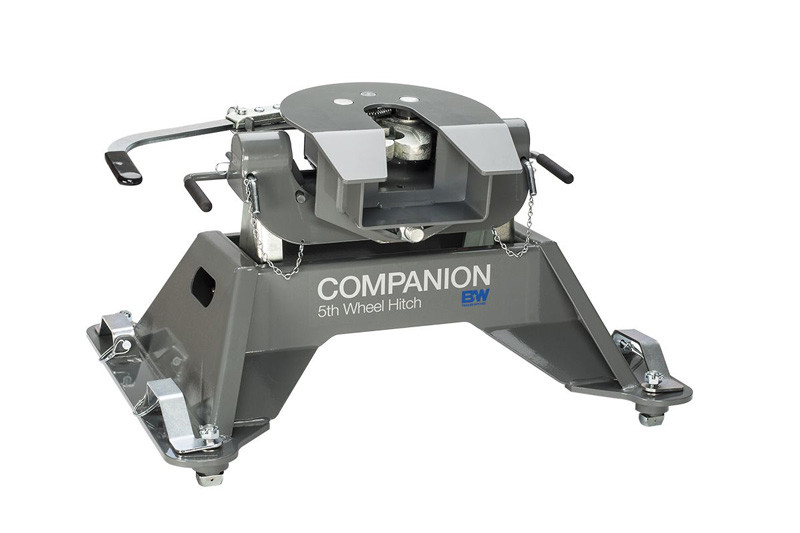
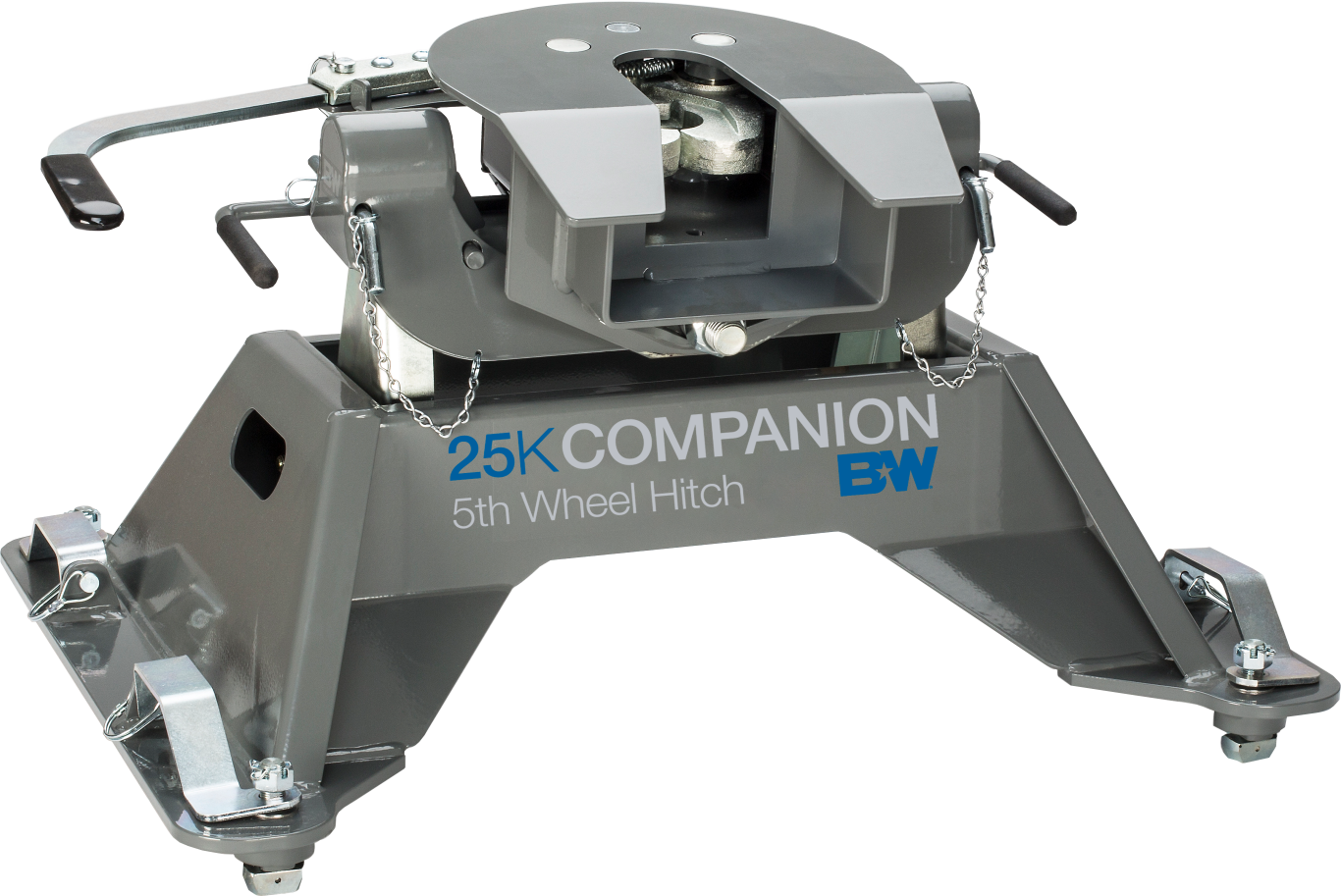
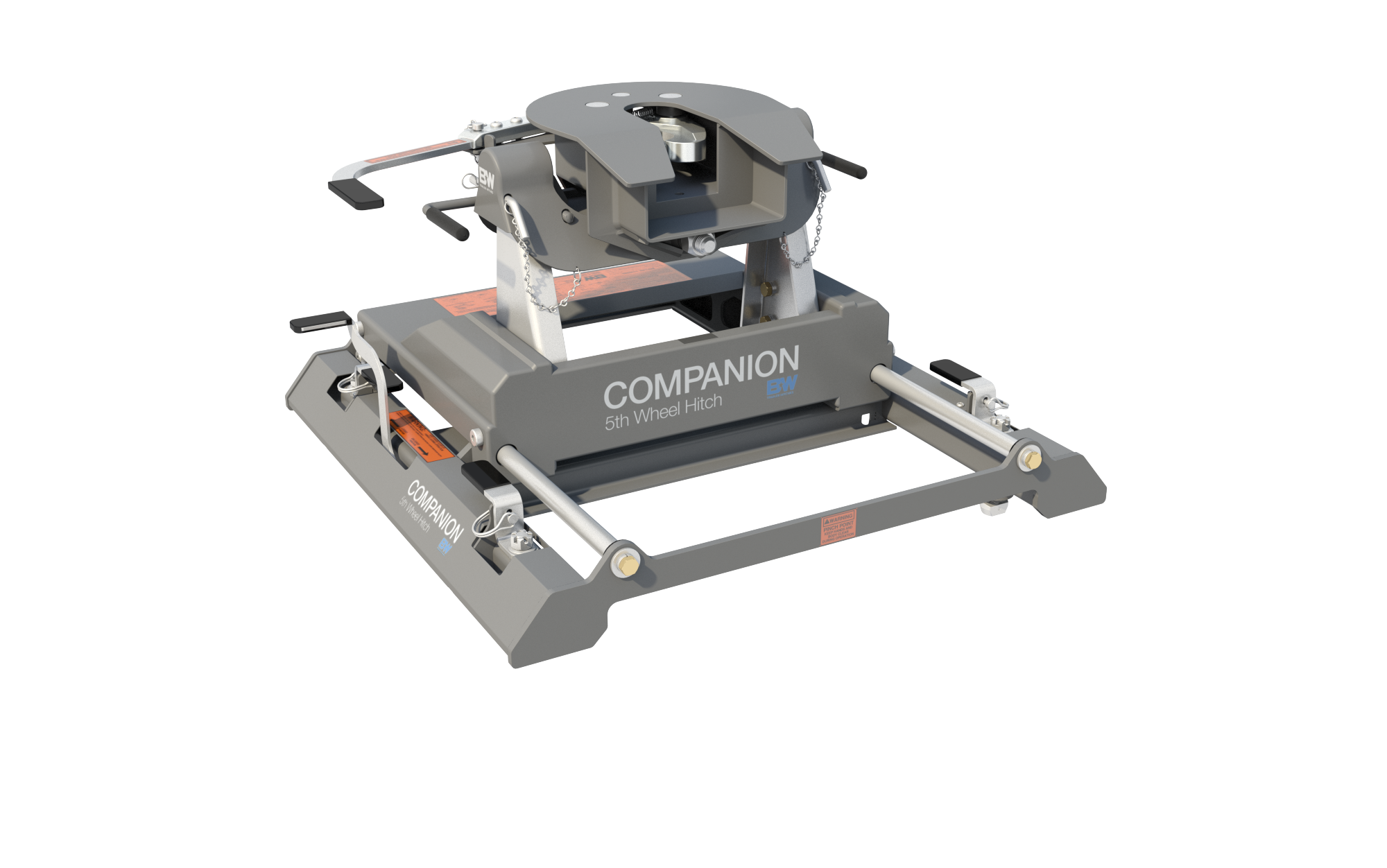
2016-2019 Chevrolet/GMC 2500 & 3500 Heavy Duty with OEM Puck System B&W 25K Companion 5th Wheel Hitch Base For 2016-2019 GM Puck System RVB3705B&W Trailer Hitches$900.00In Stock
View productOur in-house experts typically reply within one business day.

B&W Trailer Hitches
Verify Fitment
Select your vehicle to confirm this part fits.


Always the correct part
We know our products
Quality Products
Free Shipping!
Always the correct part
We know our products
Quality Products
Free Shipping!

| GTW | 20,000 lbs |
| PROP 65 WARNING: | WARNING: This product may expose you to chemicals including Nickel (Metallic), which is known to the state of California to cause cancer. For more information, go to www.P54Warnings.ca.gov. |
| VTW | 5,000 lbs |

B&W Trailer Hitches is an American manufacturer known for durable, innovative towing products, including gooseneck hitches, fifth-wheel hitches, receiver hitches, and ball mounts. Built in Kansas by employee-owners, B&W products are engineered for dependable performance, easy installation, and long-lasting quality.
B&W Trailer Hitches is an American manufacturer known for building innovative, dependable towing products designed to make hitching easier and towing more comfortable. The company began in 1987 in Humboldt, Kansas, when founders Roger Baker and Joe Works combined their fabrication experience to build custom truck beds and solve common problems faced by truck owners.
B&W changed the gooseneck hitch industry with the introduction of the Turnoverball Gooseneck Hitch. Its under-bed mounting system and reversible hitch ball allowed truck owners to quickly store the ball beneath the bed, leaving a clean and unobstructed surface when the hitch was not in use. B&W later applied the same practical approach to the Companion Fifth Wheel Hitch, creating a removable fifth-wheel hitch engineered for a quiet, smooth, and secure towing experience.
Today, B&W manufactures gooseneck hitches, fifth-wheel hitches, receiver hitches, ball mounts, and towing accessories at its nearly 600,000-square-foot facility. The company is owned by approximately 500 employee-owners who remain committed to American manufacturing, trusted materials, skilled craftsmanship, and long-lasting product quality.
Whether you are towing a work trailer, livestock trailer, camper, or fifth wheel, B&W Trailer Hitches offers thoughtfully engineered towing equipment built to perform mile after mile.
Experts available to answer your questions
Call 888-634-94944 compatible vehicles
| Year | Make & Model | Notes |
|---|---|---|
| 2016 - 2019 | Chevrolet Silverado 2500 HD | With a Factory Towing Package |
| 2016 - 2019 | Chevrolet Silverado 3500 HD | With a Factory Towing Package |
| 2016 - 2019 | GMC Sierra 2500 HD | With a Factory Towing Package |
| 2016 - 2019 | GMC Sierra 3500 HD | With a Factory Towing Package |
The 2016-2019 Chevrolet/GMC 2500 & 3500 Heavy Duty with OEM Puck System B&W Companion 5th Wheel Hitch Base For 2016-2019 GM Puck System RVB3700 (Part #BQVLRVB3700) fits 2016-2019 Chevrolet Silverado 2500 HD models. The 2019 model year is the last year covered by this part number. For newer models, check for an updated version.
The 2016-2019 Chevrolet/GMC 2500 & 3500 Heavy Duty with OEM Puck System B&W Companion 5th Wheel Hitch Base For 2016-2019 GM Puck System RVB3700 (Part #BQVLRVB3700) fits the following vehicles: 2016-2019 Chevrolet Silverado 2500 HD; 2016-2019 Chevrolet Silverado 3500 HD; 2016-2019 GMC Sierra 2500 HD; 2016-2019 GMC Sierra 3500 HD. Always verify your specific year, make, and model before ordering.
Yes, the 2016-2019 Chevrolet/GMC 2500 & 3500 Heavy Duty with OEM Puck System B&W Companion 5th Wheel Hitch Base For 2016-2019 GM Puck System RVB3700 (Part #BQVLRVB3700) is designed to fit the 2016-2019 Chevrolet Silverado 2500 HD.
The 2016-2019 Chevrolet/GMC 2500 & 3500 Heavy Duty with OEM Puck System B&W Companion 5th Wheel Hitch Base For 2016-2019 GM Puck System RVB3700 (Part #BQVLRVB3700) Refer to the included instructions for installation details. Basic hand tools are typically all you need.
The Companion 20K Hitch is a fifth-wheel hitch system designed for towing trailers. It has a maximum trailer weight rating of 20,000 lbs and a maximum trailer tongue weight rating of 5,000 lbs. The hitch mounts to the truck bed using a puck system and includes a coupler that engages the king pin of a fifth-wheel trailer.
The Companion 20K Hitch fits 2016–2019 GM Puck System trucks. The manual does not specify compatibility with other truck models or manufacturers.
The hitch is compatible with standard fifth-wheel trailers that have a king pin. However, you must not exceed the hitch's tow rating (20,000 lbs) or tongue weight rating (5,000 lbs), and you must verify that your trailer's ratings do not exceed these limits. Additionally, certain pin box types are incompatible: do not use capture plates such as PullRite SuperGlide that remove the pivot point between the hitch and trailer. Pin boxes with a wedge that relocates the pivot point, such as Reese Sidewinder or Reese Revolution, may be used.
Installation requires: a large torque wrench capable of measuring 110 ft-lbs, a 3/4" socket, a 7/16" socket, a 9/16" socket or wrench, a 7/32" Allen wrench, a pair of needle-nose pliers, and a hammer.
The hitch includes two bolt bags: the Base Bolt Bag (RVB3700) contains 2 pivot arms, 8 hex cap screws (1/2" × 1 1/2"), 8 lock washers (1/2"), 4 threaded blocks, 1 wire torsion spring, 1 mounting clip, 1 cap screw (1/4" × 1/2"), and 1 lock nut (1/4"). The Coupler Bolt Bag (RVC3006) contains 2 button head cap screws (3/8") and 2 lock nuts (3/8"). The coupler assembly includes the coupler jaws, coupler handle, saddle, locking pins, and safety pins.
Before installation, remove all parts from packaging and verify that all parts and hardware are present using the parts list. Remove any debris and obstructions from the truck bed, including plastic caps over the attachment points. It may be necessary to remove plastic grommets from around the mounting points to fully seat the base down to the truck.
The hitch offers six different mounting locations (shown in Table A1) that allow flexibility in coupler height (vertical adjustment) and distance from the cab (horizontal adjustment). Choose a location so that your trailer will be as level as possible and have adequate turning clearance while towing. The three vertical positions are: Lowest (16–3/4"), Medium (17–3/4"), and Highest (18–3/4"). The two horizontal positions are: King Pin 2" Behind Axle (farthest from cab) and King Pin Over Axle (closest to cab).
Each of the eight 1/2" cap screws securing the pivot arms must be torqued to 110 ft-lbs. After all screws are started through the arms and threaded blocks, tighten and torque each bolt to this specification.
The threaded blocks are critical to proper installation. Each block has threaded holes on one side and smooth bored holes on the other side. When installing, the side with the smooth holes must be flat against the bolt plate. Align each of the five holes in the threaded block with the five vertical holes in the bolt plate. Pass the threaded block under the base's side, align it with each set of screws, and start each screw. Installing the threaded blocks backward will not allow the pivot arms to be fully tightened and could lead to hitch failure.
Measure from the center of the coupler to the cab of the truck and from the king pin or pivot point of the trailer to the furthest forward corner of the trailer. Compare these measurements to ensure proper clearance when towing. Also inspect the clearance between the bed sides and the underside of the front of the trailer to ensure there is room for the pitch and roll of the trailer while towing. Towing without adequate clearance may lead to property damage or serious injury.
Remove the latch pins from each side of the base and rotate the handles out. Position the base over the attachment points. Carefully lower it until the latch cams pass through the floor and the base rests flat against the top of the attachment points.
Locate the 1/4" cap screw, lock nut, wire torsion spring, and mounting clip. Pass the 1/4" cap screw through the mounting clip and wire spring. Thread the 1/4" lock nut onto the cap screw and tighten it just enough that the spring will stay in place but will still be able to rotate around the bolt. Locate the flange on the driver side pivot arm closest to the truck cab. Place the clip so that when the spring's coil is in line with the edge of the arm, there will be 1/2" of clearance between the bottom of the polyurethane bushing and the top of the spring. Drive the clip securely onto the flange with a hammer.
Once the base is in place, remove the cotter pins from each of the four castle nuts. Engage the cams with each attachment point by turning the latch handles back to their latched position. If a handle will not turn easily, loosen the castle nut until the cam will freely turn and engage the attachment point. With the handles in the latched position, tighten the castle nut until snug to increase tension. Rotate the latch handle open and closed. Tighten the castle nut slightly and rotate the handle open and closed again. Repeat until you feel the cam engage the attachment point while closing the handle. The handle is set at proper tension when there is friction between the cam and attachment point but the handle can still be closed by hand without bumping, tapping, or otherwise forcing it closed. Do not set tension so high that excessive force is required to close the handles, as this may result in property damage or personal injury.
Lubricate the polyurethane bushings on top of the pivot arms with high grade lithium grease. Place the coupler over the pivot arms with the saddle handles parallel to the base in the latched position. Place the saddle lock pins through the saddle, then insert the hairpins through the holes in the end of the saddle lock pins to secure the coupler to the pivot arms.
Pull out the coupler arm and pin it with the safety locking pin near the base of the arm. Locate the two 3/8" × 1–1/4" button head cap screws and two 3/8" flanged lock nuts from the bolt bag. Using these fasteners, attach the coupler handle to the arm and tighten. Pull out the coupler handle safety pin. Caution: pulling the arm out away from the coupler creates a pinch point; use caution to avoid injury.
Adjust the resting angle of the coupler plate by rotating the spring on the driver side pivot arm. Pulling the top of the spring away from the cab will increase the angle of the coupler plate. Set the angle so that the coupler will tilt away from the cab when coupling. Tighten the 1/4" nut once the spring's orientation is set.
Remove the safety pin from the coupler handle and open it. Adjust the height of the fifth-wheel trailer so that the king pin plate is slightly lower than the top of the coupler. Back the truck toward the trailer, centering the trailer's king pin in the coupler, until the king pin engages the jaws. Close the coupler handle and insert the safety pin through the handle and the coupler. Connect the brake and lighting systems before towing.
The pull test verifies that the trailer is correctly attached. Ensure the truck is stationary with the emergency brake engaged and the tailgate down, trailer wheels chocked, and landing gear down supporting the trailer's weight. Confirm no one is between the truck and trailer. Release the emergency brake and engage the trailer brakes. Gently attempt to pull the trailer forward with the truck. When properly connected, the trailer will prevent the truck from moving. If the truck and trailer are not correctly attached, the trailer will separate from the truck.
Lower the landing gear and chock the trailer wheels. Raise the trailer until the tongue weight is removed from the truck. Unpin the coupler handle and rotate it to the open position to unlatch the jaws. If the jaws do not open, readjusting the landing gear may relieve pressure and allow them to open. Use the safety pin to lock the handle in the open position. When you are sure that the landing gear will support the trailer, move the truck forward to release the jaws from the king pin. The jaws will always open when the pressure of the trailer is taken off the coupler as the truck pulls away.
To remove the coupler, remove the saddle lock pins, grab the saddle handles, and lift to remove the coupler from the pivot arms. To remove the base, remove the latch pins from each side of the base and turn the handles. Carefully lift and position the base out of the attachment points.
The Companion 20K Hitch has a maximum trailer weight rating of 20,000 lbs and a maximum trailer tongue weight rating of 5,000 lbs. Do not exceed these ratings or the tow or weight ratings of your truck or trailer. Exceeding these ratings may cause damage to towing components or loss of attachment between the trailer and truck.
A visual inspection of the hitch should be performed before each time you tow. Regularly check that all pinned connections are secure and that all bolted connections are at the correct torque specification. Check for cracks or damage to the hitch. Do not tow with the hitch if cracks or damage outside of normal wear is found. Towing with a hitch that has cracks or damage could result in damage to the tow vehicle, trailer, towing components, or loss of attachment between the tow vehicle and trailer.
Yes. When towing a wedge car trailer, towing stability greatly depends on keeping the center of gravity as low as possible. Load heavy cars over the axles. Never tow with a single car on the front of the trailer. Never exceed speeds that are reasonable for the roadway conditions (e.g., turns, going around a curve). Failure to account for proper trailer center of gravity and reasonable speeds may cause damage to the truck, trailer, towing components, and loss of attachment between the truck and trailer.
Approximately 15–25% of the trailer weight should be on the hitch (tongue weight).
Grease the saddle through the grease zerk approximately every six months with multi-purpose grease. This allows the coupler to pivot freely. Also grease the jaws with multi-purpose automotive type chassis grease. Lubricate the coupler top surface with multi-purpose automotive type chassis grease or use a nylon lube plate to provide a lubricated surface.
Base latch handle tension and all bolted connections should be checked regularly. The latches must have the proper resistance when rotating, and bolts must have proper torque. Always perform a visual inspection before towing. Verify latch tension each time the Companion base is placed in a truck, and periodically before towing.
No. Do not modify this product in any manner. Doing so could alter its integrity and lead to a loss of attachment between the trailer and the tow vehicle.
Pin boxes with a wedge that relocates the pivot point, such as Reese Sidewinder or Reese Revolution, may be used. Do not use capture plates such as PullRite SuperGlide that remove the pivot point between the hitch and trailer. Towing a trailer without a functioning pivot point between the hitch and trailer will cause significant damage to the hitch which may lead to serious injury or death.
The Companion 20K Hitch fits 2016–2019 GM Puck System trucks only. Verify your truck model and year match this specification before purchasing.
You need a large torque wrench (110 ft-lbs capacity), 3/4", 7/16", and 9/16" sockets, 7/32" Allen wrench, needle-nose pliers, and a hammer.
All eight 1/2" cap screws securing the pivot arms must be torqued to 110 ft-lbs.
No drilling is required. The hitch mounts to existing GM Puck System attachment points on the truck bed.
No. The hitch mounts to the truck bed using existing puck system attachment points. You may need to remove plastic caps or grommets from around the mounting points, but the bed itself does not need to be removed.
Perform a visual inspection of the hitch. Check that all pinned connections are secure, all bolted connections are at correct torque, and there are no cracks or damage. Verify latch tension and ensure the coupler handle is properly closed and the safety pin is installed.
Loosen the castle nut until the cam will freely turn and engage the attachment point. Then follow the standard tension adjustment procedure by tightening the castle nut slightly and rotating the handle open and closed repeatedly until you feel the cam engage the attachment point while closing the handle.
If the jaws do not open, readjusting the landing gear may relieve pressure and allow them to open. Lower the landing gear further to reduce the pressure on the coupler, which should allow the jaws to open.
This indicates that the truck and trailer are not correctly attached. The coupler handle may not be fully closed, the safety pin may not be properly installed, or the king pin may not be fully engaged in the coupler jaws. Do not tow. Reattach the trailer and verify that the coupler handle is fully closed, the safety pin is inserted, and the king pin is properly engaged before attempting to tow.
Free Shipping
Ships free on all orders
 Authorized Dealer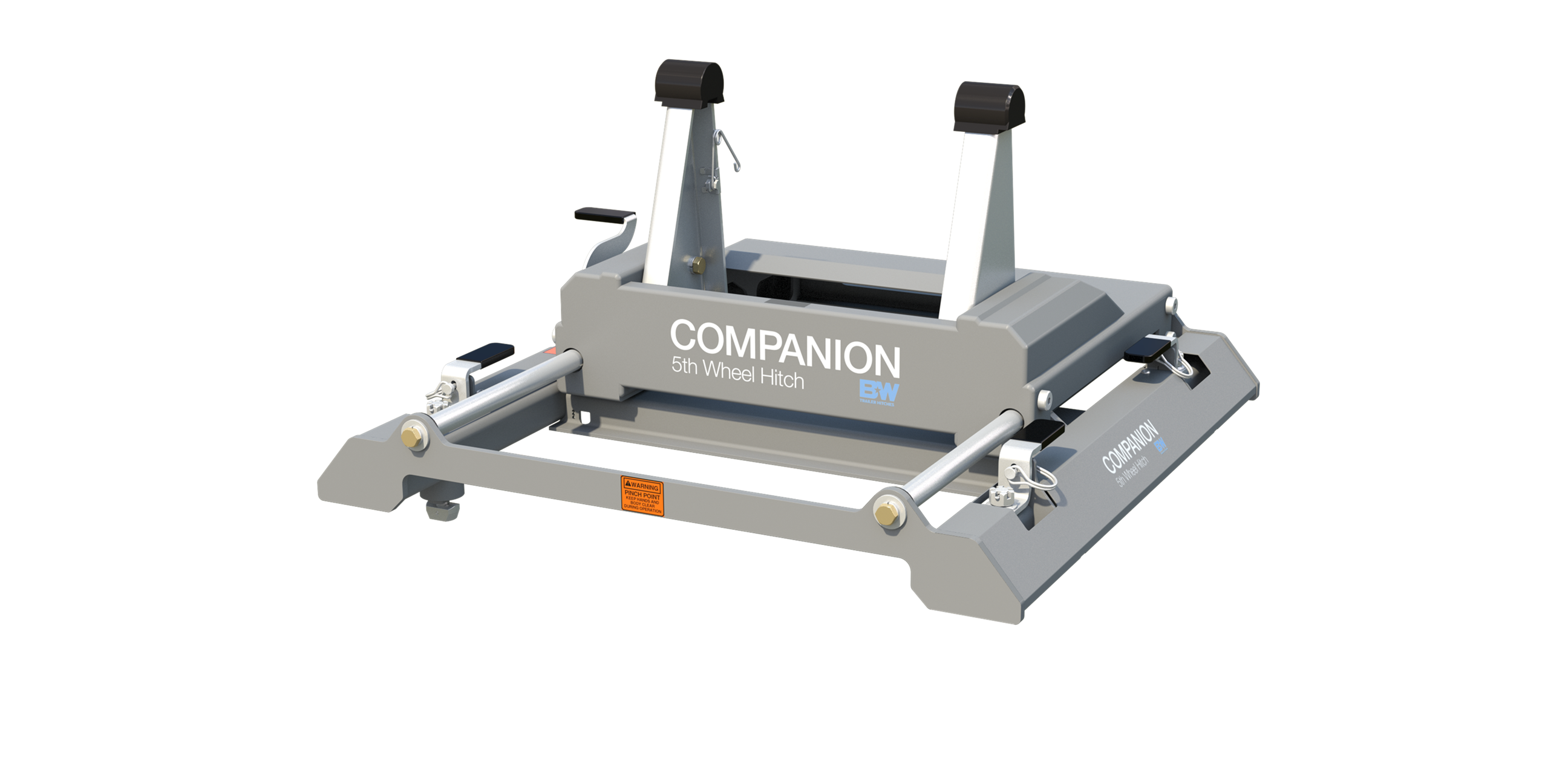
Quick Ship
In stock and ready to ship — order now!
FREE ShippingFREE SHIPPING
Estimated delivery Sun, Sep 27 - Wed, Sep 30
Order before 2 PM EST Monday–Friday for same-day processing
Guaranteed safe & secure checkout
No reviews have been added for this product.