
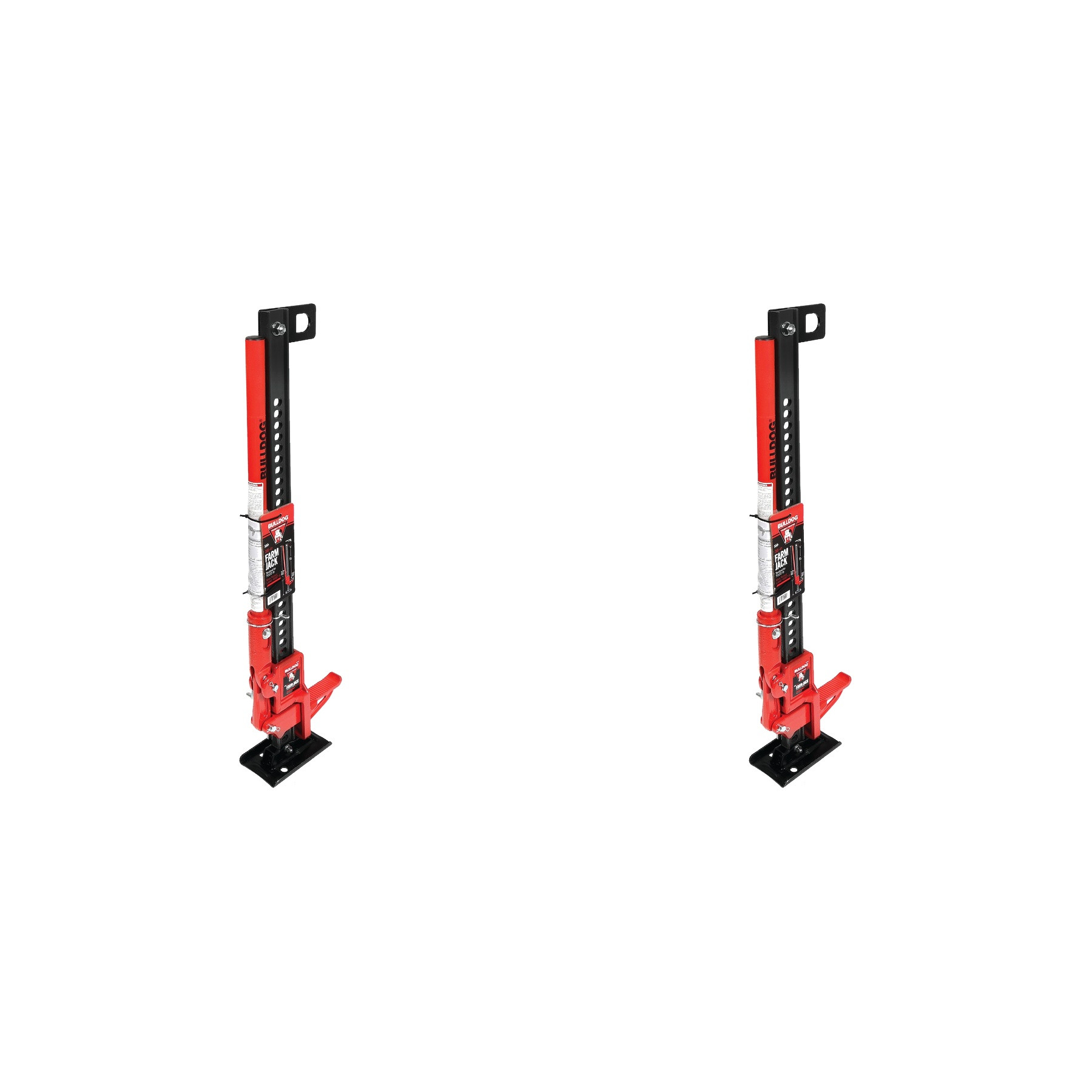
BULLDOG (30-Pack) Farm Jack, 7,000 lbs. Lift Capacity, 30 Inch Travel, 36 TallBulldogOriginal price was $6,187.50. Current price is $4,885.50.Out of Stock
View productOur in-house experts typically reply within one business day.

Bulldog

Always the correct part
We know our products
Quality Products
Free Shipping!
Always the correct part
We know our products
Quality Products
Free Shipping!
Complete kit bundle containing all necessary components for your project. Professional-grade components designed for reliable performance and long-lasting durability.

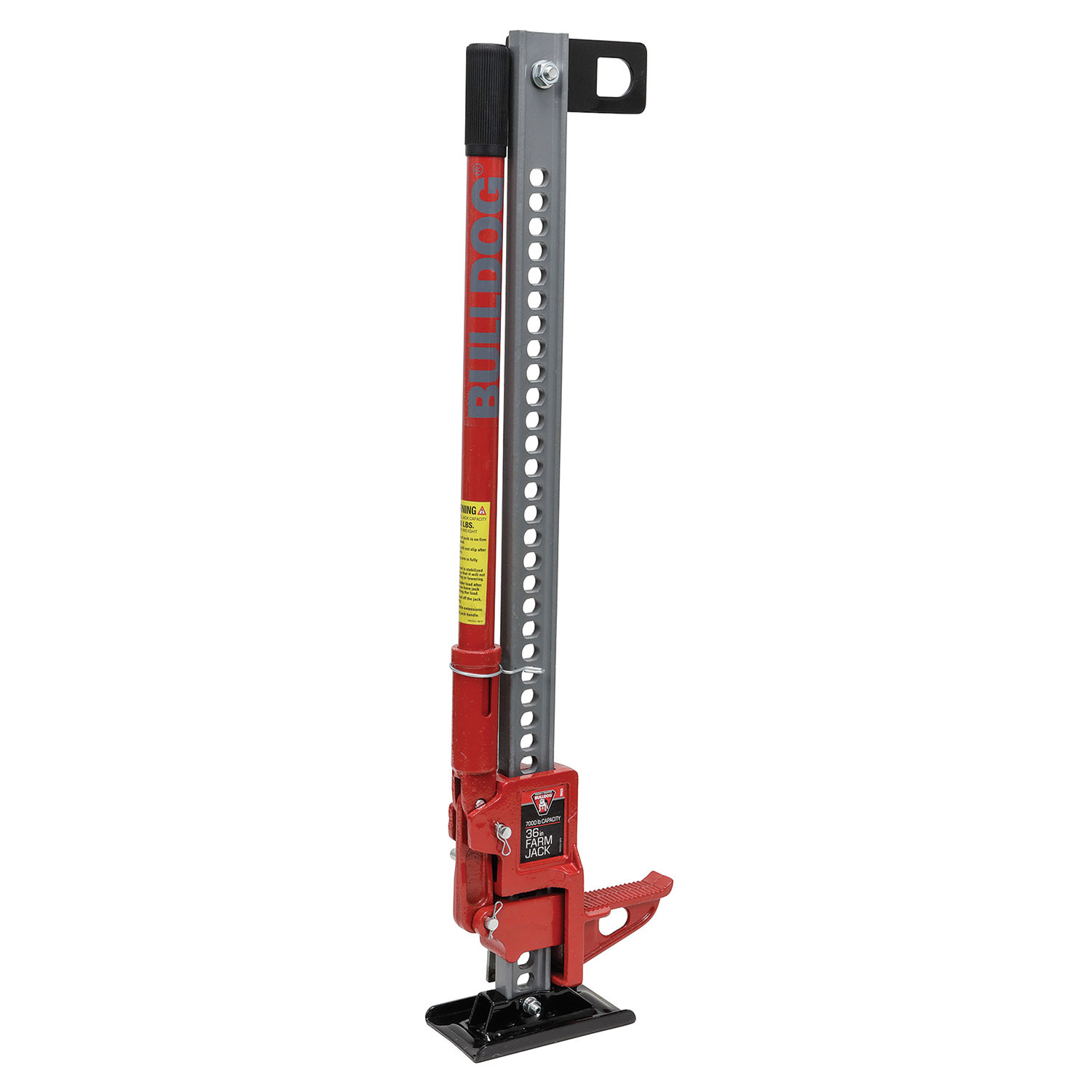
This Bulldog 36 In. tall farm jack is designed to lift heavy loads and equipment. It is the perfect tool for tearing out stubborn stumps or pulling fence posts and poles. It also serves as an all-purpose hoist or winch. The dependable, rugged ratchet design has a durable, solid steel construction.
| BRAND: | BULLDOG |
| PART NUMBER: | 7064300 |
| WARRANTY: | LIMITED 1 YEAR WARRANTY |
| WEIGHT: | 28.3 LBS |
| CAPACITY: | 7,000 LBS. |
| TRAVEL: | 30 IN. |
| HANDLE LENGTH: | 26 IN. |
| FOOT PLATE SIZE: | 4.6 IN. X 7 IN. |


Keywords: BD7064300-2PK bundle kit, complete kit, professional components, industrial kit, BD7064300, BULLDOG

Founded in 1920, Bulldog has become the standard for heavy-duty trailer connection hardware in agricultural, military and utility service. The line covers gooseneck hitches and couplers, A-frame and channel-mount trailer couplers with the Wedge-Latch mechanism, and heavy-duty jacks, built for unmatched strength, reliability and safety under demanding loads.
Bulldog was founded in 1920 and has spent more than a century supplying the connection hardware that heavy trailers depend on. Its market has always been the demanding end: agricultural, military and utility applications where a coupler failure is not an inconvenience but a serious incident. The brand summarises its position as Tough and Tested, and it sits within the Horizon Global towing group alongside Reese, Draw-Tite, Fulton, Tekonsha, Bargman and Wesbar.
Gooseneck equipment is the brand's signature. Gooseneck hitches mount in the truck bed over the rear axle, which places the load where the chassis can carry it properly and allows far tighter turning than a receiver hitch permits. Matching gooseneck couplers attach at the trailer end, in round tube and square configurations across the capacity range used by livestock, equipment and flatbed trailers.
The conventional trailer coupler range is built around the Wedge-Latch mechanism, which uses a wedge to take up wear between coupler and ball rather than relying on a fixed clamp that loosens over time. That matters on a trailer accumulating hard miles, where slack in the coupling shows up as noise and shock loading. Couplers are offered in A-frame form for standard tongues and in channel-mount form for straight tongue and fabricated frames, with adjustable channel versions that let a coupler be positioned to suit the tongue height.
Heavy-duty jacks complete the line, sized for the tongue weights that gooseneck and equipment trailers generate. Across the range the emphasis is consistent: forged and heavy-section components, load ratings backed by testing, and hardware specified for agricultural, military and heavy-duty commercial use rather than occasional recreational towing.
Experts available to answer your questions
Call 888-634-94943 Years
The Farm Jack is a manual hydraulic lifting device designed for raising stationary loads, winching, and clamping. It features a steel bar frame with a reversing latch mechanism, climbing pins, and adjustable clamps. It can be used to lift vehicles, equipment, or other loads for maintenance, repair, or repositioning.
Three sizes are available: 36" Farm Jack (part number N7064300), 48" Farm Jack (part number N7064400), and 60" Farm Jack (part number N7064500). The size refers to the height of the steel bar frame.
The maximum load capacity is 1,500 lbs for raising or lowering a stationary load. When used as a winch, the maximum load is 1,500 lbs. When used as a clamp, the maximum load is 1,500 lbs. Never exceed these limits.
No. The manual explicitly states: "Do not use jack on curved or tubular surfaces. The load may slip off, causing serious bodily injury and/or death." The jack must be used only on firm, level, and dry surfaces.
Place the base plate of the jack on a firm, level, and dry surface with the steel bar frame in a vertical position. If needed, use the optional foot plate included with the jack to better stabilize the base. Never use the jack on soft, uneven, or wet surfaces.
Yes. The manual states: "Use optional foot plate included to stabilize jack base as needed." The foot plate is provided to improve stability on uneven surfaces.
1. Place the base plate on a firm, level, dry surface with the steel bar frame vertical. 2. With the handle vertical and clipped to the steel bar frame, pull the reversing latch into the raise position until it locks. 3. Pull the handle away from the steel bar frame. 4. Using the handle, raise the lifting mechanism until the lower clamp is securely under the load. 5. While grasping the handle firmly with both hands, carefully move the handle up and down. As you push down, the upper climbing pin disengages and engages in the next hole above. As you raise the handle, the lower climbing pin repeats this process. The load is lifted on each downstroke of the handle. 6. Maintain controlled grip of the handle throughout the entire handle stroke. 7. Ensure the load remains stabilized and the jack remains secure and vertical while raising. 8. When the load reaches the desired height, secure the handle in the vertical position by clipping it to the steel bar frame.
1. The jack must have a load of 500 lbs or greater before it can be lowered; otherwise, the lifting mechanism will slide down the steel bar frame to the base plate. 2. Position the jack under the load and raise the load as described in the raising instructions to remove any blocks holding the load up. 3. Place the handle in the vertical position, clipped against the steel bar frame before attempting to lower the load. 4. Shift the reversing latch to the lower position. 5. While grasping the handle with both hands, carefully move the handle up and down. The load will be lowered on each upstroke of the handle. 6. Maintain controlled grip of the handle throughout the entire handle stroke. 7. Stabilize and immobilize the load before lowering it onto any stabilizing blocks.
The reversing latch is a mechanism on the jack handle that switches between raise and lower modes. To raise a load, pull the reversing latch into the raise position until it locks. To lower a load, shift the reversing latch to the lower position. The latch must be properly positioned before operating the jack in either direction.
Yes. To use the jack as a winch: 1. Loosen the top clamp bolt and rotate the clamp so it is in-line with the steel bar frame. Retighten the bolt to 40 ft-lbs. 2. Attach one end of a chain or tow strap securely to the load. Attach the other end securely to the top clamp opening. It is recommended to use a shackle (not included) for attachment. 3. Attach another chain or tow strap securely to a fixed object. Attach the other end securely to the lower clamp. It is recommended to use a shackle (not included) for attachment. 4. Operate the jack as if it were being used to raise a load. The maximum load when used as a winch is 1,500 lbs. Always use chains or tow straps that have a greater working strength capacity than the jack.
Yes. To use the jack as a clamp: 1. The top clamp must be positioned perpendicular to the steel bar frame. 2. The top clamp can be moved to any position along the steel bar frame. Remove the top clamp bolt and reposition the top clamp to a new hole position on the steel bar frame. Retighten the bolt to 40 ft-lbs. 3. Operate the jack as if it were being used to raise a load, clamping material between the top and lower clamps. The maximum load when used as a clamp is 1,500 lbs. Do not exceed the maximum clamping force of 1,000 lbs, or the top clamp could bend or break.
The top clamp bolt must be tightened to 40 ft-lbs (foot-pounds). This applies when rotating the clamp for winching use and when repositioning the clamp for clamping use.
The maximum clamping force is 1,000 lbs. If you exceed this limit, the top clamp could bend or break, resulting in serious bodily injury and/or death.
The maximum load when used as a winch is 1,500 lbs. Additionally, the top clamp will support up to 1,000 lbs when used as a winch. Exceeding either limit will result in the top clamp bending or breaking, causing the load to move or the chain or tow strap to snap back, resulting in serious injury and/or death.
Critical safety warnings include: (1) Never exceed maximum rated capacity of 1,500 lbs. (2) Never position any part of your body under the jack or raised load without proper immobilization and support. (3) Never use the jack on unstabilized or immobilized loads. (4) Never use on curved or tubular surfaces. (5) Never attempt to raise more than one tire at a time. (6) Never raise an inflated tire more than 6 inches above the ground. (7) Do not allow children to play on or around the product or load. (8) The jack in vertical unsupported position may tip and cause serious bodily injury or death; always support the jack or lay it on its side when not in use. (9) The handle may move rapidly when shifting the reverse latch or during lifting/lowering; always keep your head and body out of the handle path. (10) Do not perform maintenance on the jack while it is under load.
Before every use, inspect the jack carefully for missing or damaged components and ensure that the jack is clean and lubricated. Check the climbing pins for damage and wear. Make sure the steel bar frame is straight and nothing is blocking the steel bar frame holes. Ensure the jack is properly lubricated. Do not use the jack if it is damaged, worn, or out of alignment.
The jack must have a load of 500 lbs or greater before it can be lowered. If the load is less than 500 lbs, the lifting mechanism will slide down the steel bar frame to the base plate instead of lowering in a controlled manner.
If your hands slip, the jack handle may move rapidly and/or unexpectedly. Always keep your head and body out of the handle path of movement. If any part of your body is in the path of the handle, it may strike you and result in serious injury and/or death. Maintain a controlled grip of the handle throughout the entire handle stroke.
The jack handle may move rapidly when shifting the reverse latch. When shifting, ensure the handle is latched in the upright position against the steel bar frame and securely hold the bar in position. If the handle moves rapidly and strikes you, it will result in serious injury and/or death.
The manual provides specific restrictions for tire lifting: Never attempt to raise more than one tire at a time. Never raise an inflated tire more than 6 inches above the ground. Failure to follow these instructions may result in serious bodily injury and/or death.
You must inspect and lubricate the jack before every use. The jack is not self-lubricating. Using the jack without proper lubrication will result in poor performance and damage to the jack. Do not use the jack if it is damaged, worn, or out of alignment.
Lubricate the jack with a light penetrating oil or a Teflon or silicone spray at the locations shown in the manual. These locations include both climbing pins and associated springs, the shear pin in the handle pin, and front and back edges of the steel bar frame.
The jack can be cleaned with water and a mild detergent if needed. Dry and lubricate immediately after cleaning.
Binding of the climbing pins may be due to dirt, corrosion, or a worn or bent steel bar frame. If binding occurs, clean and lubricate the jack. Test the jack by raising it without a load. If binding continues, do not use the jack.
No. Never perform maintenance on the jack while it is under load.
The Farm Jack is covered by a limited warranty for a period of 1 year against material defects in both material and workmanship, excluding ordinary wear and tear. The warranty is valid only if the products are returned to Horizon Global for inspection and testing, and if the inspection discloses that any alleged non-conformance is material and has not been caused by misuse, neglect, wear and tear, improper installation, unsuitable storage, improper repair, alteration, or accident. The products must have been installed, maintained, and used in accordance with the manufacturer's instructions.
Do not use the jack if it is damaged, worn, or out of alignment. Inspect the jack carefully before each use. Check the climbing pins for damage and wear. Make sure the steel bar frame is straight and nothing is blocking the steel bar frame holes. If damage or wear is found, do not use the jack.
Yes. The jack must be properly lubricated before every use. The jack is not self-lubricating. Using the jack without proper lubrication will result in poor performance and damage to the jack. Lubricate with a light penetrating oil or Teflon or silicone spray at the climbing pins, springs, shear pin, handle pin, and front and back edges of the steel bar frame.
The maximum load capacity is 1,500 lbs for raising, lowering, winching, or clamping. Never exceed this limit.
No. The jack must be used only on firm, level, and dry surfaces. Do not use on curved or tubular surfaces, as the load may slip off and cause serious injury or death.
Tighten the top clamp bolt to 40 ft-lbs (foot-pounds).
Binding of the climbing pins may be due to dirt, corrosion, or a worn or bent steel bar frame. First, clean and lubricate the jack thoroughly with a light penetrating oil or Teflon or silicone spray, paying special attention to the climbing pins and associated springs. Test the jack by raising it without a load. If the binding continues after cleaning and lubricating, do not use the jack.
Poor performance is typically caused by inadequate lubrication. Inspect the jack before use and lubricate when necessary with a light penetrating oil or Teflon or silicone spray at the climbing pins, springs, shear pin, handle pin, and front and back edges of the steel bar frame. If the jack is damaged, worn, or out of alignment, do not use it.
This occurs when the load is less than 500 lbs. The jack must have a load of 500 lbs or greater before it can be lowered properly. If the load is less than 500 lbs, the lifting mechanism will slide down the steel bar frame to the base plate. Ensure the load meets the minimum weight requirement before attempting to lower.
On Sale Today
Original price was $370.28. Current price is $239.70.You save $130.58 (35%)
Free Shipping
Ships free on all orders
 Authorized Dealer


FREE ShippingFREE SHIPPING
Estimated delivery Mon, Oct 26 - Thu, Oct 29
Order before 2 PM EST Monday–Friday for same-day processing
Guaranteed safe & secure checkout
No reviews have been added for this product.