

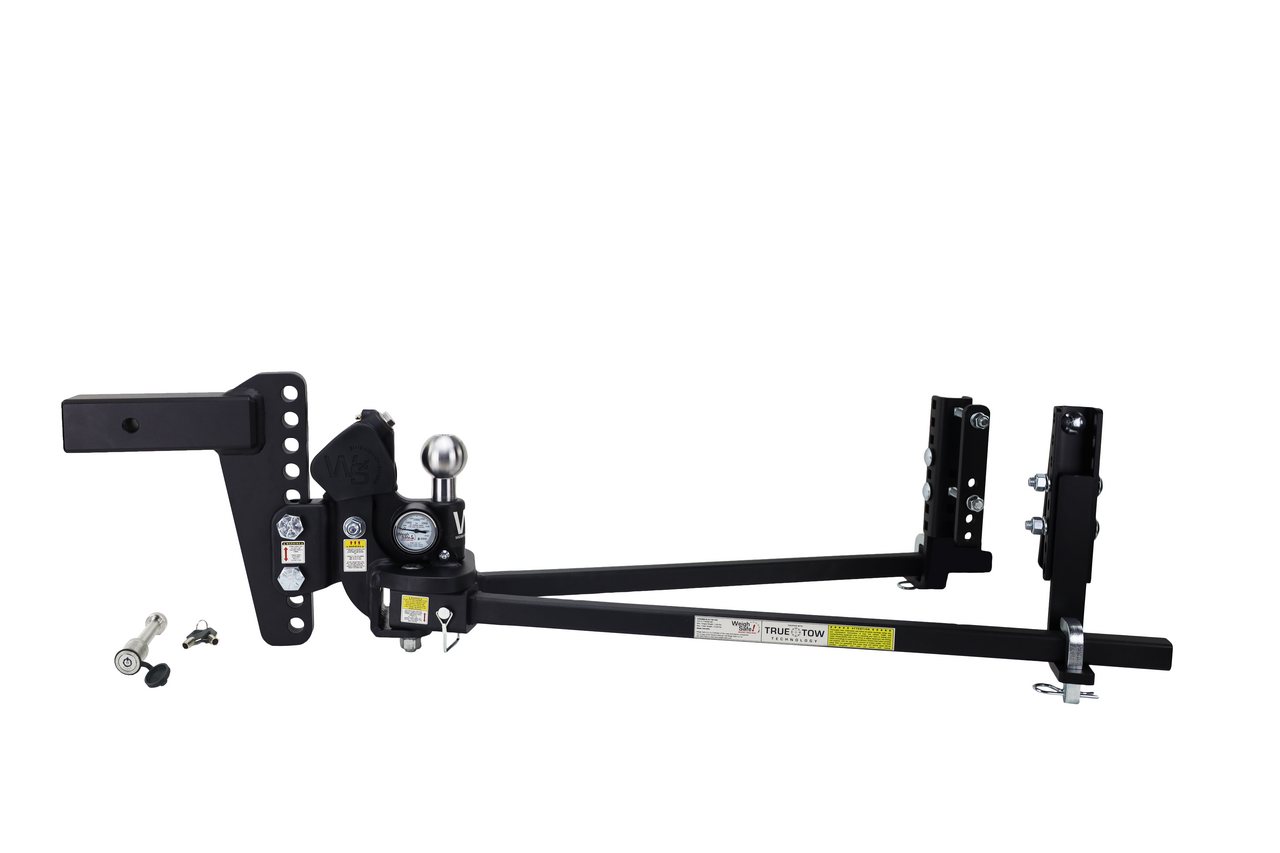
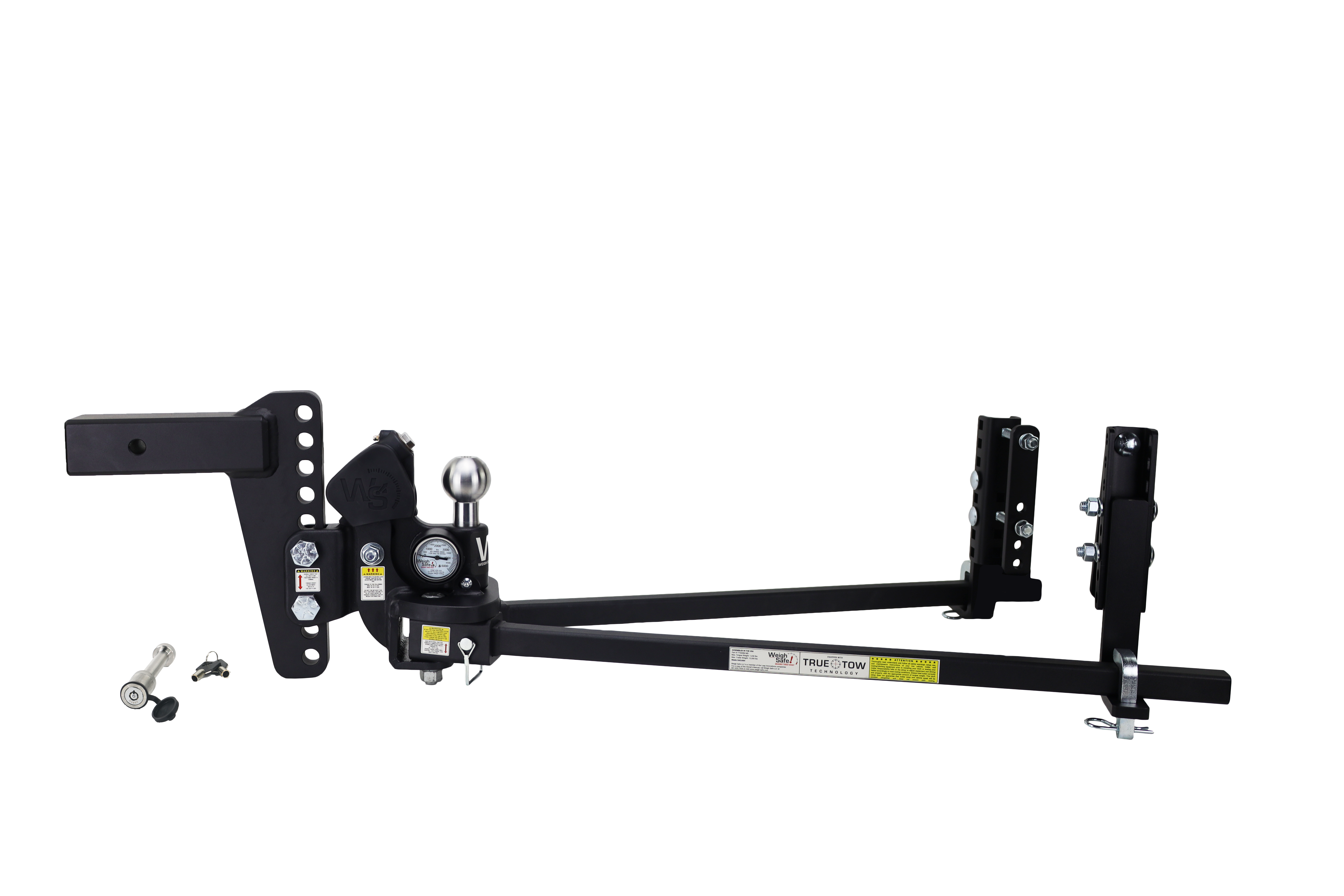
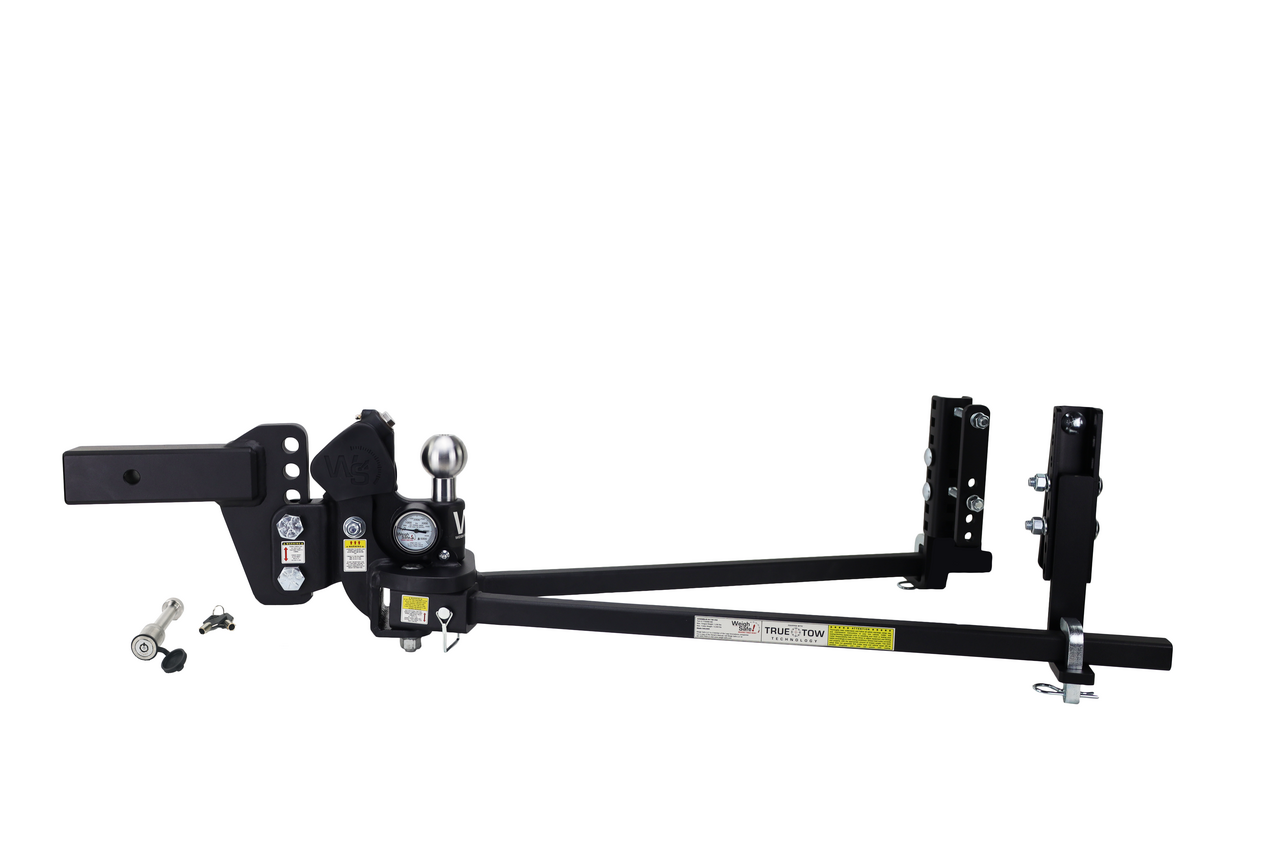
Weigh Safe TrueTow Heavyweight WDH - 8" Drop, 2" Shank - 18,500 GTW TTHW8-2Weigh Safe$1,180.00In Stock
View productOur in-house experts typically reply within one business day.

Weigh Safe

Always the correct part
We know our products
Quality Products
Free Shipping!
Always the correct part
We know our products
Quality Products
Free Shipping!

Weigh Safe True Tow Weight Distribution Hitch - Heavyweight is part of the True Tow family, measuring vehicular tongue weight and providing exact measurement and force needed to accurately redistribute weight across your towing system. It also boasts the simplest, quickest, and most accurate installation process in the industry and comes in a range of drop lengths and shank sizes for various applications.

Weigh Safe manufactures adjustable trailer hitches with a built-in tongue weight scale, letting drivers read tongue weight directly at the hitch instead of guessing. Products include adjustable ball mounts, weight distribution hitches, gooseneck balls and towing accessories, machined from aircraft-grade aluminum and stainless steel on CNC equipment at the company's Lindon, Utah facility.
Weigh Safe entered the towing industry in November 2013 with a patented adjustable ball mount that had a tongue weight scale built into it. The product won Best New Tools and Equipment Product at that year's SEMA Show, and it addressed a genuine gap: tongue weight is one of the most important numbers in safe towing, and until then almost nobody could measure it without a truck scale or a bathroom scale and a lever. Founder Kevin McAllister spent more than a decade developing the design and accumulated fourteen U.S. patents over his career, nearly all of them aimed at safety.
The core product remains the adjustable ball mount, where a hydraulic gauge in the shank reads tongue weight as the trailer is coupled. Getting that number right keeps the tow vehicle's steering axle loaded and reduces the tendency toward trailer sway. The range has since grown to include the True Tow weight distribution system, which applies the same measurement principle to weight distribution setups, along with the CERT and Aero hitch lines, gooseneck balls and a broad range of towing accessories.
Weigh Safe is headquartered in Lindon, Utah, where its mechanical, manufacturing and electrical engineering teams work alongside production. Components are cut from aircraft-grade aluminum, stainless steel and high-quality steel, then machined to tight tolerances on CNC equipment. Every product moves through inspection and testing intended to meet or exceed published industry standards, and the company states it now manufactures more aluminum adjustable trailer hitches than any other U.S. hitch maker.
The products serve RV owners, boat and horse trailer owners, contractors and anyone towing near the limits of their vehicle, where knowing the actual tongue weight rather than estimating it changes how the rig behaves. Interchangeable hitch balls and keyed locks let one ball mount cover several trailers.
Experts available to answer your questions
Call 888-634-9494See - https://www.weigh-safe.com/warranty/
The Weigh Safe True Tow is a weight distribution hitch system that measures tongue weight and distributes the load between the tow vehicle and trailer using spring arms and a lead screw adjustment mechanism. The hitch includes a gauge that displays tongue weight and distributed tongue weight (DTW). By adjusting the lead screw, you increase or decrease the force applied by the spring arms to the trailer brackets, which distributes weight more evenly across all axles and improves towing stability and sway control.
The Weigh Safe True Tow is available in four weight ratings based on spring arm size: 8,500 lbs (Middleweight), 12,500 lbs, 18,500 lbs, and 22,000 lbs (Heavyweight). The weight rating determines the maximum gross trailer weight the hitch can safely handle. Choose the rating that matches your trailer's loaded weight.
The hitch is available in drop sizes of 2", 2.5", 4", 6", 8", and 10", and shank sizes of 2" and 2.5". The drop size is the vertical distance from the receiver to the ball, and the shank size is the ball diameter. Select the drop size based on your trailer coupler height relative to your tow vehicle's receiver, and the shank size to match your trailer's coupler size.
No. The hitch is not designed to work behind a motorhome with spring arms in use. If you are towing from a motorhome, you will need to use a different hitch system.
The recommended maximum distance from the vehicle's rear axle to the towball is 70". Exceeding this distance may affect the hitch's performance and safety.
Required tools include: a measuring tape, a lift arm with 1-1/8" socket end (Heavyweight) or 3/4" socket end (Middleweight), a torque wrench capable of 150 ft-lb, a 3/4" socket, and a 1-1/8" socket. You will also need the DTW calculator tool, available on the Weigh Safe True Tow App or at www.weigh-safe.com.
Yes. The DTW (Distributed Tongue Weight) calculator tool is required to properly adjust the hitch. It is available on the Weigh Safe True Tow App (iOS and Android) or at www.weigh-safe.com. Without the DTW tool, you will not be able to accurately calculate the correct distributed tongue weight needed for your specific towing system.
Park your trailer and tow vehicle on flat level ground in line with each other. Put wheel stops on the trailer wheels and uncouple the trailer from the tow vehicle. Pull the tow vehicle forward 4 to 5 feet to allow working space. Check and inflate all tires of both the tow vehicle and trailer to the proper pressure before every connection. Before installation, measure your tongue weight without spring arm attachment to determine the correct hitch setup.
Tongue weight changes with varying levels of propane and freshwater tanks, and any other cargo the trailer carries, including toys for toy haulers. The hitch setup is dependent on the measured tongue weight for each separate tow, so you must measure and adjust your hitch according to the instructions before each connection to ensure proper weight distribution and safe towing.
First, level the trailer to be parallel to the ground by measuring the front and back of the trailer frame to the ground and adjusting as needed. With the trailer level, measure from the ground to the top of the trailer coupler. The top of the tow ball should be set some distance above this measurement. A good rule of thumb is to set the tow ball 1/8" higher for every 100 lbs of tongue weight. If you don't know your actual tongue weight, you can measure it by putting on the head assembly at a best guess height, lowering your trailer onto the tow ball completely, and reading the gauge.
The draw bar can be positioned in either the rise or drop position depending on the height of your trailer coupler relative to your tow vehicle's receiver. If your trailer coupler is lower than the receiver, use the drop position. If your trailer coupler is higher than the receiver, use the rise position. The correct position ensures the tow ball is at the proper height to level your trailer when towing.
Slide the head assembly onto the draw bar and insert Grade 8 bolts and washers into the correct holes to set the ball height. Make sure to add both a washer and flat lock washer between the bolt and slider. Torque the bolts to 150-320 ft-lbs using a torque wrench.
Locate the center-line of where the trailer brackets need to be placed by measuring from the center of the trailer coupler along the trailer frame and marking at 32" on both sides. Securing the brackets at the 32" mark will put the least amount of stress on the trailer and hitch, providing the safest tow. If a frame member, propane mount, or battery mount is in the way, the brackets can be moved forward, closer to the coupler, down to a minimum distance of 27" from the coupler center. The further back the brackets, the less stress on your tow vehicle, hitch, and trailer.
Before installing the trailer brackets, ensure there are no brake lines, electrical wiring, or gas lines that would be in the way of the bracket placement. If something is obstructing the placement, it will need to be re-routed or avoided to prevent damage by the trailer brackets.
1. Place one 1/2" x 3-1/2" carriage bolt through the top hole in the outside C channel bracket and align it with the top hole of the inside flat bracket. Slide on a 1/2" lock washer and thread on a 1/2" nut a couple of turns. 2. Slip the brackets over the trailer frame and line up the top bolt with the center-line mark. Tighten the nut until hand tight. 3. Insert the second 1/2" x 3-1/2" carriage bolt in the highest open hole in the outside C channel bracket under the trailer frame and press it through the corresponding hole on the inside flat bracket. Slide on a 1/2" lock washer and thread on a 1/2" nut until hand tight. 4. There should not be a gap larger than 1/2" between the bolts and the trailer frame. 5. Use a 3/4" socket and torque wrench to tighten the 1/2" nuts, alternating between top and bottom to avoid over-tightening one side. Torque all trailer bracket bolts to 90 ft-lbs.
The ideal height for the flat portion of the spring arm platform is as close to 9" below the top of the trailer coupler. This will allow the spring arms to be horizontal with the trailer frame, which will create the smoothest tow. In some cases, if the lead screw on the head assembly tops out before you reach your DTW, the spring arm platform might need to be less than 9".
Slide the spring arm platform between the outside C channel bracket and set it to the correct height (ideally 9" below the top of the trailer coupler). Once positioned, insert two 1/2" x 3" carriage bolts into the square holes in the outside C channel bracket that line up with the corresponding holes in the spring arm platform. Press them all the way in, slide on a 1/2" lock washer, and thread on a 1/2" nut on each bolt. Tighten to hand tight, then use a 3/4" socket and torque wrench to tighten the 1/2" nuts to 90 ft-lbs. Repeat on the other side of the trailer frame.
Insert the spring arms into the spring arm sockets so the hole in the spring arm lines up with the hole on the spring arm socket. Insert the clevis pin into the hole from the outside to the inside of the hitch to allow removal even if the spring arms are close together. Secure the clevis pin with the attached wire. Repeat on the other side. Do not pound directly on the spring arm sockets as this could cause them to chip or crack; instead, use the spring arms as a lever to move the compressed sockets.
You need to take three measurements in inches, measuring in a straight line and always using the side of the spring arm closest to the tow vehicle: (1) From the rear vehicle axle center-line to the spring arm, (2) From the spring arm to the center of the trailer brackets, and (3) From the spring arm to the center-line of a single axle or center-line between multiple axles. Pull out one spring arm until the bar is perpendicular to the head assembly and use it as a base point for all measurements. Input these measurements into the DTW tool on the Weigh Safe True Tow App or website.
With the trailer still coupled to the tow vehicle, use the trailer tongue jack to lift both the tow vehicle and trailer until you can swing the spring arms into place over the spring arm platforms. If you reach the highest level of the trailer tongue jack and the spring arms cannot be lifted onto the platforms, you can use the lift arm to lift the spring arms up onto the platforms. Use the L-fingers and L-finger pins to secure the spring arms onto the spring arm platforms. Repeat for both spring arms on each side of the trailer.
Before adjusting the lead screw, loosen the clamp bolt with a 1-1/8" socket (Heavyweight) or 3/4" socket (Middleweight). Using the lift arm or the appropriate size socket, tighten or loosen the lead screw until your Weigh Safe gauge reaches the DTW number calculated by the DTW tool. Turning clockwise increases distributed tongue weight and counterclockwise decreases it. Every few turns, jounce the trailer to reduce friction. After reaching the correct DTW, retighten the clamp bolt to 60-150 ft-lbs (Heavyweight) or 35-65 ft-lbs (Middleweight). Do not tow until the DTW is achieved.
If the lead screw is hard to turn, try jouncing the trailer (stand on or kick the tongue) to loosen high friction points and try again. Sometimes the added force in the spring arms can cause extra friction in the tow ball, resulting in slow or no change in tongue weight while adjusting the lead screw. Jouncing helps relieve this friction. If the lead screw still won't turn after jouncing, refer to the troubleshooting section for additional solutions.
1. Pull your trailer into the place you want it parked, most effectively done on a flat surface. 2. Set the parking brake and put stops under the wheels of the trailer. 3. Unhook the electrical cord, chains, and breakaway cable from the tow vehicle. 4. Raise the trailer tongue jack until it starts to raise both the trailer and tow vehicle, then continue raising until the weight is lifted off the ends of the spring arms. 5. Remove the L-finger pins and L-fingers. 6. Slide the spring arms away from the trailer frame to clear the trailer brackets. 7. Lower the trailer tongue jack until the trailer tongue is resting on the hitch again and you can unhook the trailer coupler latch. 8. Use the trailer tongue jack to lift the trailer off the tow ball and pull the tow vehicle away from the trailer. 9. Unhook the spring arms from the head assembly and remove the head assembly from the draw bar. 10. Store your hitch in a safe, secure location protected from weather.
Torque specifications vary by component and hitch model: Clamp bolt: 60-150 ft-lbs (Heavyweight) or 35-65 ft-lbs (Middleweight). Trailer bracket bolts (Grade 5): 65 ft-lbs. Trailer bracket bolts (Grade 8): 90 ft-lbs. Spring arm swivel bolts: 60-150 ft-lbs. Slider bolts: 150-320 ft-lbs. All bolts and nuts must be torqued to the specified amount before every tow.
Using a torque wrench, confirm that the spring arm socket bolts are torqued to a minimum of 60 ft-lbs before each towing session. This is a critical safety check that must be performed before every tow.
Tongue weight should be within 10-15% of your gross trailer weight (GTW). Towing with a tongue weight of less than 10% or more than 15% of the gross trailer weight greatly increases the likelihood of loss of vehicle control. Always verify that your tongue weight is within this range before towing.
You must disconnect the spring arms in the following situations: (1) When backing up to avoid damage to the trailer, trailer brackets, and spring arms. (2) When turning sharper than 60 degrees between the truck center line and trailer center line. (3) When towing or backing up if the angle between the tow vehicle centerline and trailer centerline is greater than 60 degrees. (4) When towing across a significant transition in grade (e.g., backing from a flat street to a steep uphill driveway) to avoid excessive strain on the hitch assembly. (5) When towing in extreme road conditions including rough roads, ditches, dips, or while launching a boat.
Never tow with spring arms in the highest position (lead screw loosened all the way), as this can cause extreme forces on the lead screw axle, resulting in hitch failure and voiding the warranty. Never tow or back up with spring arms attached if the angle between tow vehicle centerline and trailer centerline is greater than 60 degrees. Never tow with spring arms attached in extreme road conditions including rough roads, ditches, dips, or while launching a boat.
Never cut, weld, grind, bend, or modify any of the hitch components in any way. Any modifications will void the warranty and may compromise the safety and integrity of the hitch.
Before every towing trip, you must: (1) Inspect all fasteners for wear, tear, and fatigue. Ensure all nuts, bolts, pins, and clips are tightly and securely in place. Do not tow until all fasteners have been checked. (2) Check that all bolts and nuts are torqued to the specified amount. (3) Confirm that spring arm socket bolts are torqued to a minimum of 60 ft-lbs using a torque wrench. (4) Check all plugs and screws in the head assembly to make sure none have backed out or are leaking hydraulic fluid. (5) Verify that the hitch is properly adjusted after loading your trailer onto the tow vehicle.
Never turn sharper than 60 degrees between the truck center line and trailer center line without disconnecting the spring arms. If your trailer tongue is narrower than 50 degrees, the turning radius between your truck and trailer will decrease. It is recommended to test this in an empty lot with someone helping you determine how far you can turn without your spring arm sockets making contact with each other.
Check all plugs and screws in the head assembly to make sure that none have backed out or are leaking any hydraulic fluid. The friction surfaces should be kept clean and well lubricated with high-pressure multipurpose grease or bearing grease. Apply grease by twisting the spring arm sockets completely to the outside positions and applying grease to the top of the spring arm sockets and where they contact the rest of the head assembly.
The lead screw should be serviced with grease bi-annually (or more frequently in warmer climates or if not more frequently). There are two grease ports on the head assembly that supply grease to the lead screw. Use a grease gun filled with high-pressure multipurpose grease or bearing grease and pump into the ports. To access the lower grease port on the Middleweight, the lead screw will need to be loosened into its lowest position. For the Heavyweight version, the lower grease port can be accessed at any position. Fill the top and bottom ports generously to keep areas well lubricated.
Use high-pressure multipurpose grease or bearing grease for all lubrication points on the hitch, including the lead screw ports and the friction surfaces of the spring arm sockets and head assembly.
To swap out the 2-5/16" tow ball for a 2" tow ball (or vice versa), use a 5/32" hex wrench to loosen and remove the ball retaining pin and screw. Once the pin has been removed, pull the old tow ball out. Insert the new tow ball into the head assembly and replace the ball retaining pin and screw. Tighten with the 5/32" hex wrench.
If the lead screw is not turning, check the following: (1) Make sure the lead screw is not bottomed out. If it is, raise the height of your trailer bracket platforms one inch and try again. (2) Check if the lead screw has been serviced with grease lately. Grease the ports bi-annually to keep frictional surfaces lubricated. Without lubrication, friction can increase and prevent the lead screw from turning. (3) Large amounts of torque may be needed with large trailers. If this is the case, extend the tongue jack to lift the trailer tongue, which will lower the force on the lead screw. Adjust the lead screw and retract the tongue jack periodically to check if you have reached the required DTW. (4) High friction points can cause the lead screw to be hard to turn. Jounce the trailer tongue up and down and side to side, then try to turn the lead screw again.
Yes, galling on the spring arm sockets is normal and happens with regular use. It is actually a sign that you are getting the best sway control available. There is nothing defective with your hitch, and it will not affect the performance of the weight distribution or sway control systems. Regular maintenance can help reduce galling and improve performance. This includes greasing the top and bottom surfaces where the spring arms connect with the head assembly and keeping the torque of the spring arm swivel bolts between 60-150 ft-lbs.
If your brackets are slanted, this issue normally arises if the torque is too low on the trailer bracket bolts. Check that the bolts are torqued to the correct specification (65 ft-lbs for Grade 5 bolts, 90 ft-lbs for Grade 8 bolts). The problem can come from either a bad torque wrench or sometimes the paint on the frame of the trailer starts to compress or flake off, causing the torque on the bolts to loosen, which then allows the brackets to become slanted.
To verify if your gauge is reading accurately, you can check your tongue weight at a CAT scale: (1) Pull your truck with your trailer attached to a CAT scale so that the tow vehicle is on the scale but not the trailer axles. (2) Get the weight measurement. (3) Drive off and unhook your trailer. (4) Drive back onto the scale with just the tow vehicle. (5) Get the weight measurement. (6) Subtract the tow vehicle weight from the combined weight. This is your tongue weight. Make sure the scale is flat and level when hooked up to the trailer, as an upwards or downwards ramp can throw off the true tongue weight. Also, make sure no weight is altered during these measurements (such as someone getting in or out of the vehicle or adding or removing weight).
Sometimes there is friction build-up between the tow ball, trailer, and other parts of the hitch and trailer preventing an accurate reading on the gauge. To relieve friction build-up, try jouncing your trailer. Jouncing refers to making your trailer shift vigorously onto the tow ball by pulling forward and backward and braking hard. Make sure your trailer is coupled to your hitch before jouncing to prevent disconnecting. Make sure to jounce your trailer with the spring arms attached when trying to achieve your distributed tongue weight (DTW).
If you are having a hard time moving your spring arms into place, try the pyramid method: After you have coupled and latched the trailer onto the tow ball, lower the trailer jack down to raise the trailer coupler and hitch head to remove added pressure. This should cause the spring arms to pivot upwards, making it easy to pivot them on and off the spring arm platforms. Make sure the lead screw is loosened all the way. If there is sufficient torque (65 ft-lbs) and there is no sign of paint chipping or wearing off, you can try putting some grease on the spring arm platform, but only if you are experiencing no sway problems to start with. Putting grease on the spring arm platform will lower the friction and reduce forward and backward forces on the brackets, keeping them from moving.
The Weigh Safe True Tow is available in multiple weight ratings (8,500 lbs, 12,500 lbs, 18,500 lbs, 22,000 lbs) and drop/shank sizes. It fits any tow vehicle with a standard 2" receiver. Verify your trailer's gross weight and coupler size match the hitch rating and shank size. The hitch is not designed for motorhomes with spring arms in use.
You need a measuring tape, lift arm (1-1/8" socket for Heavyweight or 3/4" for Middleweight), torque wrench (150 ft-lb capable), 3/4" socket, 1-1/8" socket, and the DTW calculator tool (Weigh Safe True Tow App or website).
The manual does not mention drilling as part of the installation process. The trailer brackets are secured using carriage bolts that are inserted through existing holes in the bracket assembly and trailer frame.
Torque the Grade 8 bolts that secure the head assembly to the draw bar to 150-320 ft-lbs using a torque wrench.
Torque all trailer bracket bolts to 90 ft-lbs. This includes both Grade 5 and Grade 8 bolts used to secure the brackets to the trailer frame.
Tongue weight must be 10-15% of your gross trailer weight. Verify this before every tow using the Weigh Safe gauge. Tongue weight outside this range greatly increases the risk of loss of vehicle control.
Disconnect spring arms when backing up, turning sharper than 60 degrees, towing in extreme conditions (rough roads, ditches, dips, boat launching), or crossing significant grade transitions. Never tow with spring arms in the highest position (lead screw fully loosened).
Grease the lead screw ports bi-annually (or more frequently in warmer climates) using high-pressure multipurpose grease or bearing grease. Also keep the spring arm socket friction surfaces clean and well lubricated.
If the lead screw is bottomed out (the lower pivot system has reached its maximum travel between the internal gauge shield and the top of the pivot system), raise the height of your trailer bracket platforms by one inch and try to adjust the lead screw again to reach your DTW.
If the lead screw is still hard to turn after jouncing, check if the lead screw has been serviced with grease lately. Grease the ports bi-annually using high-pressure multipurpose grease or bearing grease to keep frictional surfaces lubricated. Without lubrication, friction increases and prevents the lead screw from turning. If you have a large trailer at maximum hitch rating, large amounts of torque may be needed. In this case, extend the tongue jack to lift the trailer tongue, which will lower the force on the lead screw, making it easier to adjust.
Sometimes the added force in the spring arms can cause extra friction in the tow ball, resulting in slow or no change in tongue weight while adjusting the lead screw. To relieve this friction, jounce your trailer (stand on or kick the tongue) to loosen up the high friction points. Jounce the trailer with the spring arms attached when trying to achieve your distributed tongue weight (DTW). If jouncing does not resolve the issue, refer to the troubleshooting section for the lead screw not turning, as the underlying cause may be similar.
Free Shipping
Ships free on all orders
 Authorized Dealer


Quick Ship
In stock and ready to ship — order now!
FREE ShippingFREE SHIPPING
Estimated delivery Sun, Sep 27 - Wed, Sep 30
Order before 2 PM EST Monday–Friday for same-day processing
Guaranteed safe & secure checkout
No reviews have been added for this product.