
12,000 LB Wheel End Axle Breakdown: Complete Replacement Parts Guide
The 12,000 lb (12K) wheel end represents the absolute pinnacle of single-axle trailer capacity. This is where engineering reaches its limits - the maximum weight that can be safely carried on a single axle under current regulations and design constraints. Featuring the largest bearings, most robust unitized seals, and heaviest-duty components available, the 12K axle is reserved for the most extreme heavy-haul applications where nothing less than maximum capacity will suffice.
The 12K: Engineering at the Absolute Limit
The 12,000 lb axle isn't just another size up from 10K - it represents the practical ceiling of single-axle design. Every component is maximized, every tolerance is pushed, and every material is selected for ultimate strength. This is where physics, regulations, and engineering converge to create the ultimate heavy-haul solution.
Why 12K is the Maximum
- Legal Limits: Most jurisdictions cap single-axle weight at 12,000 lbs
- Tire Technology: Current tire designs max out at 6,000 lbs each
- Bearing Limitations: Approaching theoretical limits of bearing design
- Material Science: Steel spindles at maximum practical size
- Heat Dissipation: Brake cooling becomes critical challenge
- Safety Factors: Engineering margins at regulatory minimums
Applications Demanding 12K Capacity
- Specialized Heavy Equipment: Mining and construction machinery
- Industrial Transport: Transformers, generators, industrial components
- Military Equipment: Armored vehicles and heavy ordinance
- Energy Sector: Wind turbine components, oil field equipment
- Manufacturing: Press brakes, injection molding machines
- Infrastructure: Bridge beams, precast concrete sections
Complete Parts Breakdown: 12K Maximum Capacity Assembly
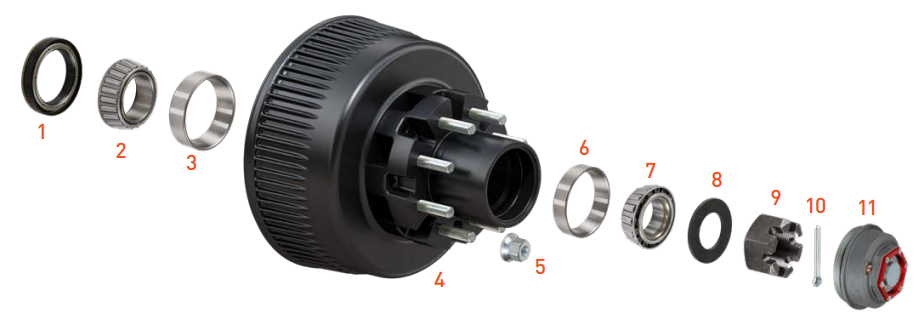
Exploded view of 12K wheel end - the ultimate in single-axle capacity
The following table details the extreme-duty components required for 12,000 lb capacity. Every part represents the maximum size and strength available in trailer axle technology.
| Item # | Part # | Description |
|---|---|---|
| Not shown | 2979981 | Electric brake assembly, right (12-1/4" x 5") - Maximum size available |
| Not shown | 297998 | Electric brake assembly, left (12-1/4" x 5") - Maximum size available |
| 1 | 295924 | Unitized oil seal (3.125 ID) - Largest seal in trailer industry |
| 2 | 293380 | Inner bearing cone (3984) - Massive 12K-specific bearing |
| 3 | 293379 | Inner bearing cup (3920) - Matched to 3984 cone |
| 4 | 297983 | Hub drum with 5/8 studs (8 on 6-1/2") - Maximum duty design |
| 5 | 176321 | Flange wheel nut (5/8"-18) - Grade 8 minimum |
| 6 | 293381 | Outer bearing cup (28622) - 12K-specific heavy-duty race |
| 7 | 293382 | Outer bearing cone (28682) - Extreme-duty outer bearing |
| 8 | 358550 | Spindle washer (1-3/4") - Extra-thick for 12K loads |
| 9 | 330037 | Spindle nut (1-3/4") - Largest standard trailer nut |
| 10 | 181899 | Cotter pin - Heavy-duty for maximum retention |
| 11 | 85373828 | Aluminum oil cap - Heavy-duty with pressure relief |
Extreme Engineering: 12K Component Analysis
The Massive Unitized Oil Seal (Part #295924)
The 12K seal pushes unitized technology to its limits:
- 3.125" ID: Largest bore in the industry
- Five-Stage Sealing: Maximum protection design
- Pressure Relief: Built-in valve for extreme conditions
- Material: Military-spec compounds for durability
- Installation: Requires specialized 12K-only tools
- Cost: $300+ each but eliminates all bearing maintenance
12-1/4" x 5" Electric Brakes: Maximum Stopping Power
The largest brakes available in trailer applications:
- Shoe Width: 5 inches - 2.5x standard brakes
- Swept Area: Nearly 200 square inches per wheel
- Magnet Size: Dual magnets on some models
- Heat Management: Requires active cooling consideration
- Power Requirements: 6-gauge wire mandatory
- Controller Needs: Commercial-grade only
The 3984/3920 Inner Bearing Set
The largest bearings used in trailer applications:
- Load Rating: Over 25,000 lbs dynamic capacity
- Roller Count: Maximum rollers for load distribution
- Race Thickness: Nearly double standard bearings
- Heat Capacity: Massive steel mass for heat absorption
- Precision: Tighter tolerances than lighter bearings
- Cost: $200+ per bearing reflects extreme specifications
Outer Bearing System (28682/28622)
- Size Comparison: Larger than inner bearings on 7K axles
- Thrust Capacity: Handles extreme side loads
- Oil Requirements: Needs constant oil bath
- Service Life: 500,000+ miles with proper maintenance
1-3/4" Spindle Hardware
- Spindle Nut: Largest in trailer industry
- Torque Requirements: 300-400 ft-lbs
- Washer Design: Distributes extreme loads
- Material: Forged steel only, no cast components
Engineering Maximum Capacity Solutions?
Our heavy-haul specialists understand the unique challenges of 12K applications. Get expert guidance for extreme-duty requirements.
Consult 12K ExpertsOperating at Maximum Capacity
Critical Operating Parameters
- Never Exceed 12,000 lbs: No safety margin beyond rating
- Speed Restrictions: Many jurisdictions limit 12K speeds
- Temperature Monitoring: Mandatory for safe operation
- Inspection Frequency: Daily when loaded
- Route Planning: Avoid steep grades when possible
- Weather Considerations: Reduce speed in adverse conditions
Load Distribution Critical
- Center Loading: Essential to prevent bearing overload
- Weight Verification: Scale every load
- Dynamic Forces: Account for 30% impact loading
- Tongue Weight: Maintain proper percentages
- Secure Loads: Movement creates point loading
Maintenance Non-Negotiables
- Oil Checks: Before every trip when loaded
- Temperature Strips: Monitor continuously
- Brake Balance: Critical with maximum loads
- Tire Pressure: Check multiple times daily
- Documentation: Log everything for liability
12K Maintenance: Zero Tolerance for Error
Oil System Management
- Oil Capacity: 16-18 oz per hub (highest of any axle)
- Oil Type: Synthetic 85W-140 mandatory
- Change Interval: 25,000 miles maximum
- Temperature Range: Monitor for 180-220°F normal
- Contamination: Any water means immediate change
- Analysis: Consider oil sampling program
Brake System Demands
- Adjustment: Every 1,000 miles under load
- Shoe Replacement: At 1/4" minimum (more than standard)
- Drum Specs: Zero tolerance for out-of-round
- Cooling Time: Allow 30+ minutes after mountain descents
- Electrical: Check voltage at each brake weekly
Component Replacement Strategy
- Replace bearings at first sign of wear
- Never reuse any hardware
- Keep complete spare assemblies on hand
- Use only OEM or certified components
- Document all maintenance with photos
Troubleshooting 12K Systems
Temperature Issues
- Normal Range: 180-220°F under load
- Warning Signs: Above 250°F requires immediate stop
- Common Causes:
- Low oil level (most common)
- Brake dragging
- Overloading
- Bearing adjustment
- Contaminated oil
- Emergency Response: Stop, cool, inspect before proceeding
Seal Failures at 12K
- Early Warning: Any oil seepage requires attention
- Failure Modes: Usually installation or overheating
- Prevention: Proper tools and procedures critical
- Field Repair: Not recommended - tow to facility
Bearing Failures
- Catastrophic Risk: 12K bearing failure extremely dangerous
- Early Detection: Temperature monitoring essential
- Causes: Usually lubrication or overload related
- Response: Complete hub assembly replacement
Cost Considerations at Maximum Capacity
Initial Investment
- Complete 12K Axle: $4,000-5,000 typical
- Brake Assemblies: $400-500 per wheel
- Bearing Sets: $300-400 per wheel
- Unitized Seals: $300+ each
- Special Tools: $1,500-2,000 investment
Operating Economics
- Revenue Potential: Highest rates for max capacity
- Insurance: Significant premiums for 12K operation
- Maintenance Budget: 2-3x standard axles
- Downtime Cost: Critical loads mean high impact
- ROI: Justified only for regular max-capacity use
Total Cost of Ownership
- Higher initial investment
- Increased maintenance costs
- Specialized service requirements
- Premium insurance rates
- But: highest revenue potential
Safety and Regulatory Compliance
Federal Requirements
- CDL: Required for 12K operations
- Inspections: More frequent than standard
- Documentation: Detailed logs mandatory
- Equipment Marking: Specific requirements
- Route Restrictions: Many roads prohibit 12K
Safety Protocols
- Pre-trip inspection checklist specific to 12K
- Driver training on maximum capacity handling
- Emergency response procedures
- Load securement standards
- Speed and route limitations
Insurance Requirements
- Higher liability limits required
- Cargo insurance mandatory
- Equipment coverage essential
- Driver qualifications strict
- Claims history critical
Frequently Asked Questions
Is 12K really the absolute maximum for single axles?
Yes, 12,000 lbs represents the practical and legal maximum for single-axle applications. While custom or specialty axles might claim higher ratings, 12K is the recognized industry maximum that meets all DOT requirements and safety standards. Physics, tire technology, and regulations converge at this limit.
Can I occasionally exceed 12,000 lbs with safety factors?
Absolutely not. Unlike lighter axles that have built-in safety margins, 12K axles are designed at the engineering limit. There is no safety factor beyond 12,000 lbs. Exceeding this weight, even briefly, risks catastrophic failure and legal liability. Always verify actual weights before transport.
Why are 12K parts so much more expensive?
The extreme specifications require specialized materials, tighter tolerances, and limited production runs. Every component must meet the highest standards with zero margin for error. The liability associated with maximum-capacity components also drives costs. Consider it insurance for safe operation at the limit.
How often do 12K axles actually fail?
When properly maintained and operated within specifications, 12K axles are remarkably reliable. However, when failures occur, they tend to be catastrophic due to the extreme forces involved. This is why preventive maintenance and monitoring are absolutely critical - there's no gradual degradation, only sudden failure.
Should I use 12K axles if I don't need the full capacity?
Generally, no. The increased costs, maintenance requirements, and operational restrictions make 12K axles impractical unless you regularly need maximum capacity. Using appropriately sized axles for your actual loads provides better economics and easier operation while maintaining safety margins.
The Future of Maximum Capacity
Technology Developments
- Materials Science: Carbon fiber and composites research
- Active Systems: Computer-controlled load distribution
- Monitoring: Real-time stress and temperature sensing
- Predictive Maintenance: AI-based failure prediction
- Regulatory Evolution: Possible capacity increases
Market Trends
- Increasing demand for maximum capacity transport
- Infrastructure projects requiring heavy equipment
- Wind and solar installations needing transport
- Manufacturing reshoring creating demand
- Specialized transport becoming premium service
Making the 12K Decision
You Need 12K If:
- Regular loads exceed 10,000 lbs on single axle
- Specialized heavy equipment transport
- Premium rates justify investment
- Competition requires maximum capacity
- Single-axle configuration mandatory
Consider Alternatives If:
- Loads rarely exceed 10,000 lbs
- Multi-axle configurations possible
- Cost sensitivity is high
- Local service unavailable
- Risk tolerance is low
Conclusion
The 12,000 lb wheel end axle stands alone at the pinnacle of trailer axle engineering. It represents the absolute maximum that current technology, materials science, and regulations allow in a single-axle configuration. Every component is pushed to its limit, every specification is maximized, and every operation must be executed with precision.
Operating at 12,000 lbs isn't just about having the biggest axle - it's about accepting the responsibility that comes with working at the edge of engineering limits. The rewards include access to the most lucrative heavy-haul contracts and the ability to move loads that others simply cannot handle. But these rewards come with demands for absolute attention to maintenance, operation, and safety.
For those who truly need maximum single-axle capacity, the 12K provides a tested, proven solution. The unitized oil seal technology ensures that despite the extreme loads, maintenance requirements remain manageable. The massive bearings and brakes are engineered to handle the stress - if you handle them with the respect they deserve.
As we push against the boundaries of what's possible in ground transport, the 12K axle represents current technology's best answer to maximum capacity needs. Whether you're moving the equipment that builds our world or transporting the infrastructure of tomorrow, the 12,000 lb wheel end axle stands ready to carry the load - all 12,000 pounds of it.
Ready for Maximum Capacity?
Explore our complete line of 12K components and get expert guidance for extreme heavy-haul applications.
Shop 12K Components