
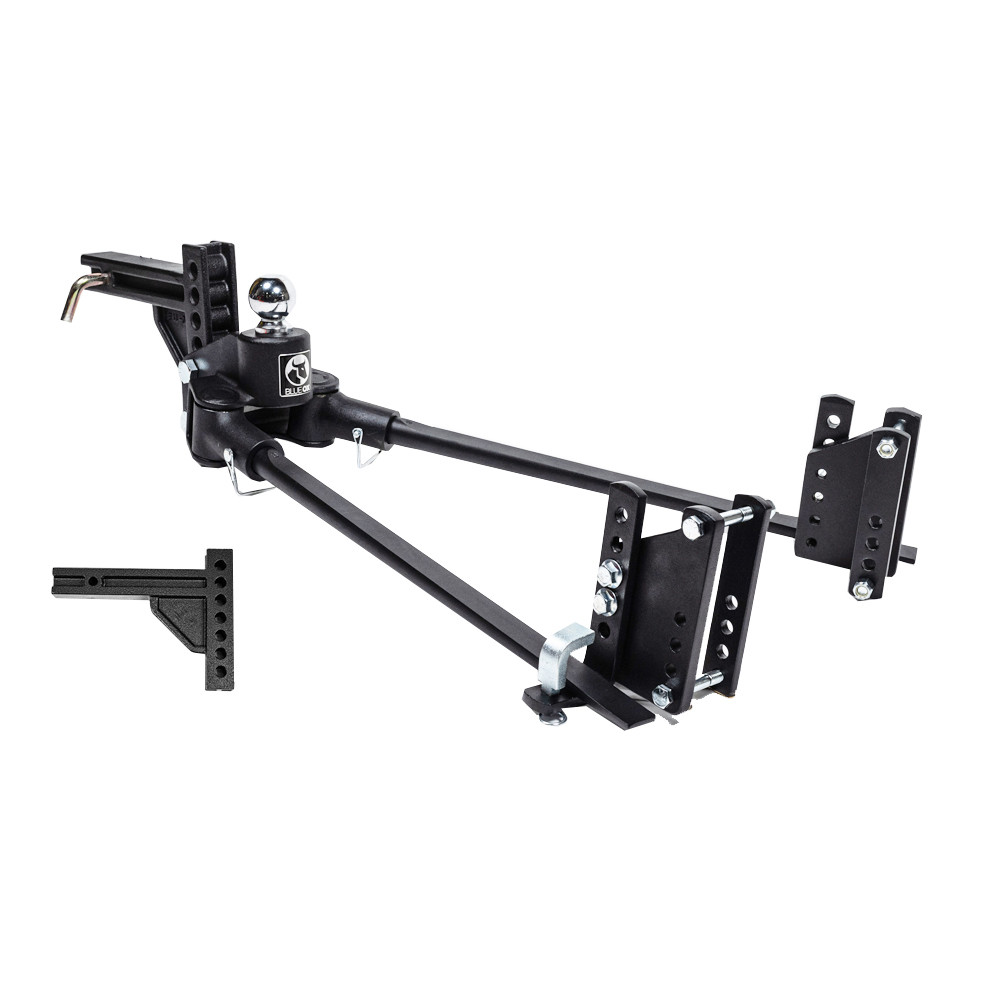
BlueOx 13k, 1k lb TW, TrackPro Weight Distribution Hitch, 2" Recievers 7 Hole Shank BXW1050Blue Ox$759.00In Stock
View productOur in-house experts typically reply within one business day.

Blue Ox


Always the correct part
We know our products
Quality Products
Free Shipping!
Always the correct part
We know our products
Quality Products
Free Shipping!

Equipped with a TrackPro system that evenly distributes weight over the axles of the tow vehicle and trailer for improved stability and handling.
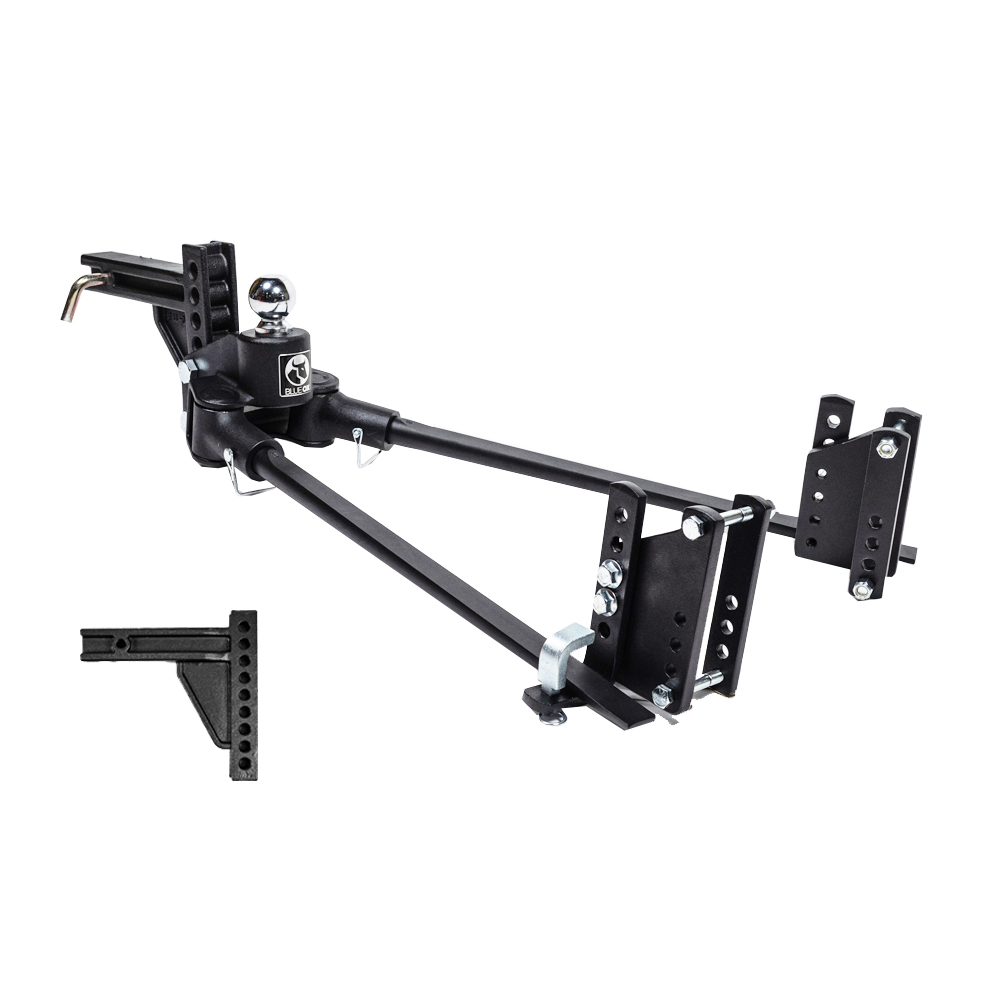
Finish: Powder Coat
Installation Required Yes/No: Yes
1908: 5
7340: No
The Blue Ox BXW1051 TrackPro Weight Distribution Hitch is a robust and reliable solution for your towing needs. It is expertly designed to evenly distribute weight over the axles of both the tow vehicle and trailer, resulting in a smoother, more stable ride. This hitch also effectively manages sway caused by uneven road conditions, wind, and adverse weather, ensuring a safe and comfortable towing experience. With a sturdy powder coat finish, it also offers maximum durability and resistance to wear and tear. Installation is required, but the process is straightforward and hassle-free.

Blue Ox is known internationally for recreational and commercial towing products, manufacturing in Pender, Nebraska since 1925. The line covers tow bars and vehicle-specific baseplates for flat towing behind a motorhome, sway control and weight distributing hitches, supplemental braking accessories and towing wiring, backed by patented designs and long-standing customer service.
Blue Ox has manufactured since 1925 and is recognised internationally for towing products and customer service. The company operates from Pender, Nebraska, where it grew out of Automatic Manufacturing Co., a business that started with cattle oilers and developed into agricultural equipment, tractor accessories and trailer towing hardware. That agricultural engineering heritage still shows in how the towing products are built, and the company holds patents across weight distribution, fifth wheel and tow bar designs.
Flat towing is the discipline Blue Ox is best known for. Towing a car with all four wheels on the ground behind a motorhome demands a system that stays rigid under braking, articulates properly over uneven ground, and connects to the towed vehicle at points strong enough to take the load. Blue Ox tow bars handle the first two, with self-aligning arms that latch under tension and release without a struggle when the load is off them. Vehicle-specific baseplates handle the third, engineered per make and model to tie into structural mounting points behind the fascia.
The wider flat towing range covers supplemental braking systems, safety cables and the accessories that make a complete legal setup, along with baseplate wiring and dinghy towing harnesses that pass lighting signals to the towed vehicle without back-feeding its electrical system.
For conventional trailer towing, Blue Ox weight distributing hitches with integrated sway control transfer tongue load onto the tow vehicle's front axle and resist the yaw that crosswinds and passing trucks induce.
The company describes its foundation as customer service, designing around what owners actually ask for, and it runs an RV park adjacent to the factory where customers can stay. Sister operations at the same Nebraska site include Automatic grain roller mills and MAD-RAMPS pivoting ramp systems.
Experts available to answer your questions
Call 888-634-9494Limited Lifetime
The TrackPro™ is a weight distribution and sway control hitch system. It uses loaded spring bars, friction L brackets, and an integrated hitch head to prevent trailer sway and distribute weight. As the trailer tries to sway, the spring bars pivot on the hitch head and balance the load with the L brackets to control sway. At the same time, it puts more weight on the towing vehicle's front tires, increasing steering control and braking.
The TrackPro™ fits on trailer frames that are 3–6" tall.
The TrackPro™ accepts any 1-1/4" ball shanks. The system comes with a pre-installed 2-5/16" x 20K rated chrome plated hitch ball. Optional replacement balls are available: 2" x 7.5K rated (part BXW4051) and 2-5/16" x 13K rated (part BXW4049).
BXW0851 has 800 lbs. maximum tongue weight capacity, BXW1051 has 1000 lbs., and BXW1351 has 1300 lbs. Each model comes with a 2-5/16" x 20K rated chrome plated hitch ball.
The spring bars are marked with a line system on the shank end to identify the weight rating: 600 lb bar has 1 line, 800 lb bar has 2 lines, 1000 lb bar has 3 lines, and 1300 lb bar has 4 lines.
No. Due to the preset pitch of the hitch head, there are no additional adjustments needed after initial product setup. Sway prevention is built into the TrackPro™ system and requires no adjustments.
Each TrackPro™ kit includes a 2-5/16" x 20K rated chrome plated hitch ball (pre-installed), hitch head assembly, receiver hitch mount, spring bars (pair), L bracket plates (pair), backing plates (pair), offset L bracket mounting plates (pair), pins, bolts, washers, nuts, cotter pins, spring lock pins, quick links, retaining keys, a spring bar lift tool, and a 2" square Blue Ox embossed decal.
Required tools are: torque wrench, tape measure, 3/4" socket, 3/4" wrench, 1-1/8" socket, and 1-1/8" wrench. Note: Items #1–#3 (specific tools) depend on your TrackPro™ model.
Professional installation is recommended. The manual states: 'We recommend that this product be installed by an authorized Blue Ox® Professional Installer. Improper installation and/or operation can create a hazard which can cause serious injury, property damage or death. Improper installation and/or operation will void the warranty.'
Park the towing vehicle and trailer in a straight line on firm, level ground. For vehicles with automatic leveling systems or air-ride suspension, refer to your vehicle's owner's manual for proper towing setup prior to TrackPro™ installation. Remove the existing receiver hitch. For Ram truck owners, reference the Trailer Towing section of your vehicle owner's manual for proper hitch setup instructions. For vehicles with integrated sway control, reference your vehicle owner's manual on how to disable this system.
Torque the 3/4"-10 bolts to 250 ft/lbs.
Apply Blue Loctite to the threads and torque the 1/2" whiz flange bolts to 78 ft/lbs.
Level the trailer and measure the coupler height. Install the hitch head onto the receiver shank using the 3/4"-10 bolts, 3/4" lock washers, and 3/4"-10 hex nuts. Measure the hitch head ball height. The ball height needs to be the same or 1" higher than the trailer coupler height; adjust as necessary. It is recommended for optimal towing performance to set the ball height 2" higher than the top of the trailer coupler.
Measure 20"–25" back from the center of the ball coupler and mark this point on the trailer tongue frame on both sides. Center the L bracket mounting holes on the backing plate over the marked area so that the offset is towards the front of the trailer on each side. Both backing plates should be an equal distance from the ball coupler. The end of the spring bar should be a minimum of 4" from the center of the L bracket backing plate to the open end of the bar.
Insert the spring bars into the pivoting trunnion so that the lines indicating the spring bar size are facing upward. Then insert locking pins from the inside of the bar towards outside.
1. Park the towing vehicle and trailer in a straight line on firm, level ground. 2. Install the hitch head/receiver mount assembly into the towing vehicle receiver tube and secure with the 5/8" x 3" pin and clip. 3. Couple the trailer to the hitch head. 4. Install both spring bars into the pivot tubes and install locking pins per installation instructions. 5. Confirm that both L brackets are secure against trailer frame. 6. Support the trailer tongue weight with the trailer jack. Place the spring bar into the dip on the lift tool, then place the hook end into the square hole in the L bracket. Raise the lift tool upward until the spring bar securely snaps into place. Place the bar locking pin into the square hole on the L bracket and secure with a hair pin. Do this on both sides of the trailer.
1. Park the towing vehicle and trailer in a straight line on firm, level ground. 2. Support the trailer tongue weight with the trailer jack to ease tension on the spring bars. Remove the locking pin from the L bracket. Ensure you are not in the path of the spring bar as it is removed, standing rearward or behind the end of the spring bar. Hold the tool horizontal with hook inward and slide under the spring bar in a forward motion. The hook of the tool will press against the L bracket. Hold the tool firmly and pull outward with the tool. This will remove the spring bar from the L bracket. Do this on both sides of the trailer. 3. Disconnect the spring bars from the hitch head by removing locking pins from each side. Remove spring bars from pivot tubes. 4. Unhook the trailer coupler from the hitch head. 5. Remove the hitch pin and clip from the hitch receiver. 6. Remove the hitch head/receiver mount assembly from the receiver tube.
Caution must be used when unhooking due to the potential of injury caused by tension on the spring bars. Hold the lift tool firmly as you release the spring bar from the L bracket. Apply outward pressure to the lift tool in a slow and steady manner. Ensure you are not in the path of the spring bar. Support the trailer tongue weight with the trailer jack to ease the tension on the spring bars and allow for easier unhooking.
Check the grease zerk on the front of both bar pivots before each use to ensure they are not dry. Use a couple pumps of molybdenum grease on each bar pivot at least twice a year. Wipe away excess grease after application. Periodically grease the hitch ball with molybdenum grease. Before each tow, confirm that all brackets are tightened to specified torque specs.
The tongue weight should be 10–15 percent of gross trailer weight. Handling and control of your towing vehicle and trailer is greatly improved when the cargo is properly loaded and distributed.
The towing vehicle's loaded ball height should never be greater than its uncoupled height. Front wheel overload and loss of rear wheel traction can occur and can lead to unstable handling, reduced braking ability, and a tendency to jackknife when turning and braking at the same time.
No. Do not attempt to tow any type of trailer behind another trailer. Towing multiple trailers may cause severe instability, loss of control, and/or structural failures.
If the TrackPro™ hitch is in an accident, it must be replaced. Do not use it again. An accident can cause unseen damage and using it again could result in more damage or serious injury. Do not use the hitch if it is damaged or missing parts.
Always use safety chains while towing. Cross chains under the coupler for proper installation and to prevent the tongue from dropping to the ground. Only allow enough slack in chains for tight turns; the chains should not drag on the ground. To alleviate slack, twist chains equally from the hook end. Safety chains should be rated at equal to or greater than twice the maximum gross trailer weight rating (GTWR).
The TrackPro™ is backed by a limited lifetime warranty. Automatic Equipment Manufacturing Company warrants to the original (first) retail purchaser that this product shall be free from defect in material and workmanship under normal use and service for as long as the original retail purchaser owns the product. Coverage is valid only if the customer warranty card is returned within 30 days of purchase and a copy of the original invoice accompanies any claim. The warranty is non-transferable and does not cover incorrect or improper installation, improper use, modification, neglect, failure to maintain, misuse, accident, normal wear and tear, paint, or rust.
Optional and replacement kits include: spring bar kits for 800 lb (BXW4040), 1000 lb (BXW4041), and 1300 lb (BXW4042) bars; spring bar lift tool kit (BXW4043); L bracket plates kit (BXW4072); L bracket with mount single (BXW4073) and pair (BXW4074); retaining key kit (BXW4078); pins kit (BXW4047); hitch head assembly kit (BXW4096); hitch ball kits in 2" x 7.5K (BXW4051) and 2-5/16" x 13K (BXW4049); and various receiver mounts with different hole configurations and shank lengths.
The spring bars are designed to deflect 2"–3" on a properly set system. This creates the necessary load on the spring bars to achieve an enjoyable ride. The spring bars will always return back to straight and will not stay bent.
Yes. It is normal to see some wear on the L bracket where the spring bar sits during towing as this is a natural wear point.
The TrackPro™ fits trailer frames 3–6" tall and accepts 1-1/4" ball shanks. Confirm your trailer frame height and coupler type match these specifications.
Choose BXW0851 for 800 lbs., BXW1051 for 1000 lbs., or BXW1351 for 1300 lbs. maximum tongue weight capacity. Select the model that matches or exceeds your fully loaded trailer's tongue weight.
You need a torque wrench, tape measure, 3/4" socket and wrench, and 1-1/8" socket and wrench.
Professional installation is recommended. Improper installation will void the warranty and can cause serious injury or property damage.
Torque the 3/4"-10 hitch head bolts to 250 ft/lbs and the 1/2" L bracket bolts to 78 ft/lbs (with Blue Loctite applied to threads).
Position the L brackets 20"–25" back from the center of the ball coupler on both sides of the trailer tongue, with the offset towards the front of the trailer.
Tongue weight should be 10–15 percent of gross trailer weight. Improper weight distribution can cause instability and loss of control.
Apply molybdenum grease to each bar pivot at least twice a year (a couple pumps per pivot). Periodically grease the hitch ball. Check grease zerks before each use.
Verify that the ball height and coupler height are matched. Adjust the hitch head position as needed so the ball height is the same or 1" higher than the trailer coupler height (or 2" higher for optimal performance).
Adjust the hitch mount receiver higher. Each adjustment up or down equals 1-1/4".
Excessive sway may indicate that the trailer is improperly loaded. As a guideline, the tongue weight should be 10–15 percent of gross trailer weight. If it is not, redistribute the weight accordingly. If you encounter continuous sway or swaying that does not dissipate quickly, adjust the load. For all truck models with factory sway control, it is suggested that the sway control be disabled for the best performance of the Blue Ox® TrackPro™.
Verify that the spring bars are properly rated for your tongue weight. The spring bars should match the weight rating of your TrackPro™ model (800 lb, 1000 lb, or 1300 lb).
Recommend that the tow vehicle tires are inflated to 90% of max inflation state as shown on the tire side wall. Do not exceed the vehicle manufacturer's specification for tire pressure.
Free Shipping
Ships free on all orders
 Authorized Dealer


Quick Ship
In stock and ready to ship — order now!
FREE ShippingFREE SHIPPING
Estimated delivery Sat, Sep 26 - Tue, Sep 29
Order before 2 PM EST Monday–Friday for same-day processing
Guaranteed safe & secure checkout
No reviews have been added for this product.