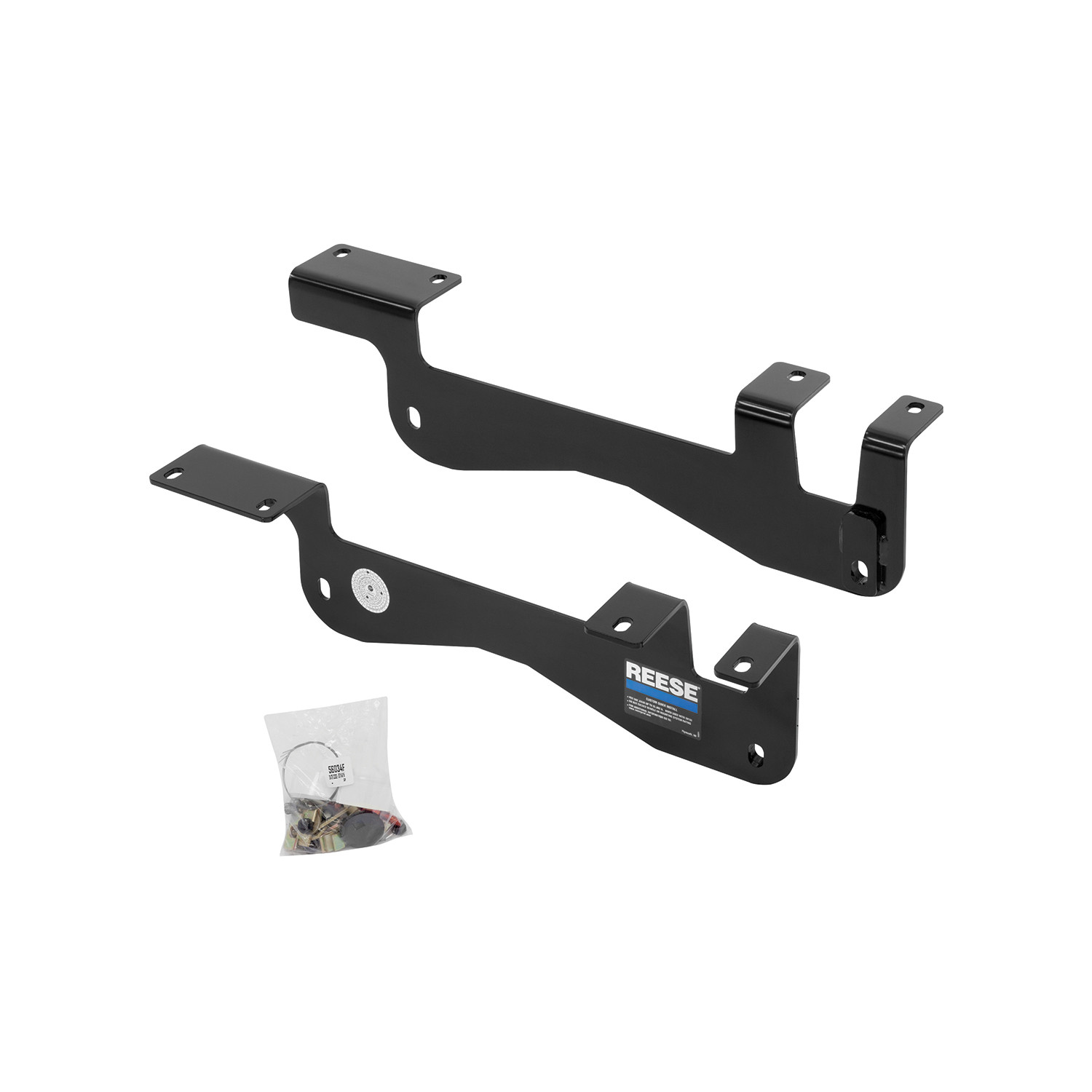

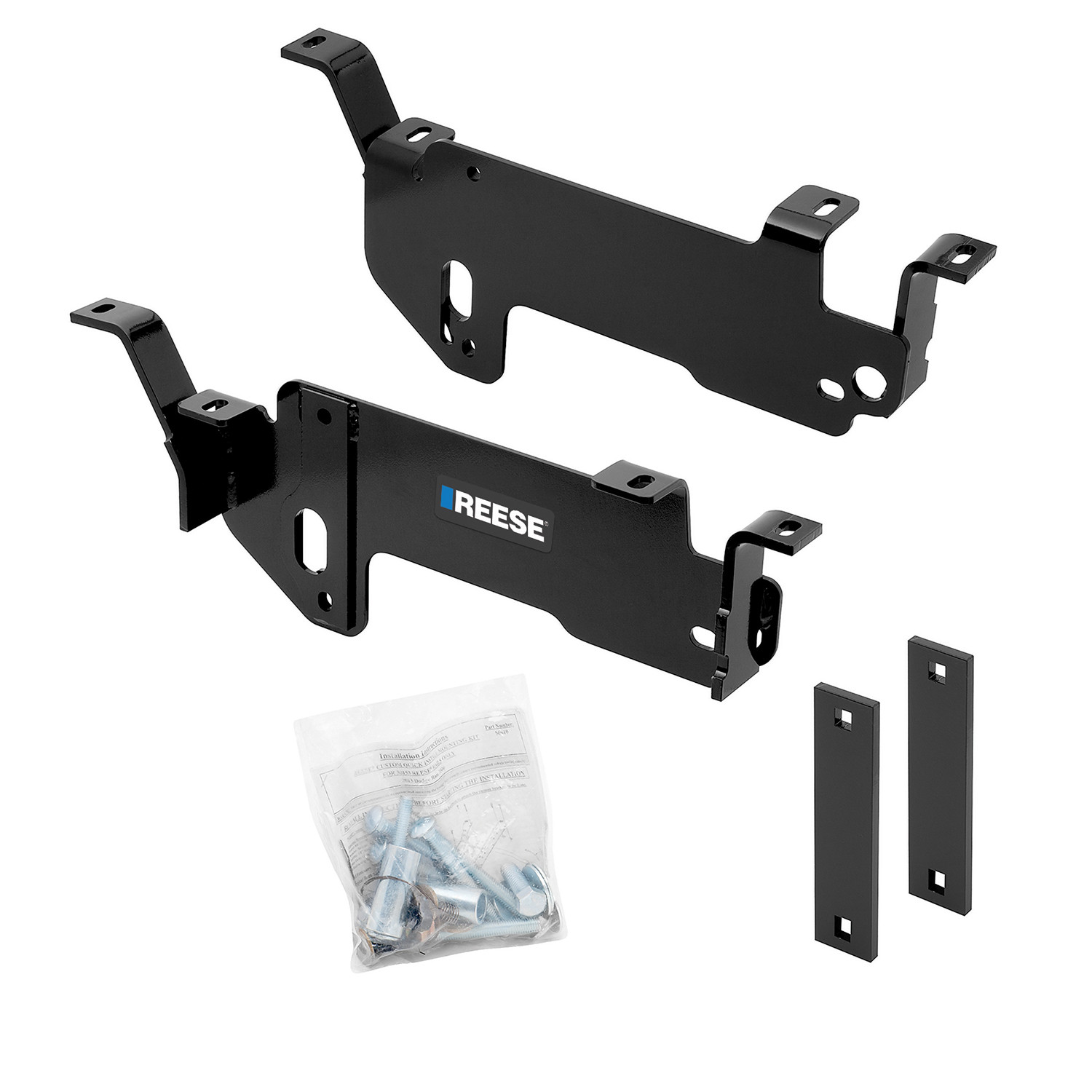
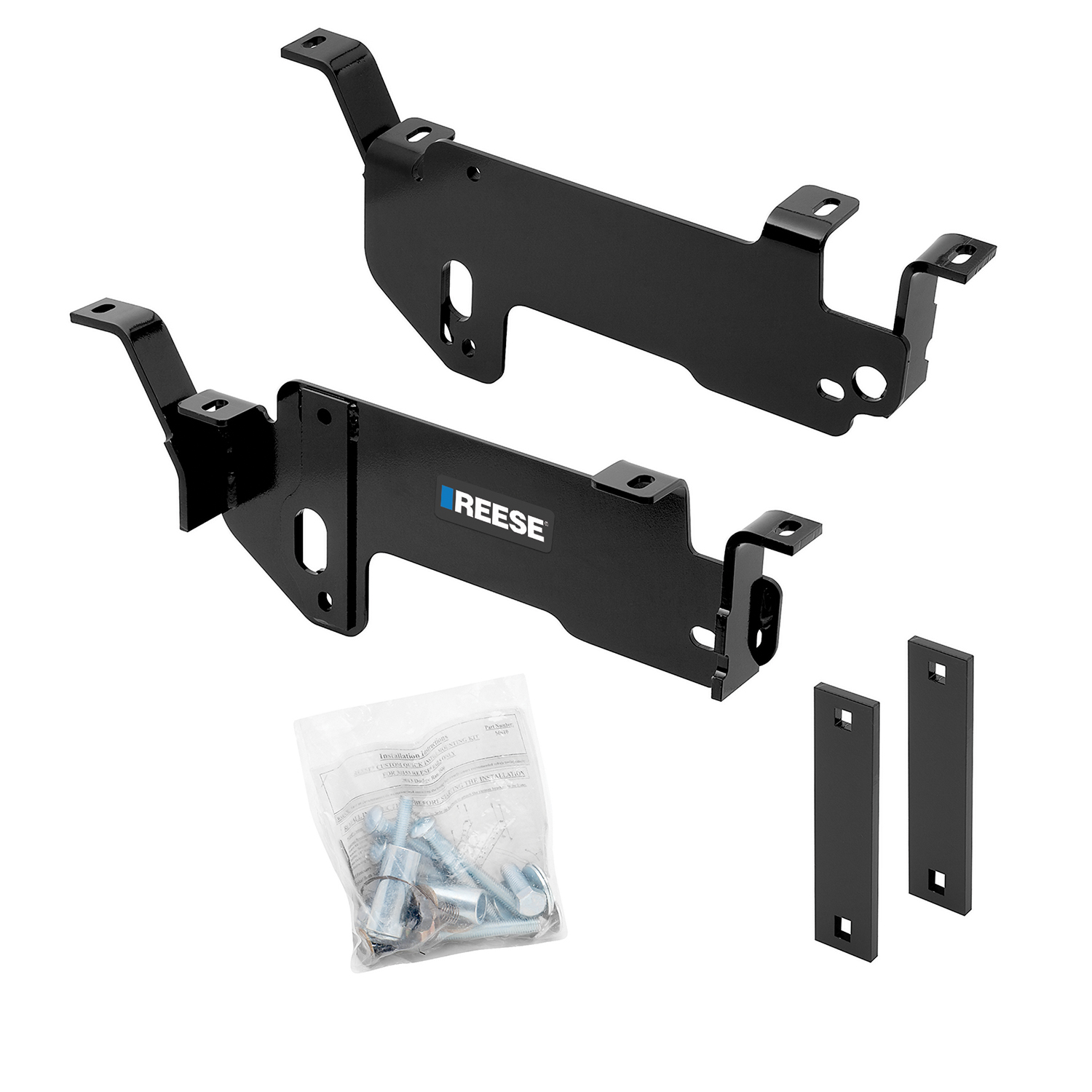
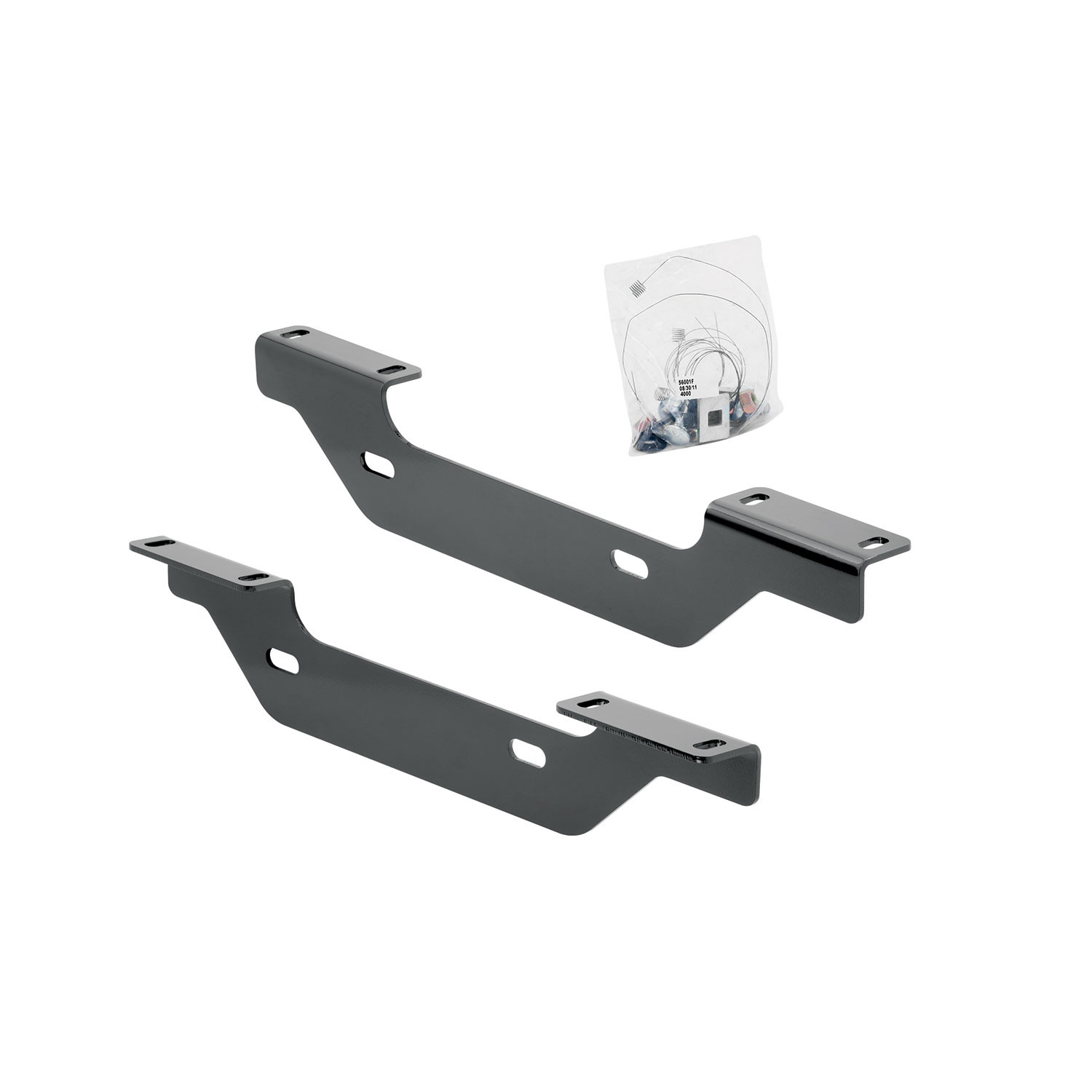
Reese Fifth Wheel Hitch Mounting System Custom Install Kit, Outboard RE56021-53ReeseOut of Stock
View productOur in-house experts typically reply within one business day.

Reese

Always the correct part
We know our products
Quality Products
Free Shipping!
Always the correct part
We know our products
Quality Products
Free Shipping!

Want to take the family on a cross-country adventure? Or perhaps you're planning a shorter trip to your favorite campground. Whatever your destination, it's important to have the right equipment, especially when towing a fifth wheel trailer. To ensure proper hookup and safety while towing, you'll need something to attach your fifth wheel hitch in the bed on your truck. Many pickups come equipped with factory-installed rails or puck systems, but if you don't have one of these already installed, don't worry. REESE has an extensive line of mounting rails and bracket kits, custom-made to the exact specifications needed based on your truck's year, make, and model. REESE also offers several Industry Standard designs, as well as fastener kits, spacer kits, and a Power Puck mounting kit, so you can be sure you're covered, no matter what pickup you're using to tow. So make it easy. Make it fun. Make it REESE, so you can make the journey as enjoyable as the destination.
| BRAND: | REESE |
| PART NUMBER: | 56021 |
| WARRANTY: | LIMITED LIFETIME WARRANTY |
| WEIGHT: | 41.9 LBS |
| UNIVERSAL OR SPECIFIC FIT: | SPECIFIC |
| WELDING REQUIRED: | NO |
| MOUNTING HARDWARE INCLUDED: | YES |
| RAILS INCLUDED: | NO |
| DRILLING REQUIRED: | YES |
| MATERIAL: | STEEL |
| BOLT GRADE: | Grade 8 |
| LOCKABLE: | NO |
| COLOR: | BLACK |

Reese has designed towing equipment since 1952 and remains a benchmark for heavy-duty towing. The line covers fifth wheel hitches such as the modular M5, gooseneck couplers including the Goose Box, air-ride and short-bed pin boxes, weight distribution systems with active sway control, and the accessories that connect them, all built to exceed published industry standards.
Reese has been pioneering towing performance since 1952, when Margaret Reese asked her husband TJ to stop travel trailers rocking every time somebody walked through them. His answer, the first pair of stabilising jacks, was simple and effective enough to change the RV industry. From that starting point Reese grew into a designer and manufacturer of complete towing systems, and today it anchors the heavy-duty end of the Horizon Global towing portfolio.
Fifth wheel towing is where the brand's engineering is most visible. The M5 fifth wheel hitch uses a modular design that breaks into manageable sections for assembly, with a wider stance, tighter tolerances and a shock absorption system aimed at the jolts that travel up through a truck bed. For owners who would rather tow from a gooseneck coupler and keep the bed clear, the Goose Box 20K replaces the trailer's king pin with a gooseneck connection carrying its own air-ride cushioning.
Pin boxes are a Reese speciality. The 5th Airborne uses air-ride technology to dampen road shock and reduce the chucking motion that makes fifth wheel towing tiring, while the Sidewinder was designed for short-bed pickups, pivoting the connection point so the trailer can turn sharply without the front cap meeting the cab.
For conventional towing, Reese weight distribution systems restore load to the tow vehicle's front axle and control sway. The Pro Round Bar distributes weight evenly while damping sway, and the Pro Dual Cam II uses active cam-based sway control that works harder the stronger the sway force becomes. Complete kits pair bars, head and shank to a rated tongue weight, and dedicated sway control kits can be added to existing setups. The products suit RV owners, horse and livestock haulers and anyone towing near the upper end of a vehicle's rating.
Experts available to answer your questions
Call 888-634-9494Lifetime
Yes, part 56021 is designed for 2013 to Current Dodge Ram 3500 trucks. However, it is specifically designed to work only with the REESE® 30153 rails kit. The kit includes custom brackets for frame attachment but does not include the rails themselves; those are supplied separately with part number 30153.
No. Plastic bed liners must be cut out of the way to provide metal-to-metal contact between the mounting rails and the truck frame. Spray-in bed liners are acceptable and the rails may be installed over them. Consult your installer for the recommended curing time if using a spray-in liner.
Yes, the kit is designed for both short bed and long bed configurations. However, on 2013–2018 trucks with 6.5' (short) beds only, a truck box support beam extension must be cut off using a reciprocating saw to allow the frame brackets to mount properly to the outside of the truck frame. This extension is not a structural part of the truck box.
The kit includes: 2 straps, 1 driver side bracket, 1 passenger side bracket, 4 conical washers (1/2"), 2 carriage bolts (1/2"-13 x 4.5"), 4 hex nuts (1/2"-13), 2 bolts (5/8"-11), 1 cable tie (8.5"), 2 bushings (2.773"), 4 carriage bolts (1/2"-13 x 5.5"), 2 flat washers (5/8"), 4 conical washers (5/8"), 2 hex nuts (5/8"-11), 2 wire pulls (5/8"-11), 4 spacer-collars, and 2 bolts (5/8"-11 x 4.5"). All fasteners are Grade 8 unless otherwise specified. The fastener kit is part number 56021F. The rails and additional fasteners are supplied separately with part number 30153.
Required tools are: wrenches or sockets in 3/4", 15/16" and 10mm sizes; drill bits in 1/8", 9/16" and 1 1/4" hole saw sizes; a center punch; and a measuring tape. For 2013–2018 trucks with 6' beds, a reciprocating saw is also required to cut the truck box support beam extension.
The manual states to lower and remove the spare tire if extra room is needed. It is not strictly required but recommended for easier access. You must remove the inner plastic wheel well liner to allow access to the frame. After installation, reinstall the spare tire.
Before installation, lower and remove the spare tire if extra room is needed, and remove the inner plastic wheel well liner to allow access to the frame. Detach the two electrical harness hanger plugs from the inside driver side of the frame just rear of the fuel tank. For 2013–2018 trucks with 6.5' beds only, cut off the truck box support beam extension using a reciprocating saw. Always measure your truck and trailer for clearance at the cab and bumper before installing to ensure there is adequate space for turns.
Place the rear mounting rail in the truck bed and use a tape measure to center it between the weld seams on the width of the truck bed floor. Position it at the proper distance from the rear edge of the truck bed as shown in Figure 3 of the manual. For long beds, the distance is approximately 1-9/16"; for short beds, approximately 1-7/16". Mark and center punch the holes, then drill pilot holes with a 1/8" bit before enlarging them.
Drill pilot holes with a 1/8" bit first. Then enlarge the holes to 9/16" for the frame bracket slots. For row 2 holes in the bed, enlarge them to 1 1/4" for the bushings. On 2019-up trucks only, the 9/16" hole on the passenger side in row 2 must also go through the bed crossmember below the bed floor.
Yes. On 2013–2018 trucks with 6.5' beds only, you must use a reciprocating saw to cut off the extension attached to the truck box support beams that straddles the frame. This extension is not a structural part of the truck box and is only used by the manufacturer during assembly. Cutting it allows the frame brackets to mount to the outside of the truck frame.
Torque all hardware to 110 ft-lbs, except for 5/8" hardware on 2013–2018 trucks, which must be torqued to 212 ft-lbs. Torque in the following sequence: first torque the mounting rails to the frame brackets, then torque the frame brackets to the truck frame. The manual does not specify the torque value for 5/8" hardware on 2019-up trucks.
Use the 5/8" pull wire (part 14) to install the 5/8" bolt (part 7) through the access hole on the inside of the frame. Place a 5/8" flat washer (part 11) on the bolt on the outside of the frame. Route the pull wire through the rear hole of the frame bracket, then loosely install the 5/8" conical washer (part 12) and 5/8" nut (part 13). For 2019-up trucks, use the longer 5/8" x 4.5" bolt (part 16) instead, which will pass through the frame.
The U-shaped spacer (part 15, called spacer-collar) is positioned in the corrugation between the truck bed and the mounting rail or between the bed and the side bracket. Its purpose is to eliminate crushing of the bed corrugation when the carriage bolts are tightened.
Place the unassembled 5th wheel saddles, slider, or goose into the already-installed rear mounting rail. Position the front mounting rail by inserting its tabs into the rear mounting rail and pushing it tight towards the rear rail. Ensure the front rail is centered between the weld seams on the width of the truck bed floor. If using more than one hitch product with the rails, install both at the same time to align the second rail and ensure neither product compromises the fit of the other.
After fully installing the 56021 custom attachment brackets, tighten fasteners in this sequence: first torque the mounting rails to the frame brackets, then torque the frame brackets to the truck frame. Torque all hardware to 110 ft-lbs, except 5/8" hardware on 2013–2018 trucks, which must be torqued to 212 ft-lbs.
After installation, secure the electrical harness with the cable tie (part 8) supplied with the kit.
Do not exceed the towing vehicle manufacturer's recommended vehicle towing capacity. Always measure your truck and trailer before installing the hitch to ensure there is adequate clearance at the cab and at the bumper to allow for turns. The warranty does not cover damage from overloading or misapplication.
After installation, verify that all fasteners are tightened to the correct torque values (110 ft-lbs for most hardware, 212 ft-lbs for 5/8" hardware on 2013–2018 trucks). Ensure the mounting rails are centered between the weld seams and positioned correctly. Check that the spare tire and inner plastic wheel well liner have been reinstalled. Verify that the electrical harness is secured with the cable tie.
Check the mounting system bolt tightness once per year. This is an owner responsibility to ensure the kit remains secure and safe during use.
The 56021 kit includes custom mounting brackets and fasteners (part 56021F) to attach the brackets to the truck frame. It does not include the mounting rails themselves; those are supplied separately with part number 30153. The kit is designed to work only with the 30153 rails kit.
Yes, the 56021 is designed for 2013 to Current Dodge Ram 3500 trucks. It works only with the REESE® 30153 rails kit. Plastic bed liners must be cut away; spray-in liners are acceptable.
You need wrenches/sockets (3/4", 15/16", 10mm), drill bits (1/8", 9/16", 1 1/4" hole saw), a center punch, measuring tape, and a reciprocating saw for 6' beds on 2013–2018 trucks.
Yes. You must drill pilot holes (1/8"), enlarge them to 9/16", and enlarge row 2 bed holes to 1 1/4". On 2013–2018 trucks with 6.5' beds, you must also cut the truck box support beam extension with a reciprocating saw.
Torque all hardware to 110 ft-lbs, except 5/8" hardware on 2013–2018 trucks, which must be torqued to 212 ft-lbs. Torque the mounting rails to the frame brackets first, then the frame brackets to the truck frame.
Do not exceed the vehicle manufacturer's recommended towing capacity. Always measure your truck and trailer for cab and bumper clearance before installation. Check bolt tightness once per year.
Remove the inner plastic wheel well liner for frame access. Lower and remove the spare tire if extra room is needed. For 2013–2018 trucks with 6.5' beds, cut the truck box support beam extension. Detach the electrical harness hanger plugs from the driver side frame.
Check mounting system bolt tightness once per year. Save your warranty sheet and receipt for future support.
Verify that you have drilled the pilot holes in the correct locations by comparing your marks to Figure 3 in the manual. Ensure the mounting rail is centered between the weld seams on the width of the truck bed floor and positioned at the correct distance from the rear edge (approximately 1-9/16" for long beds, 1-7/16" for short beds). If the holes still do not align, remove the frame bracket and re-check the rail position before enlarging the holes to 9/16".
Use a measuring tape to verify the rail is centered between the weld seams on the width of the truck bed floor. If it is off-center, loosen the fasteners (which should be tightened only snug at this stage, not fully torqued) and reposition the rail. Ensure it is pushed tight towards the other mounting rail if installing both front and rear rails. Re-tighten snug and verify centering before final torquing.
Ensure you are using the correct bolt for your truck year. On 2013–2018 trucks, use the shorter 5/8" bolt (part 7) with the pull wire (part 14) to guide it through the frame access hole on the inside of the frame. The pull wire is essential for routing the bolt through the frame. If the bolt still does not fit, verify the access hole is clear of obstructions.
The extension must be cut using a reciprocating saw to allow the frame brackets to mount to the outside of the truck frame. If you do not have access to a reciprocating saw, contact a professional installer or tool rental service. The extension is not a structural part of the truck box and is only used by the manufacturer during assembly, so cutting it will not compromise the integrity of the truck bed.
Matt
Ordered online. Shipment arrived on time and with all the correct parts. Great customer service and friendly staff. Also, pricing was great!
May 22, 2023

Total for 0 items:
$0.00
On Sale Today
You save $230.15 (38%)
Free Shipping
Ships free on all orders
 Authorized Dealer
FREE ShippingFREE SHIPPING
Estimated delivery Tue, Sep 22 - Fri, Sep 25
Order before 2 PM EST Monday–Friday for same-day processing
Guaranteed safe & secure checkout