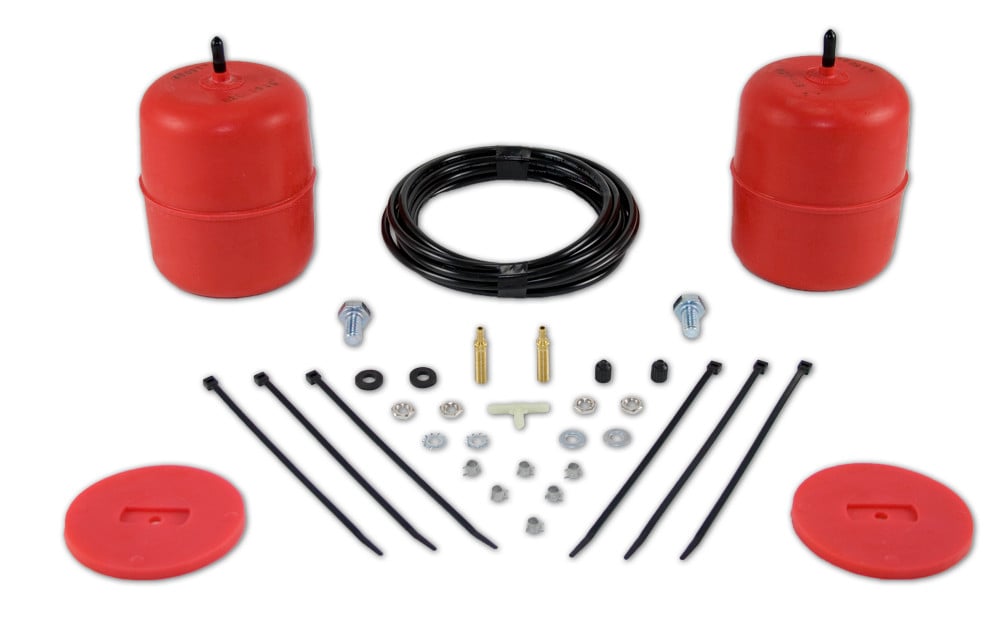
Air Lift AIR LIFT 1000 80702Air LiftOriginal price was $194.99. Current price is $179.56.In Stock
View productOur in-house experts typically reply within one business day.

Air Lift
Verify Fitment
Select your vehicle to confirm this part fits.
2007 - 2017 Jeep Wrangler
Confirmed to Fit
2018 Jeep Wrangler JK
Confirmed to Fit

Always the correct part
We know our products
Quality Products
Free Shipping!
Always the correct part
We know our products
Quality Products
Free Shipping!
AD-938 LS user guide.pdf
MN-695_60817.pdf
AD-985-ALC-Warranty- Flyer.pdf
Air Lift 1000
Coil Spring
Rear
No Drill

Air Lift adjustable air helper springs level your load, and give your truck, van, or SUV a safer, more comfortable ride. Air springs are easy to install inside the existing coil spring with common mechanic's tools. Just add air when towing or hauling a heavy load, and reduce air pressure when unloaded, they are fully adjustable for a great ride. Air Lift air springs eliminate sag, sway, and bottoming out. They are made with rugged, durable components for long, reliable service. Air Lift 1000 kits fit many popular customer vehicles with coil springs. They're designed to: add support to rear springs on many popular SUVs, replace OEM front air springs on P-30 motor homes, provide front end support for snowplows, winches, etc., improve muscle car traction for drag racing, and improve ride and handling for full-size vans and trucks with front coil springs. Air adjustable with quick connecting, easy-to-use air fittings, Air Lift 1000 air helper springs have a typical max pressure of 35 PSI on cars and SUVs, and 90 PSI on motorhomes. They also have up to 1000 pounds of leveling capacity, right up to the manufacturer's recommended Gross Vehicle Weight Rating. Air Lift 1000 kits also come standard with a limited lifetime warranty and an exclusive 60 day ride satisfaction guarantee.
Air Lift Company has developed dependable air spring suspension products since our inception in 1949. Our original product, a rubber air spring inserted into a car’s factory coil spring, was created and patented in 1950. We’ve come a long way since 1949 and are proud to be a dedicated suspension specialist company.
Today, Air Lift load support products are sold worldwide and are engineered to fit over 540 vehicles. Our extensive product line offers air helper springs for trucks, RVs, SUVs, CUVs, and vans, as well as the most technologically advanced on-board air compressor systems for on-the-go air spring control.
Air Lift leads the industry in no-drill applications – kits that bolt onto your vehicle’s frame, speeding the installation process. Our teams work constantly to bring innovative products to you and upgrade existing products with the latest technology.
All of our efforts are spent ensuring your safety and comfort by designing, engineering, and manufacturing the highest quality suspension products. We are a family-owned business based in Lansing, Michigan, and make your family and cargo’s safety our top priority.
Experts available to answer your questions
Call 888-634-9494Limited Lifetime
2 compatible vehicles
| Year | Make & Model | Notes |
|---|---|---|
| 2007 - 2017 | Jeep Wrangler | — |
| 2018 | Jeep Wrangler JK | — |
Yes, the Air Lift AIR LIFT 1000 60817 (Part #BBCG60817) is designed to fit the 2007-2017 Jeep Wrangler.
The Air Lift AIR LIFT 1000 60817 (Part #BBCG60817) fits 2007-2017 Jeep Wrangler models. The 2018 model year is the last year covered by this part number. For newer models, check for an updated version.
The Air Lift AIR LIFT 1000 60817 (Part #BBCG60817) fits the following vehicles: 2007-2017 Jeep Wrangler; 2018 Jeep Wrangler JK. Always verify your specific year, make, and model before ordering.
The Air Lift AIR LIFT 1000 60817 (Part #BBCG60817) Refer to the included instructions for installation details. Basic hand tools are typically all you need.
Yes, kit 60817 is designed for Jeep Wrangler 2WD and 4WD models. Check that your vehicle matches this specification before purchasing.
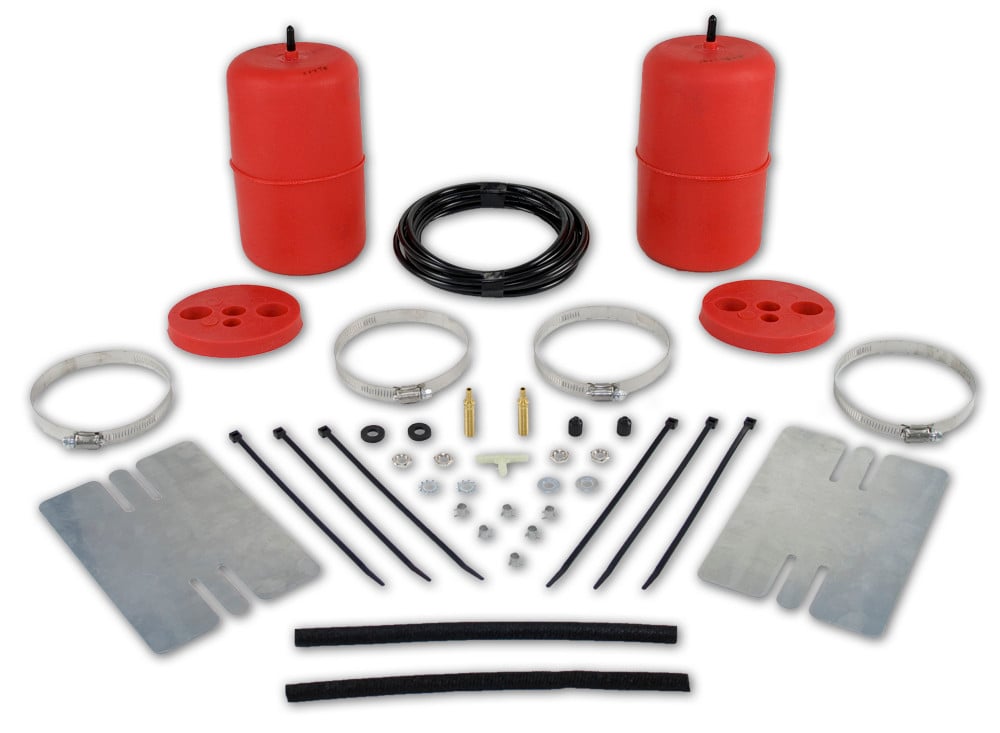
The Air Lift 1000 is an air spring suspension support system that uses pressurized air springs installed within the vehicle's coil springs to help level the vehicle and improve ride comfort. The system includes two air springs, air lines, inflation valves, and related hardware.
Required tools include: 2 hoist or floor jacks, 1 safety stand, safety glasses, standard sockets/ratchet and wrenches, drill with bits, pliers, air compressor or compressed air source, and a spray bottle with dish soap and water solution for leak testing.
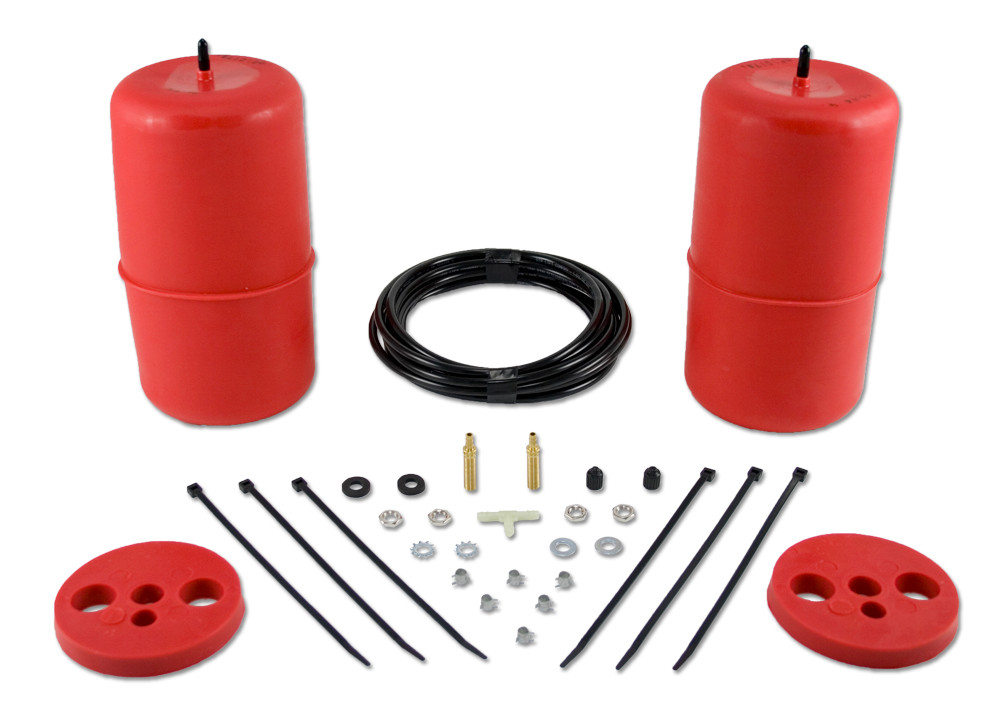
The kit includes: 2 air springs (part 46172), 2 lower protectors (09119), 6 universal clamps (10638), 6 tie straps (10466), 2 valve caps (21230), 4 5/16" hex nuts (21233), 2 rubber washers (21234), 2 star washers (18411), 2 5/16" flat washers (18405), 1 tee (21236), 2 valves (21455), and 1 heat shield kit (34668).
Jack up the rear of the vehicle or raise it on a hoist. Support the frame with safety stands. Lower the axle or raise the body until the suspension is fully extended. This allows proper air spring installation.
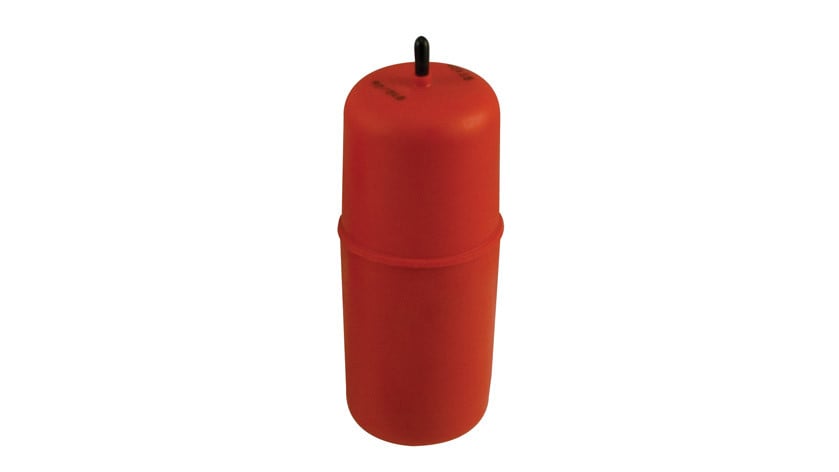
First, remove the plastic cap from the barbed stem and exhaust air from the spring by rolling it toward the stem, then replace the cap to hold it flat. Insert the flattened air spring into the coil spring through the lowest opening with the stem at the bottom. Push it up or down within the coil by hand or with a blunt instrument such as a spoon-type tire iron. When fully inside, remove the cap and allow the spring to assume its original shape. Push it to the top of the coil spring.
The lower protector (part 09119) is installed between the bottom of the air spring cylinder and the lower spring seat to protect the air spring from damage.
A tee air line installation is recommended for most applications. Use dual air lines only if the weight in the vehicle varies significantly from one side to the other and unequal pressures are needed to level the load or compensate for axle torque transfer in racing applications.
Slide an air line clamp onto the air line, push the air line over the barbed stem covering all barbs, then use pliers to compress and slide the clamp forward until it fully covers the barbed section.
Leave sufficient air line slack to prevent any strain on the fitting during axle motions. This allows the suspension to move freely without pulling on the air line connections.
Maintain at least 8 inches of clearance between the air line and the exhaust system to prevent the air line from melting.
Yes. You must drill a 5/16" hole for the inflation valve. The valve can be mounted in the gas cap well, trunk, rear bumper, fender flange, or behind the license plate, ensuring it is protected and accessible with an air hose.
The heat shield kit (part 34668) protects the air spring from heat damage. Two heat shields must be installed onto the exhaust pipe on the driver side of the vehicle. Bend the tabs to provide a 1/2" dead air space between the exhaust pipe and the heat shield, then attach with clamps and bend for maximum clearance to the air spring.
Maintain at least 2–3 inches of clearance between the tail pipe and the air spring. If necessary, loosen the clamps and rotate or move the heat shields to obtain additional clearance.
Inflate the air springs to 35 PSI initially. Test for air leaks by applying a 1/5 dish soap to 4/5 water solution to all valve cores, fittings, and connections.
After inflating to 35 PSI, apply a liquid solution of 1/5 dish soap to 4/5 water to all valve cores, fittings, and connections. Bubbles indicate a leak. Recheck air pressure after 24 hours; a 2–4 PSI loss is normal. If pressure drops more than 5 PSI, retest for leaks.
Minimum air pressure is 5 PSI; maximum is 35 PSI. Always maintain at least the minimum pressure to prevent the air spring from being pinched. Never inflate beyond the maximum pressure.
No. Installing the Air Lift 1000 does not alter the Gross Vehicle Weight Rating (GVWR) or payload of the vehicle. You must check your vehicle's owner's manual and never exceed the maximum load listed for your vehicle. Exceeding the GVWR is dangerous and voids the Air Lift warranty.
Check the air pressure weekly. Always maintain at least the recommended minimum air pressure (5 PSI) to prevent the air spring from being pinched. Never inflate beyond the maximum air pressure (35 PSI).
Use a soapy water solution of 1/5 liquid dish soap and 4/5 water to check all air line connections and the inflation valve core. Bubbles indicate a leak. If you suspect a leak, check all connections before deflating and removing the air spring.
Always add air to springs in small quantities, checking the pressure frequently. Air springs require less air volume than a tire and inflate quickly, so gradual inflation prevents over-pressurization.
Inflate your air springs to 35 PSI before adding the payload. This allows the air cylinder to properly mesh with the coil spring. After the vehicle is loaded, adjust your air pressure down to level the vehicle and for ride comfort.
When carrying a payload, increase the tire inflation pressure in proportion to any overload condition. Air Lift recommends a 2 PSI increase above normal for each 100 lbs of additional load on the axle. Do not exceed the vehicle manufacturer's maximum GVWR.
No. Air pressure can be adjusted with any type of compressor as long as it can produce sufficient pressure to service the springs. Even a bicycle tire pump can be used, though it requires more effort.
If the air springs are properly installed and maintained, they can last indefinitely.
No, the vehicle can be lifted on a hoist for short-term service work such as tire rotation or oil changes. However, if the vehicle will be on the hoist for a prolonged period, support the axle with jack stands to take the tension off the air springs.
If the vehicle's headlights are shining into the trees or the vehicle is leaning to one side, it is not level. Raise the air pressure to correct either of these problems and level the vehicle.
If the vehicle has a rough and harsh ride, it may be due to either too much pressure or not enough. Try different pressures to determine the best ride comfort for your vehicle.
Stability translates into safety and should be the priority. Stability issues include roll control, bounce, dive during braking, and sponginess. Tuning out these problems usually requires an increase in pressure. The driver may need to sacrifice a perfectly level and comfortable ride for better stability.
If it is suspected that the air springs have bottomed out, increase the pressure. Bottoming out can damage the air springs and void the warranty.
Yes. It may be necessary to maintain different pressures on each side of the vehicle. Loads such as water, fuel, and appliances will cause the vehicle to be heavier on one side. As much as a 50 PSI difference is not uncommon when using dual air lines.
The Air Lift 1000 carries a Lifetime Limited Warranty from the date of original purchase. The warranty covers defects in workmanship and materials when used on cars and trucks as specified by Air Lift Company and under normal operating conditions.
The warranty does not apply to products that have been improperly applied, improperly installed, or not maintained in accordance with installation instructions. The warranty is void if damage or failure is caused by accident, abuse, misuse (including racing or off-road activities), abnormal use, faulty installation, liquid contact, fire, or external causes; operating outside Air Lift Company's instructions or specifications; or service, alteration, maintenance or repairs performed by anyone other than Air Lift Company. Failure to maintain correct minimum pressure, bottoming out, over-extension, or rubbing against another component also voids the warranty.
A 2–4 PSI loss after initial installation is normal. Recheck air pressure after 24 hours. If pressure has dropped more than 5 PSI, test for leaks using a soapy water solution of 1/5 dish soap to 4/5 water applied to all valve cores, fittings, and connections. Bubbles indicate a leak that must be corrected.
If the vehicle's headlights are shining into the trees or the vehicle is leaning to one side, raise the air pressure to level the vehicle. If using dual air lines, you may need to maintain different pressures on each side to compensate for uneven loading.
A rough and harsh ride may be due to either too much pressure or not enough. Try different pressures to determine the best ride comfort. Start with the vehicle level or slightly above, and adjust the pressure up and down to find the best ride.
If the vehicle rocks and rolls, adjust the air pressure to reduce movement. Increasing pressure usually improves stability and reduces roll control issues, bounce, and sponginess.
On Sale Today
Original price was $206.99. Current price is $149.99.You save $57.00 (28%)
Free Shipping
Ships free on all orders
 Authorized Dealer

Quick Ship
In stock and ready to ship — order now!
FREE ShippingFREE SHIPPING
Estimated delivery Thu, Sep 17 - Sun, Sep 20
Order before 2 PM EST Monday–Friday for same-day processing
Guaranteed safe & secure checkout
No reviews have been added for this product.