
B&W Trailer Hitches Custom Installation Brackets For Universal Mounting Rails For Some Ford Trucks Fifth Wheel Trailer Hitch Bracket BQVLRVR2404B&W Trailer Hitches$130.00In Stock
View productOur in-house experts typically reply within one business day.

B&W Trailer Hitches
Verify Fitment
Select your vehicle to confirm this part fits.
2005 - 2009 Ford F-250
Confirmed to Fit
2005 - 2010 Ford F-250 Super Duty
Confirmed to Fit
2005 - 2009 Ford F-350
Confirmed to Fit
2005 - 2010 Ford F-350 Super Duty
Confirmed to Fit


Always the correct part
We know our products
Quality Products
Free Shipping!
Always the correct part
We know our products
Quality Products
Free Shipping!

| PROP 65 WARNING: | WARNING: This product may expose you to chemicals including Nickel (Metallic), which is known to the state of California to cause cancer. For more information, go to www.P54Warnings.ca.gov. |

B&W Trailer Hitches is an American manufacturer known for durable, innovative towing products, including gooseneck hitches, fifth-wheel hitches, receiver hitches, and ball mounts. Built in Kansas by employee-owners, B&W products are engineered for dependable performance, easy installation, and long-lasting quality.
B&W Trailer Hitches is an American manufacturer known for building innovative, dependable towing products designed to make hitching easier and towing more comfortable. The company began in 1987 in Humboldt, Kansas, when founders Roger Baker and Joe Works combined their fabrication experience to build custom truck beds and solve common problems faced by truck owners.
B&W changed the gooseneck hitch industry with the introduction of the Turnoverball Gooseneck Hitch. Its under-bed mounting system and reversible hitch ball allowed truck owners to quickly store the ball beneath the bed, leaving a clean and unobstructed surface when the hitch was not in use. B&W later applied the same practical approach to the Companion Fifth Wheel Hitch, creating a removable fifth-wheel hitch engineered for a quiet, smooth, and secure towing experience.
Today, B&W manufactures gooseneck hitches, fifth-wheel hitches, receiver hitches, ball mounts, and towing accessories at its nearly 600,000-square-foot facility. The company is owned by approximately 500 employee-owners who remain committed to American manufacturing, trusted materials, skilled craftsmanship, and long-lasting product quality.
Whether you are towing a work trailer, livestock trailer, camper, or fifth wheel, B&W Trailer Hitches offers thoughtfully engineered towing equipment built to perform mile after mile.
Experts available to answer your questions
Call 888-634-94944 compatible vehicles
| Year | Make & Model | Notes |
|---|---|---|
| 2005 - 2009 | Ford F-250 | — |
| 2005 - 2010 | Ford F-250 Super Duty | — |
| 2005 - 2009 | Ford F-350 | — |
| 2005 - 2010 | Ford F-350 Super Duty | — |
The B&W Trailer Hitches Custom Installation Brackets For Universal Mounting Rails For Some Ford Trucks Fifth Wheel Trailer Hitch Bracket BQVLRVR2400 (Part #BQVLRVR2400) fits 2005-2009 Ford F-250 models. The 2010 model year is the last year covered by this part number. For newer models, check for an updated version.
Yes, the B&W Trailer Hitches Custom Installation Brackets For Universal Mounting Rails For Some Ford Trucks Fifth Wheel Trailer Hitch Bracket BQVLRVR2400 (Part #BQVLRVR2400) is designed to fit the 2005-2009 Ford F-250.
The B&W Trailer Hitches Custom Installation Brackets For Universal Mounting Rails For Some Ford Trucks Fifth Wheel Trailer Hitch Bracket BQVLRVR2400 (Part #BQVLRVR2400) fits the following vehicles: 2005-2009 Ford F-250; 2005-2010 Ford F-250 Super Duty; 2005-2009 Ford F-350; 2005-2010 Ford F-350 Super Duty. Always verify your specific year, make, and model before ordering.
The B&W Trailer Hitches Custom Installation Brackets For Universal Mounting Rails For Some Ford Trucks Fifth Wheel Trailer Hitch Bracket BQVLRVR2400 (Part #BQVLRVR2400) Refer to the included instructions for installation details. Basic hand tools are typically all you need.
The RVK2400 (part number 2400-100) is designed for 2005–2010 Ford F250 and F350 trucks with either an 8' long bed or 6'6" short bed. If your truck is a different year, model, or bed length, this kit is not compatible. Consult B&W Trailer Hitches directly at 800.248.6564 or hitches@turnoverball.com to confirm fitment for your specific vehicle.
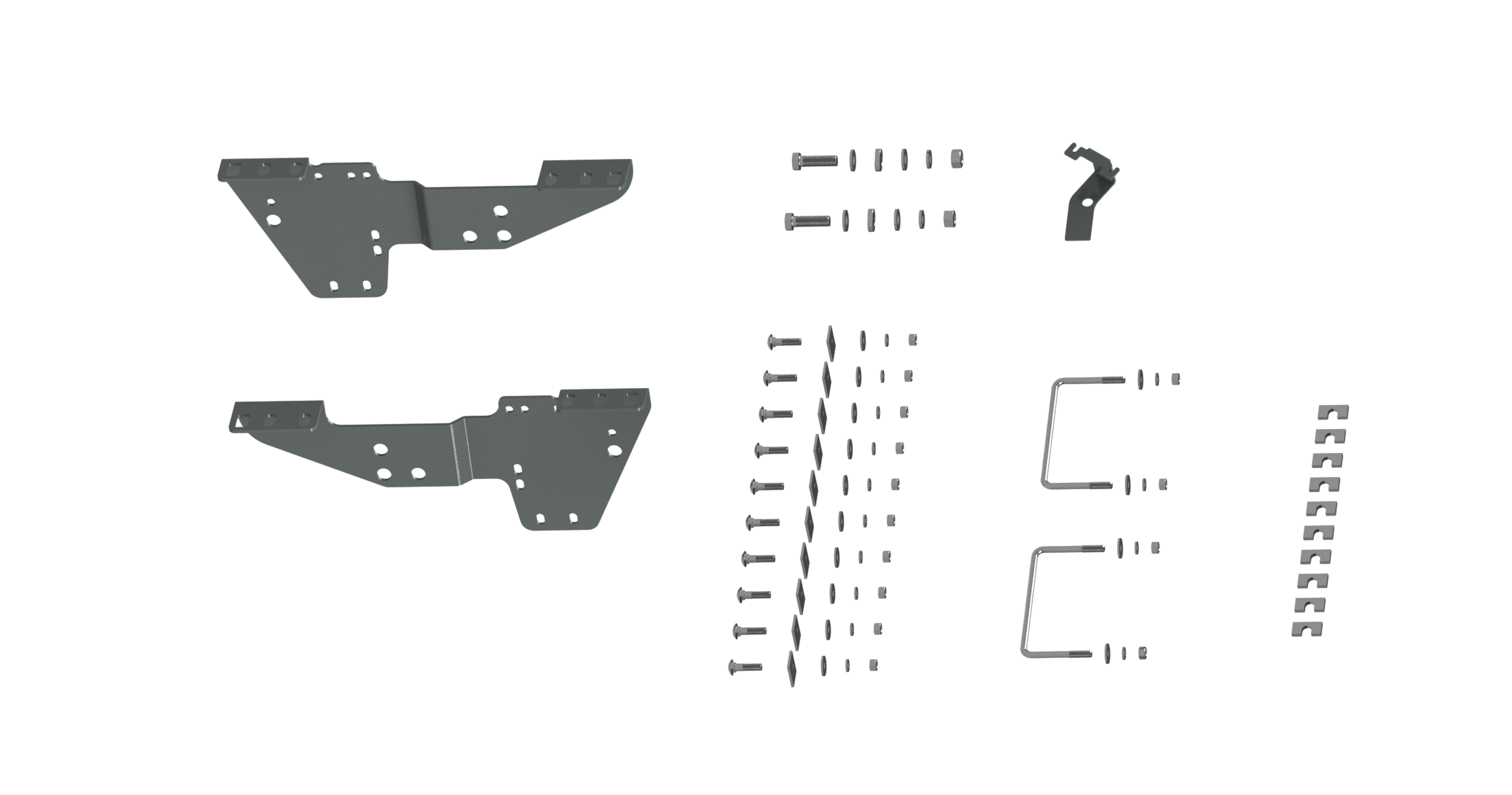
The kit includes: one Patriot Rail Box (RVR3210) containing one mounting rail; one Bracket Set Box (RVR2400) containing two frame brackets (driver and passenger side); Bracket Set Bolt Bag #1 with ten 1/2" × 2" carriage bolts, fourteen 1/2" flat washers, fourteen 1/2" split lockwashers, fourteen 1/2" finish nuts, two 3/4" × 2–1/2" cap screws, two mounting washers, two 3/4" flat washers, two 3/4" split lockwashers, two 3/4" finish nuts, and two 1/2" × 6–3/4" × 4" U-bolts; Bracket Set Bolt Bag #2 with ten 5/16" U-shaped spacers and ten offset rectangle washers. Verify all parts are present before installation using the parts list on page 1.
If your truck has a removable bed liner or mat, it must be removed before installation so the mounting rails can connect directly with the bed. However, if you have a spray-in bed liner, the mounting rails can be installed over it without removal.
Required tools include: impact wrench or ratchet with 3/4" and 1–1/8" sockets; 3/4" and 1–1/8" box end wrenches; drill with 1/8" and 9/16" drill bits; tape measure; torque wrench; center punch tool; eye protection; ear protection; flashlight; and hammer. You will also need the Patriot 5th wheel or Slider Base that will attach to the rails.
The manual states that installation must be completed by someone who is aware of the hazards involved and is knowledgeable of proper safety procedures for vehicle installation and equipment usage. While the manual does not explicitly require professional installation, it emphasizes that this is not a simple task and requires knowledge of safety procedures, proper tool usage, and awareness of potential hazards such as damage to the fuel tank during drilling.
Yes, drilling is required. You must drill five holes in the rear mounting rail location and five holes in the forward mounting rail location using an 1/8" drill bit as a pilot, then enlarge each hole to 9/16". The manual provides specific hole locations in Figure A2. Before drilling, you must carefully examine the area under the truck to ensure the fuel tank or other equipment will not be damaged.
The rear mounting rail should be positioned 32–1/8" from the rear edge of the bed (measured over the bed, not on the tailgate) and centered side-to-side. Five drill locations are marked in Figure A2 with black dots. The forward mounting rail hole locations are slightly different and are also shown in Figure A2. Use a center punch to mark all locations before drilling, and verify alignment with the frame brackets before enlarging holes to 9/16".
Installation sequence is: (1) Layout and mark the rear mounting rail hole locations; (2) Drill rear holes with 1/8" pilot bit, check alignment with frame brackets, then enlarge to 9/16"; (3) Install frame brackets on both sides using 3/4" cap screws and 1/2" U-bolts (do not tighten); (4) Install rear mounting rail with 1/2" carriage bolts, spacers, washers and nuts (hand tighten); (5) Drill forward mounting rail holes using the same method; (6) Position forward rail using the base to align pin tabs; (7) Install forward rail with carriage bolts, spacers, washers and nuts (hand tighten); (8) Final torque all fasteners in sequence.
Final torque specifications are: (1) All 1/2" nuts in the mounting rails: 80 ft-lbs; (2) All 3/4" nuts in the frame brackets: 100 ft-lbs; (3) All 1/2" nuts in the frame brackets: 80 ft-lbs. Apply torque in this sequence using a torque wrench. All fasteners should be hand-tightened during assembly and final-torqued only after all components are positioned.
U-shaped spacers are space fillers provided to accommodate the corrugation in the truck bed. They must be placed in the gap either above the bed (between the mounting rail and bed) or below the bed (between the bed and frame brackets) around each carriage bolt. The manual states: 'Failure to use u-shaped spacers will result in property damage when hardware is tightened.' Ten spacers are included in the kit.
Each frame bracket attaches to the truck frame using two fasteners: (1) A 3/4" × 2–1/2" cap screw with mounting washer, 3/4" flat washer, 3/4" lock washer, and 3/4" finish nut; (2) A 1/2" × 6–3/4" × 4" U-bolt with two 1/2" flat washers, 1/2" lock washers, and 1/2" finish nuts. Pass the cap screw through the bracket and into the frame, then attach the U-bolt over the inside of the frame into the two mounting holes in the bracket. Do not tighten at this time; hand-tighten only after all components are positioned.
Before drilling forward mounting holes, pull the RV base towards the rear of the truck and push the forward rail towards the cab to correctly space the mounting rails (see Figure C4). Then place the mounting rail in the truck bed in front of the rear mounting rail. Place the base over the rail attachment points and carefully lower it until the pin tabs pass through the attachment points on the rear mounting rail. Attach the forward rail to the forward mounting points on the base. The base should rest flat against the top of the rails. Ensure the forward rail is centered in the truck bed.
Do not exceed the tow or tongue rating of the coupler, hitch, truck, or trailer—consult vehicle and trailer manufacturer information for ratings. Exceeding ratings may cause damage to towing components or loss of attachment. When towing a wedge car trailer, keep the center of gravity as low as possible by loading heavy cars over the axles; never tow with a single car on the front of the trailer. Never exceed speeds that are reasonable for roadway conditions (turns, curves, etc.). Failure to account for proper trailer center of gravity and reasonable speeds may cause damage and loss of attachment. Do not modify the product, as this could alter its integrity.
Regularly check that all bolted connections are at the correct torque specification. A visual inspection should be performed before each time you tow. Refer to the torque specifications: 1/2" nuts in mounting rails and frame brackets at 80 ft-lbs, and 3/4" nuts in frame brackets at 100 ft-lbs.
No. The manual explicitly states: 'Do not modify this product in any manner. Doing so could alter its integrity and lead to a loss of attachment between the trailer and the tow vehicle.' Any modifications will void the product's integrity and safety.
Hand-tighten all fasteners during assembly: (1) When installing frame brackets, do not tighten the 3/4" cap screw or 1/2" U-bolt fasteners; (2) When installing the rear mounting rail, hand-tighten all 1/2" nuts on the carriage bolts; (3) When installing the forward mounting rail, hand-tighten all 1/2" nuts on the carriage bolts. Only after all components are fully positioned and assembled should you use a torque wrench to final-torque in the specified sequence: 1/2" nuts in mounting rails to 80 ft-lbs, 3/4" nuts in frame brackets to 100 ft-lbs, then 1/2" nuts in frame brackets to 80 ft-lbs.
Before drilling, carefully examine the area under the truck where modification will occur. The fuel tank may be directly below the area of the bed that needs to be drilled. Make certain that the tank or other equipment is not damaged during drilling. Damage to the tank may result in property damage, serious injury, or death. Use a flashlight to inspect the underside of the truck bed.
The RVK2400 fits 2005–2010 Ford F250 and F350 trucks with 8' long bed or 6'6" short bed only.
Yes. The Patriot 5th wheel or Slider Base is required but not included in the RVK2400 kit. You must have the base to position and align the forward mounting rail during installation.
Yes. You must drill ten holes total (five for the rear rail, five for the forward rail) using an 1/8" pilot bit, then enlarge each to 9/16". Before drilling, inspect under the truck to ensure the fuel tank will not be damaged.
Removable bed liners must be removed. Spray-in bed liners can remain; the rails install over them. Failure to remove a removable liner will prevent proper connection to the bed.
Torque all 1/2" nuts in mounting rails to 80 ft-lbs, all 3/4" nuts in frame brackets to 100 ft-lbs, and all 1/2" nuts in frame brackets to 80 ft-lbs. Use a torque wrench and apply in this sequence after all components are positioned.
Do not exceed the tow or tongue rating of the coupler, hitch, truck, or trailer. When towing a wedge car trailer, keep the center of gravity low and never tow with a single car on the front. Perform a visual inspection before each tow and regularly check that all bolted connections are at correct torque.
Regularly check that all bolted connections are at the correct torque specification. Perform a visual inspection before each tow. Retorque fasteners if any loosening is detected.
If the 1/8" holes are not centered within the slots in the frame brackets, re-drill the 1/8" holes until the brackets and the drilled holes are aligned. Do not enlarge to 9/16" until alignment is confirmed. Proper alignment is critical for correct installation.
The manual explicitly states: 'Failure to use u-shaped spacers will result in property damage when hardware is tightened.' The spacers are required to fill the gaps created by the corrugation in the truck bed. Without them, the corrugation will cause uneven pressure and damage to the mounting rails or bed when fasteners are torqued.
Regularly check that all bolted connections are at the correct torque specification. If any fasteners are found to be loose, retorque them to the correct specification: 1/2" nuts in mounting rails to 80 ft-lbs, 3/4" nuts in frame brackets to 100 ft-lbs, and 1/2" nuts in frame brackets to 80 ft-lbs. Perform a visual inspection before each tow to catch any loosening early.
Free Shipping
Ships free on all orders
 Authorized Dealer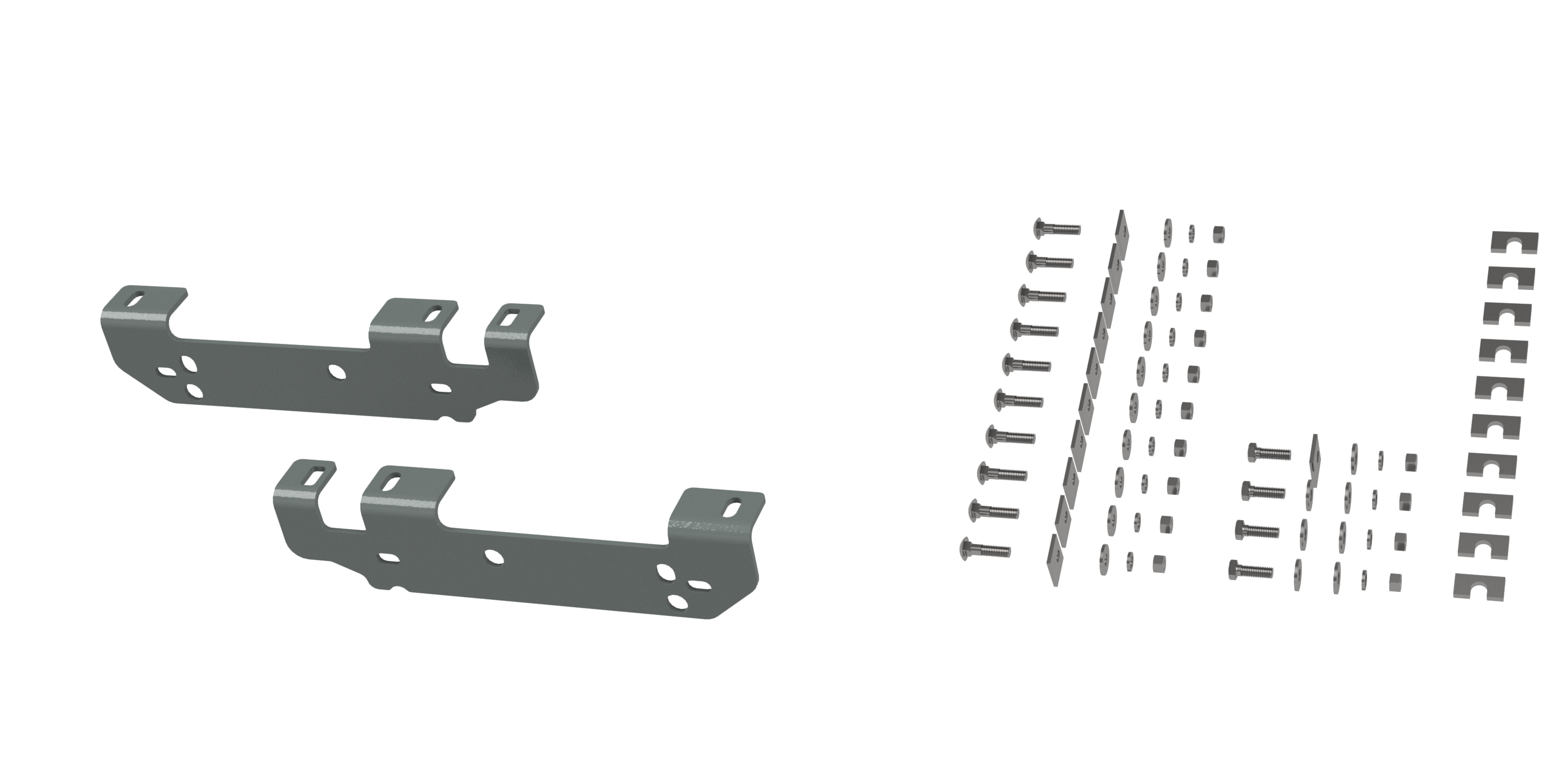


Quick Ship
In stock and ready to ship — order now!
FREE ShippingFREE SHIPPING
Estimated delivery Wed, Sep 23 - Sat, Sep 26
Order before 2 PM EST Monday–Friday for same-day processing
Guaranteed safe & secure checkout

Total for 2 items:
$260.00
No reviews have been added for this product.