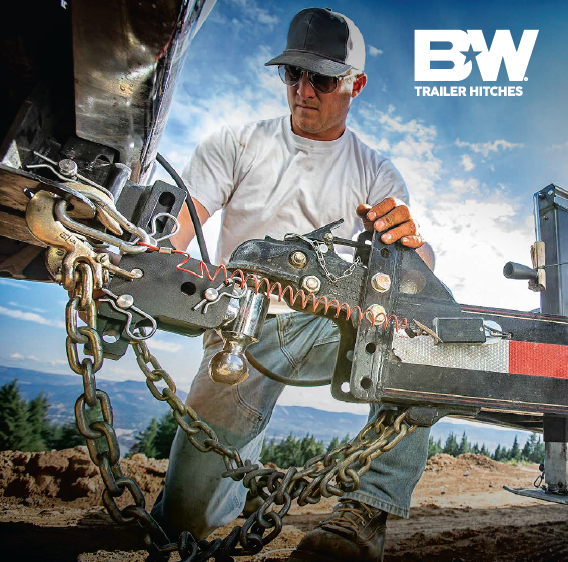

B&W Trailer Hitches Custom Installation Brackets For Universal Mounting Rails For Some GM Trucks Fifth Wheel Trailer Hitch Bracket BQVLRVR2503B&W Trailer Hitches$130.00In Stock
View productOur in-house experts typically reply within one business day.

B&W Trailer Hitches
Verify Fitment
Select your vehicle to confirm this part fits.
Confirmed to Fit
2026 GMC Sierra 1500
Confirmed to Fit


Always the correct part
We know our products
Quality Products
Free Shipping!
Always the correct part
We know our products
Quality Products
Free Shipping!

| PROP 65 WARNING: | WARNING: This product may expose you to chemicals including Nickel (Metallic), which is known to the state of California to cause cancer. For more information, go to www.P54Warnings.ca.gov. |

B&W Trailer Hitches is an American manufacturer known for durable, innovative towing products, including gooseneck hitches, fifth-wheel hitches, receiver hitches, and ball mounts. Built in Kansas by employee-owners, B&W products are engineered for dependable performance, easy installation, and long-lasting quality.
B&W Trailer Hitches is an American manufacturer known for building innovative, dependable towing products designed to make hitching easier and towing more comfortable. The company began in 1987 in Humboldt, Kansas, when founders Roger Baker and Joe Works combined their fabrication experience to build custom truck beds and solve common problems faced by truck owners.
B&W changed the gooseneck hitch industry with the introduction of the Turnoverball Gooseneck Hitch. Its under-bed mounting system and reversible hitch ball allowed truck owners to quickly store the ball beneath the bed, leaving a clean and unobstructed surface when the hitch was not in use. B&W later applied the same practical approach to the Companion Fifth Wheel Hitch, creating a removable fifth-wheel hitch engineered for a quiet, smooth, and secure towing experience.
Today, B&W manufactures gooseneck hitches, fifth-wheel hitches, receiver hitches, ball mounts, and towing accessories at its nearly 600,000-square-foot facility. The company is owned by approximately 500 employee-owners who remain committed to American manufacturing, trusted materials, skilled craftsmanship, and long-lasting product quality.
Whether you are towing a work trailer, livestock trailer, camper, or fifth wheel, B&W Trailer Hitches offers thoughtfully engineered towing equipment built to perform mile after mile.
Experts available to answer your questions
Call 888-634-94944 compatible vehicles
| Year | Make & Model | Notes |
|---|---|---|
| 2019 - 2023, 2025 | Chevrolet Silverado 1500 | Excludes CarbonPro bed |
| 2026 | Chevrolet Silverado 1500 | Excludes Trucks with CarbonPro beds & All Electric Vehicles & Trucks with Composite Mono: Leaf Spring Suspension |
| 2019 - 2023, 2025 | GMC Sierra 1500 | Excludes CarbonPro bed |
| 2026 | GMC Sierra 1500 | Excludes Trucks with CarbonPro beds & All Electric Vehicles & Trucks with Composite Mono: Leaf Spring Suspension |
The B&W Trailer Hitches Custom Installation Brackets For Universal Mounting Rails For Some GM Trucks Fifth Wheel Trailer Hitch Bracket BQVLRVR2504 (Part #BQVLRVR2504) fits the following vehicles: 2026 Chevrolet Silverado 1500; 2026 GMC Sierra 1500. Always verify your specific year, make, and model before ordering.
Yes, the B&W Trailer Hitches Custom Installation Brackets For Universal Mounting Rails For Some GM Trucks Fifth Wheel Trailer Hitch Bracket BQVLRVR2504 (Part #BQVLRVR2504) is designed to fit the 2026 Chevrolet Silverado 1500.
The B&W Trailer Hitches Custom Installation Brackets For Universal Mounting Rails For Some GM Trucks Fifth Wheel Trailer Hitch Bracket BQVLRVR2504 (Part #BQVLRVR2504) fits 2026 Chevrolet Silverado 1500 models. The 2026 model year is the last year covered by this part number. For newer models, check for an updated version.
The B&W Trailer Hitches Custom Installation Brackets For Universal Mounting Rails For Some GM Trucks Fifth Wheel Trailer Hitch Bracket BQVLRVR2504 (Part #BQVLRVR2504) Refer to the included instructions for installation details. Basic hand tools are typically all you need.
The RVK2504 is designed for 2019–2026 Chevrolet and GMC 1500 trucks, but there are important exclusions. It does not fit 2019 Chevy LD or GMC Limited 1500 trucks, trucks with CarbonPro beds, all-electric vehicles, or trucks with Composite Mono-Leaf Spring Suspension. Verify your truck model and bed type before purchasing.
Yes. The manual states it is acceptable to install the mounting rails over a spray-in bed liner. However, you must account for the liner thickness when measuring the mounting rail location and add the thickness of the sprayed liner that covers the end of the bed.
Yes. If your truck has a removable bed liner or mat, it must be removed or cut to allow the mounting rails to connect directly with the bed. A spray-in liner does not need to be removed.
Required tools include: impact wrench or ratchet with 3/4" and 10mm sockets; 3/4" and 10mm box end wrenches; drill with 1/8" and 9/16" drill bits; tape measure; flashlight; hammer; center punch tool; torque wrench; screwdriver with T15 Torx bit; and eye and ear protection. A Patriot 5th Wheel or Slider Base is also required for positioning the forward mounting rail.
The kit includes two Patriot Rail Box mounting rails, a Bracket Set with two side plates (driver and passenger), four 1/2" × 5–1/2" × 4–1/4" U-bolts, two 1/2" × 2" cap screws, eight 1/2" × 2" carriage bolts, two 1/2" × 1–1/2" carriage bolts, 22 lock washers, 20 finish nuts, 14 flat washers, two locking straps, two frame spacers, two bolt retainers, ten 3/8" U-shaped spacers, ten offset rectangular washers, and two fish wires.
It may be necessary to remove the spare tire before installation. Removing rear tires may also aid in installation. Check your truck's configuration before beginning.
You must: (1) detach the brake line bracket on the driver side frame behind the rear axle using a 10mm socket or wrench; (2) remove three T15 Torx screws from flexible wheel well liners (if present) and fold them up; (3) disconnect the wiring harness running along the top of the passenger side frame rail above the rear axle by detaching the plastic connector closest to the shock bracket and pulling the wiring down and inward. These components are reinstalled after the hitch is installed.
The rear mounting rail should be positioned 26 15/16 inches from the rear edge of the bed for short beds (less than 8 feet long), and 32 11/16 inches for long beds (8 feet long). Measure over the rear edge of the bed, not on the tailgate. Center the rail by measuring the distance from each side of the rail to the sides of the bed; both measurements should be equal.
For short beds: (1) angle the side plate so the front flange goes behind the front "V" tab of the bed flange; (2) move the side plate forward so the back flange goes between the two rear "V" tabs; (3) push the side plate rearward and rotate it onto the installed carriage bolt; (4) attach with a flat washer, lock washer, and finish nut, hand-tightened only at this stage.
For long beds: (1) angle the side plate so the front flange goes behind the front "V" tab of the bed flange; (2) move the side plate rearward so the back flange goes behind the rear "V" tab; (3) push the side plate forward and rotate it onto the installed carriage bolt; (4) attach with a flat washer, lock washer, and finish nut, hand-tightened only at this stage.
Locate the oval hole on the outside of the frame directly over the center line of the axle. Thread a fish wire onto the end of a 1/2" × 1–1/2" carriage bolt that is already placed through a locking strap. From inside the frame, pass the fish wire through the oval hole. While holding the fish wire on the outside, push the locking strap and carriage bolt into the frame. Pull the fish wire until the threaded portion of the bolt protrudes. Turn the carriage bolt until the square shoulder engages the square hole of the strap. Thread the oval frame spacer onto the carriage bolt into the oval slot, remove the fish wire, and thread a bolt retainer onto the carriage bolt. Repeat on the other side.
U-shaped spacers function as space fillers between the mounting rails and the kit attachment hardware, accounting for the corrugation in the truck bed. Always place a U-shaped spacer in the gap either above the bed (between the mounting rail and the bed) or below the bed (between the bed and the side plates). Failure to use U-shaped spacers will result in property damage when hardware is tightened.
The driver side front U-bolt must be passed under the brake lines on the inside of the frame. The passenger side front U-bolt must be positioned under the wiring harness that runs over the top of the frame. Both U-bolts are pushed through holes in the side plate and secured with lock washers and finish nuts, hand-tightened only at this stage.
The Patriot 5th Wheel or Slider Base is required for this step. Place the forward mounting rail in the truck bed in front of the rear mounting rail. Place the base over the rail attachment points and carefully lower it until the pin tabs pass through the attachment points on the rear mounting rail. Attach the forward mounting rail to the forward mounting points on the base. The base should rest flat against the top of the rails. Ensure the forward rail is centered in the truck bed.
Before drilling forward mounting holes, pull the RV base towards the rear of the truck and push the forward rail towards the cab of the truck to correctly space the mounting rails. This ensures proper spacing between the forward and rear mounting rails.
You need two drill bits: a 1/8" bit for initial pilot holes, and a 9/16" bit for enlarging the holes to final size. First, mark hole locations with a center punch and drill pilot holes with the 1/8" bit. After checking alignment with the side plates, enlarge each hole with the 9/16" bit.
You need to drill 5 holes for the rear mounting rail. Use a center punch to mark the 5 drill locations shown in Figure B2, drill each with a 1/8" bit, check alignment with the side plates, and then enlarge each hole with a 9/16" bit.
Yes. You must drill holes in the truck bed for both the rear and forward mounting rails. The rear rail requires 5 holes and the forward rail requires additional holes. Hole locations are marked with a center punch, drilled with a 1/8" pilot bit, checked for alignment, and enlarged with a 9/16" bit.
The fuel tank of the truck may be directly below the area of the bed which needs to be drilled. Always carefully examine the area under the truck where drilling will occur before drilling. Make certain that the tank or other equipment is not damaged during drilling. Damage to the tank may result in property damage, serious injury, or death.
All 1/2" nuts on the mounting rails must be torqued to 80 ft-lbs using a torque wrench.
All 1/2" nuts on the side plates must be torqued to 80 ft-lbs using a torque wrench.
The U-bolts must be tightened slowly, alternating between the top and bottom legs of the U-bolt until equally tightened to a maximum of 40 ft-lbs.
Use a torque wrench and follow this sequence: (1) torque all 1/2" nuts in the mounting rails to 80 ft-lbs; (2) torque all 1/2" nuts in the side plates to 80 ft-lbs; (3) tighten the U-bolts slowly, alternating between the top and bottom legs until equally tightened to a maximum of 40 ft-lbs.
A visual inspection of the hitch must be performed before each time you tow. Regularly check that all pinned connections are secure and that all bolted connections are at the correct torque specification. Check for cracks or damage to the hitch. Do not tow with the hitch if cracks or damage outside of normal wear is found. Towing with a damaged hitch could result in damage to the tow vehicle, trailer, towing components, and loss of attachment between the tow vehicle and trailer.
Do not exceed the tow or tongue rating of the coupler, the tow or tongue rating of the hitch, or the tow or weight ratings of the truck or trailer. See vehicle and trailer manufacturer information for ratings. Exceeding these ratings may cause damage to towing components or loss of attachment between the trailer and truck.
Yes. Additional caution must be used when towing a wedge car trailer. Towing stability greatly depends on keeping the center of gravity as low as possible. Load heavy cars over the axles. Never tow with a single car on the front of the trailer. When towing a wedge car trailer, never exceed speeds that are reasonable for the roadway conditions (e.g., turns, going around a curve, etc.). Failure to account for proper trailer center of gravity and speeds that are reasonable for the roadway conditions may cause damage to the truck, trailer, towing components, and loss of attachment between the truck and trailer.
No. Do not modify this product in any manner. Doing so could alter its integrity and lead to a loss of attachment between the trailer and the tow vehicle.
After installation, reinstall the brake line bracket and wiring harness on the passenger side. If wheel well liners were present, reinstall the T15 Torx screws and screw retainer that were removed earlier.
The RVK2504 fits 2019–2026 Chevrolet and GMC 1500 trucks, but excludes 2019 Chevy LD, GMC Limited 1500, trucks with CarbonPro beds, all-electric vehicles, and trucks with Composite Mono-Leaf Spring Suspension.
You need an impact wrench or ratchet with 3/4" and 10mm sockets, a drill with 1/8" and 9/16" bits, a torque wrench, a center punch, a tape measure, a hammer, a screwdriver with T15 Torx bit, and eye and ear protection. A Patriot 5th Wheel or Slider Base is also required.
Disconnect the brake line bracket on the driver side frame, remove wheel well liner screws (if present), and disconnect the wiring harness on the passenger side frame. All are reinstalled after installation.
Yes. You must drill 5 holes for the rear mounting rail and additional holes for the forward mounting rail using 1/8" pilot bits and 9/16" enlargement bits. Always inspect the area under the truck for the fuel tank before drilling.
Torque all 1/2" nuts on the mounting rails and side plates to 80 ft-lbs. Tighten U-bolts to a maximum of 40 ft-lbs, alternating between top and bottom legs.
Perform a visual inspection before each tow. Check that all pinned and bolted connections are secure and at correct torque. Do not tow if cracks or damage are found. Do not exceed the hitch, coupler, truck, or trailer weight ratings.
Yes, it is acceptable to install over a spray-in bed liner. Account for the liner thickness when measuring the mounting rail location. Removable bed liners must be removed or cut.
Free Shipping
Ships free on all orders
 Authorized Dealer


Quick Ship
In stock and ready to ship — order now!
FREE ShippingFREE SHIPPING
Estimated delivery Sun, Sep 27 - Wed, Sep 30
Order before 2 PM EST Monday–Friday for same-day processing
Guaranteed safe & secure checkout

Total for 2 items:
$260.00
No reviews have been added for this product.