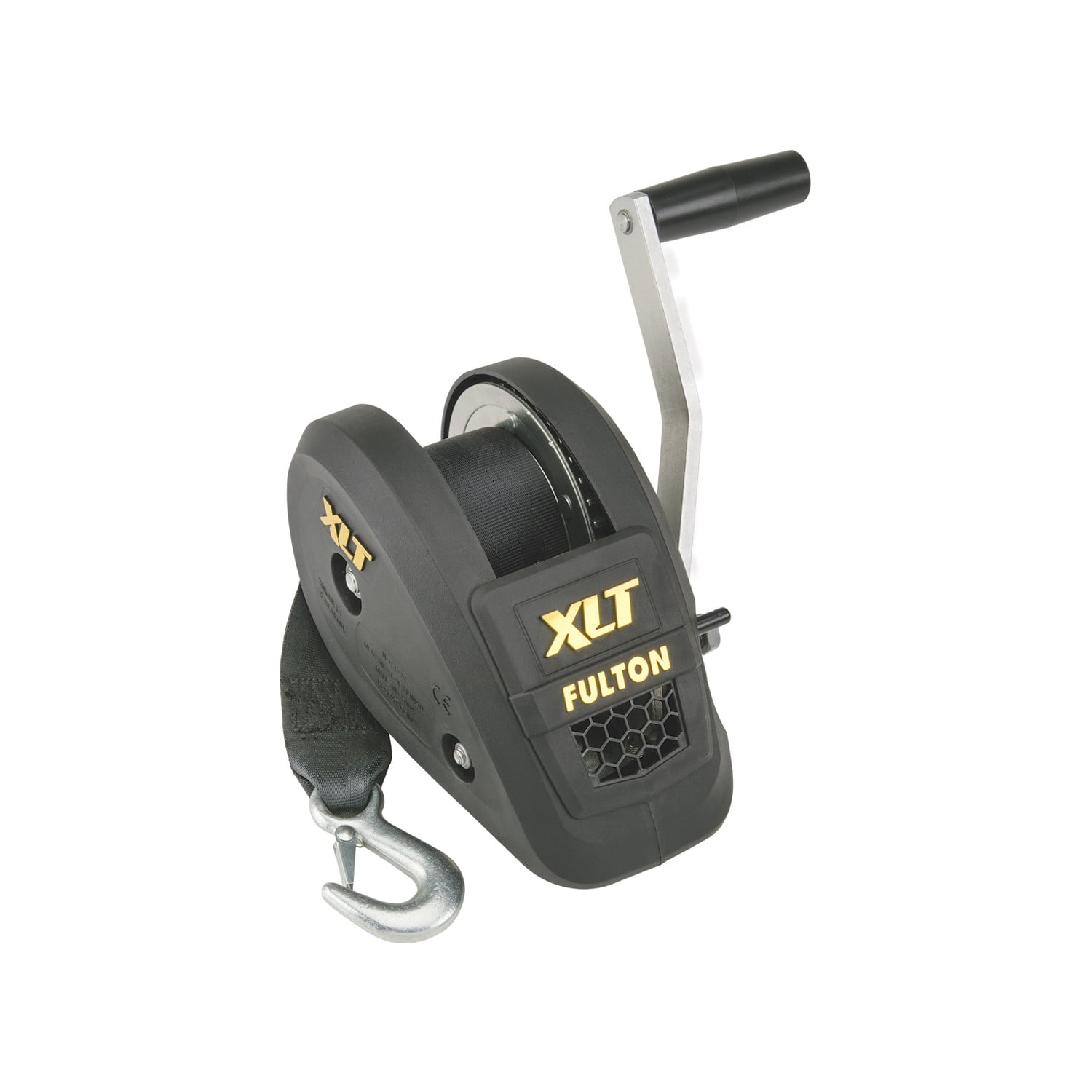
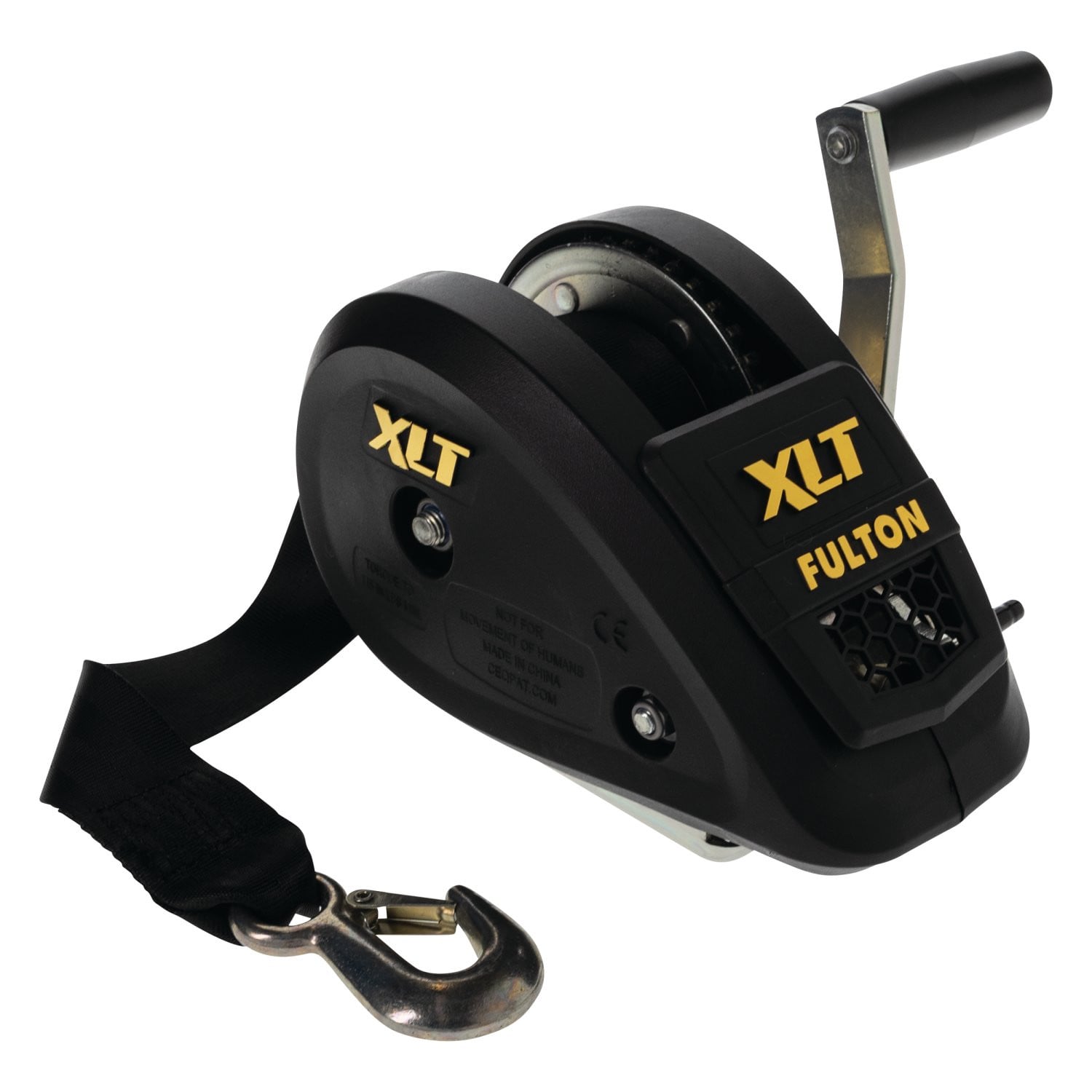
Fulton XLT Marine Trailer Winch, Single-Speed, 1,500 lbs. Capacity, 20 ft. StrapFulton$143.56Out of Stock
View productOur in-house experts typically reply within one business day.

Fulton



Always the correct part
We know our products
Quality Products
Free Shipping!
Always the correct part
We know our products
Quality Products
Free Shipping!

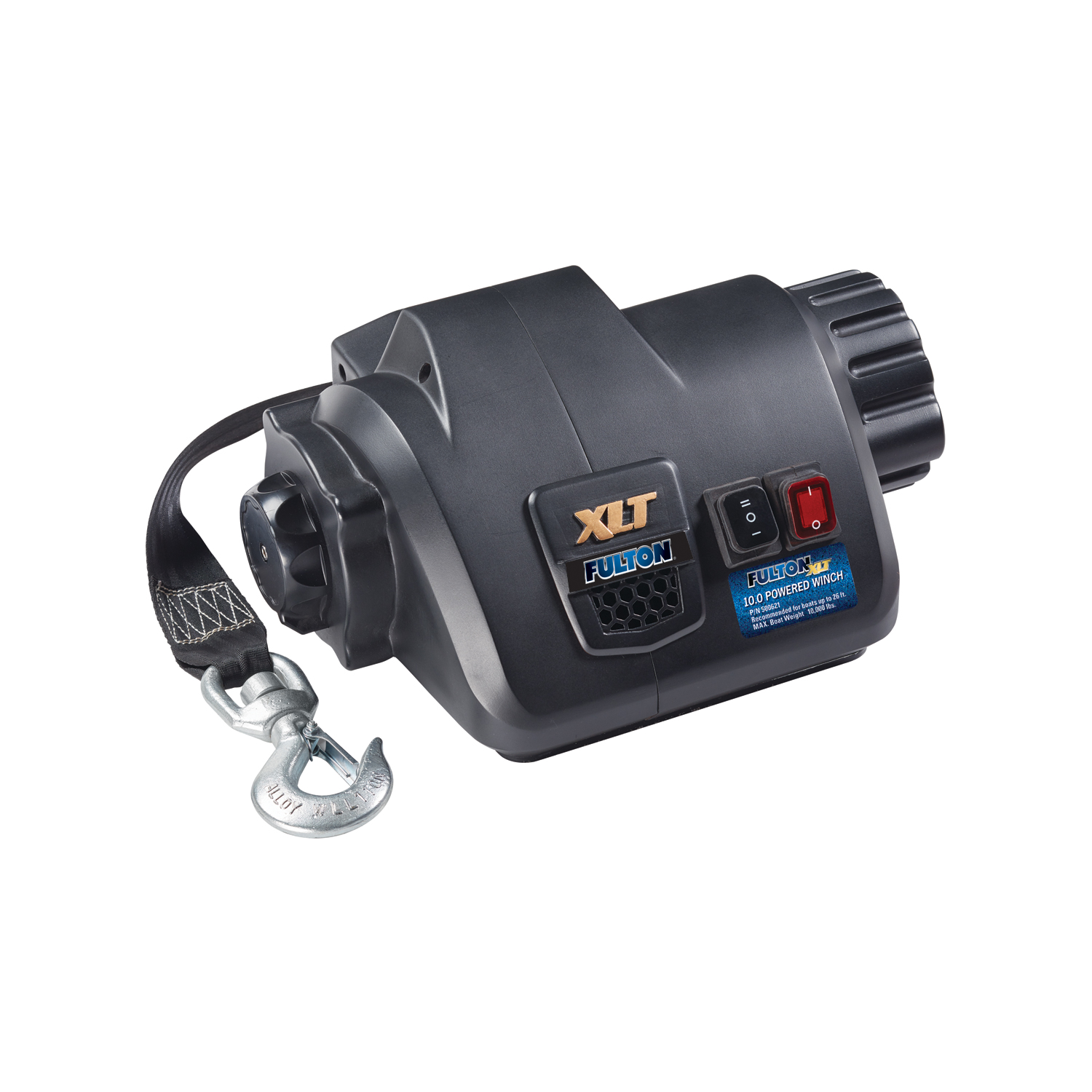
Put power were you need it most with the Fulton XLT Powered winch. Maximize you enjoyment of your boating experience by minimizing your efforts to load and unload your boat with the FULTON XLT Powered Winch
| BRAND: | FULTON |
| PART NUMBER: | 500621 |
| WARRANTY: | LIMITED 5 YEAR WARRANTY |
| WEIGHT: | 24.7 LBS |
| CAPACITY: | 10,000 LBS. |
| UNIVERSAL OR SPECIFIC FIT: | UNIVERSAL |
| TYPE: | Powered |
| CABLE LENGTH: | 26 FT. |
| REMOTE INCLUDED: | YES |
| REMOTE TYPE: | WIRELESS |
| VOLTAGE: | 12 V |
| BRAKE ACTIVATION: | ELECTRIC |
| RATED LINE PULL: | 10,000 LBS. |
| MATERIAL: | STEEL |
| FREE SPOOLING: | YES |
| POWER OUT: | YES |
| HARDWARE INCLUDED: | YES |
| HOUSING MATERIAL: | PLASTIC |
| FRAME MATERIAL: | STEEL |
| COLOR: | BLACK |
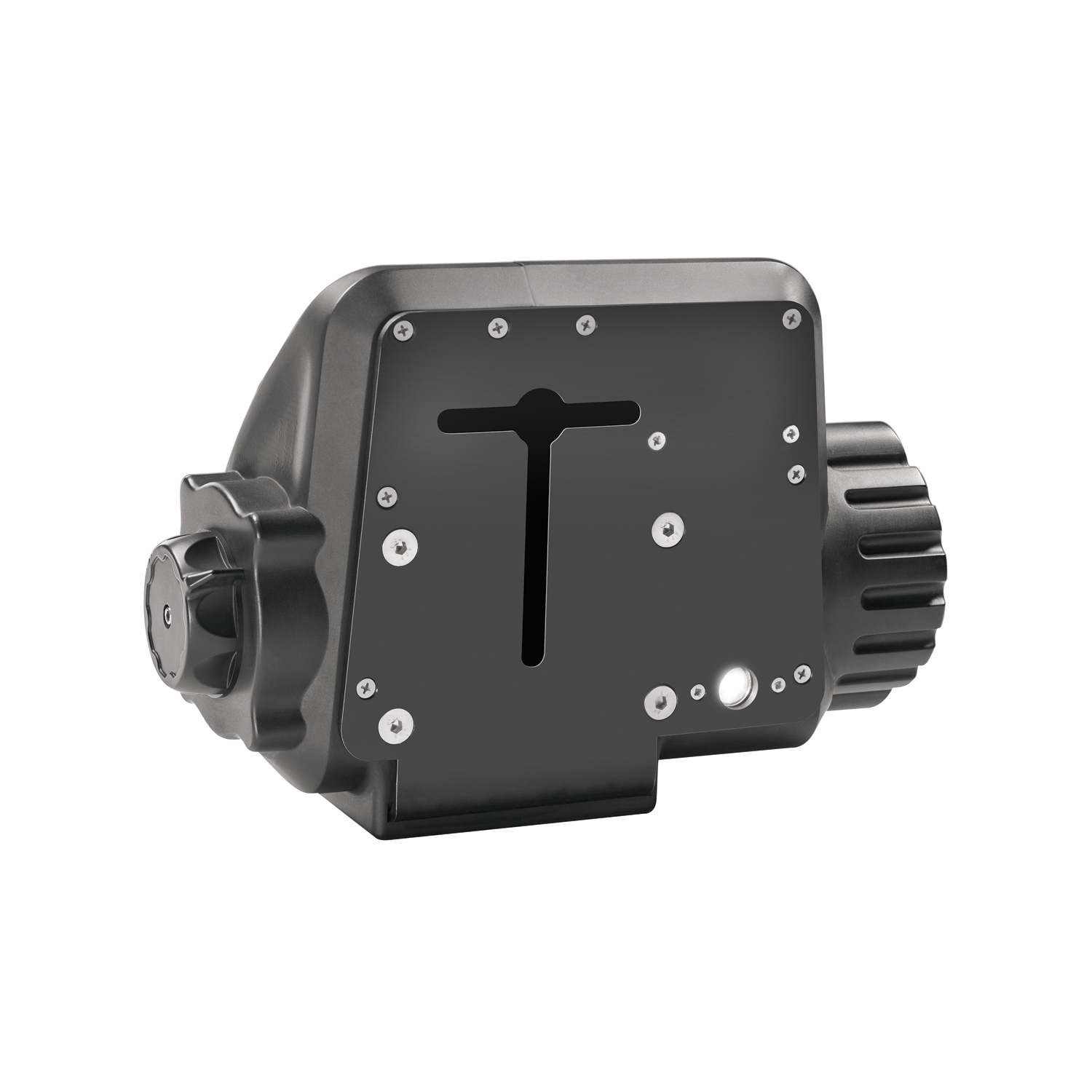
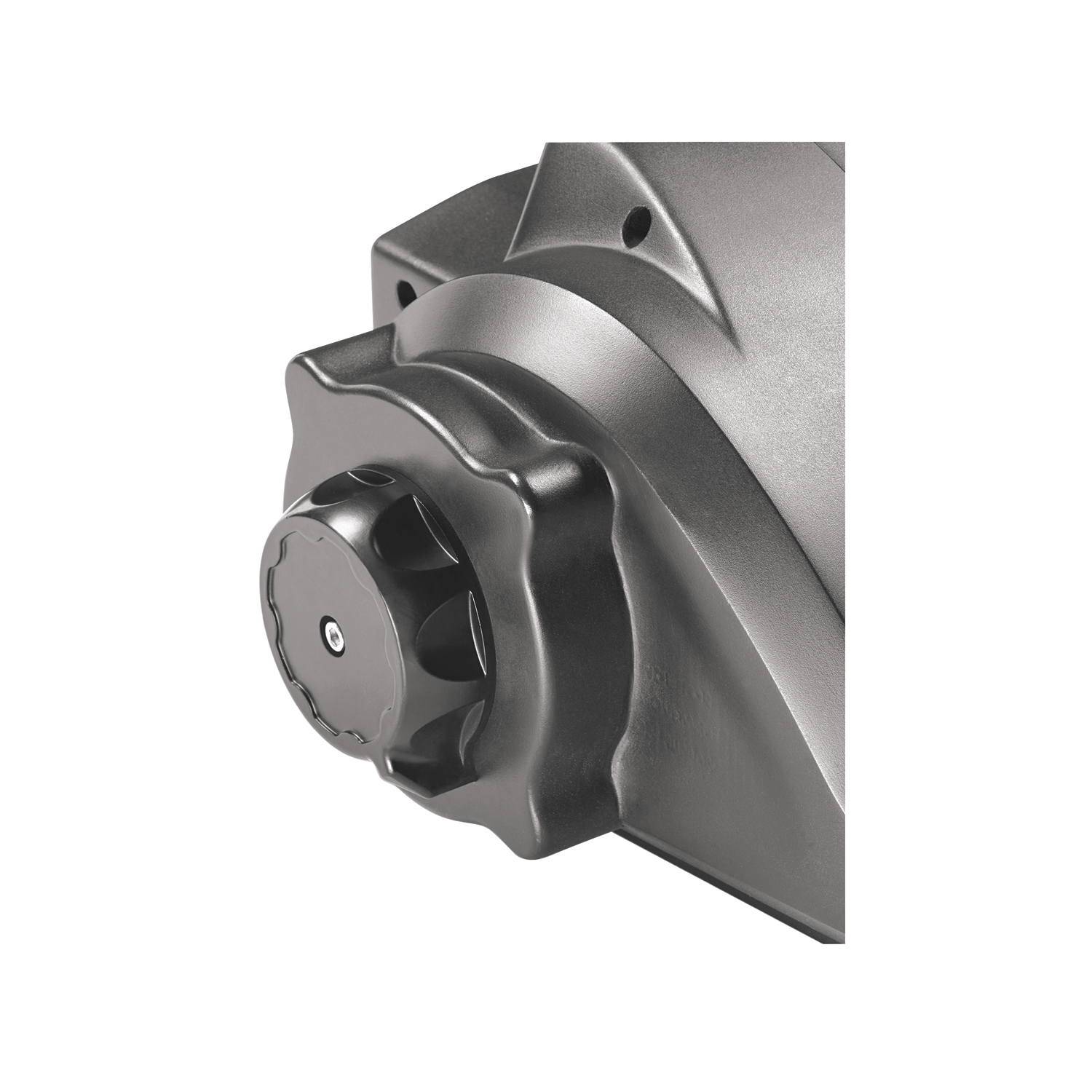
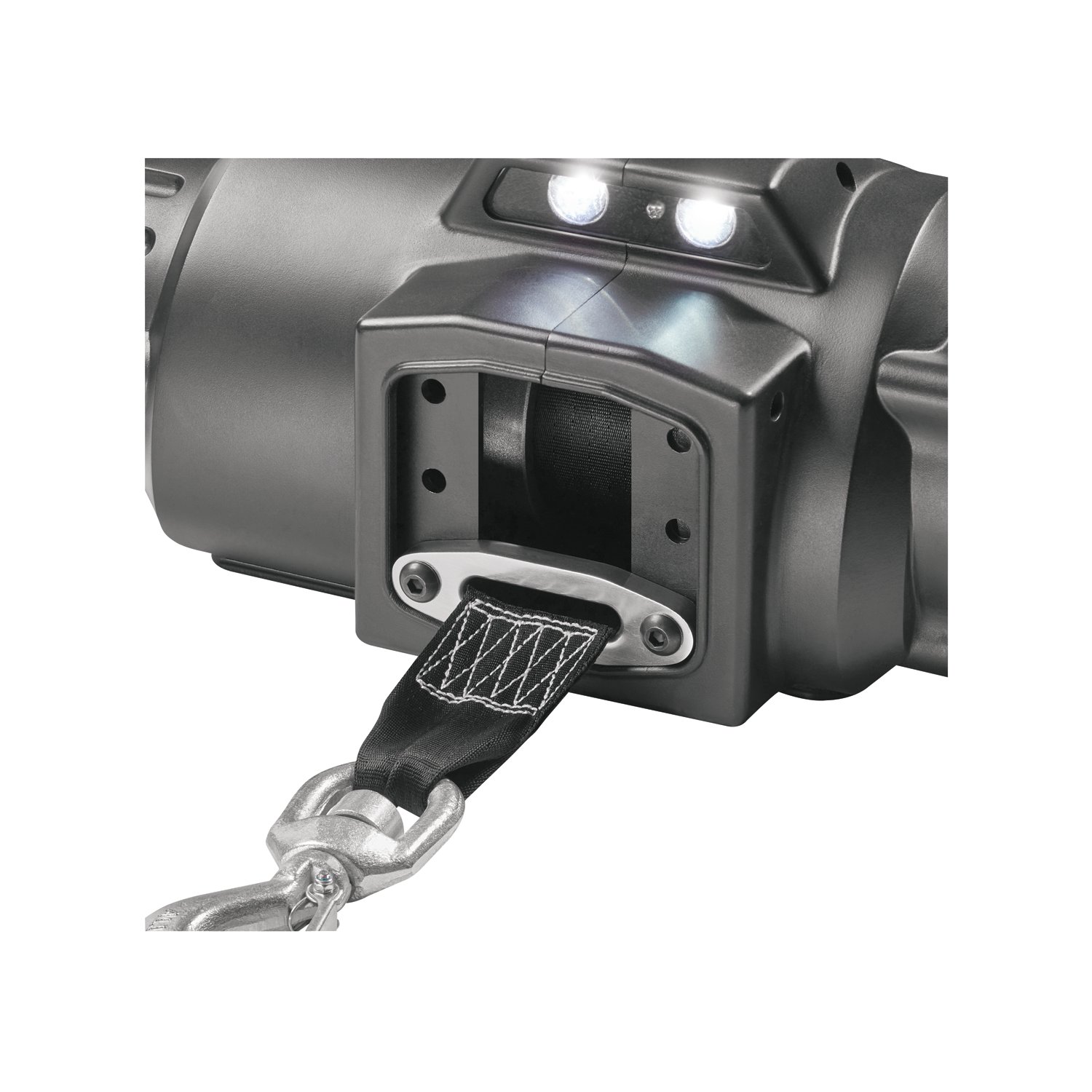
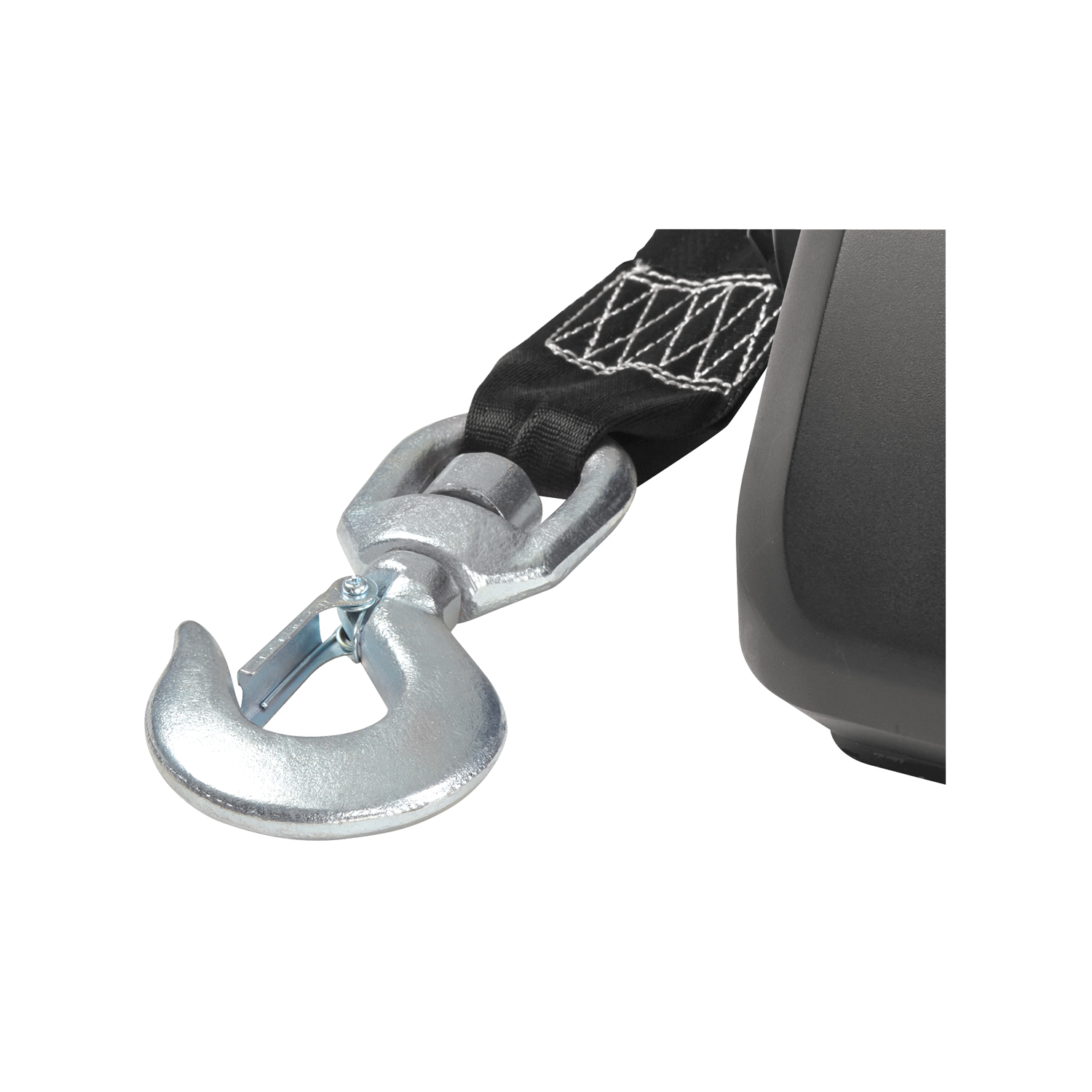

Fulton has produced marine and utility trailer hardware for more than a century, and its jacks, winches and couplers are a standard for light and medium-duty trailering. The XLT and F2 series cover swivel and fixed jacks, hand and powered winches from 1,500 to 3,200 pounds, and couplers built to keep working in wet, salty conditions.
With more than a hundred years of production behind it, Fulton has become the reference point for light and medium-duty trailer hardware, particularly on the marine side. That environment is the toughest test a trailer component faces. A boat trailer is reversed into fresh or salt water on every launch and left to sit wet, which finds every weakness in plating, sealing and material choice. Fulton's stated position is that the brand performs best when the weather is at its worst, and its product engineering reflects that. It sits within the Horizon Global towing group alongside Reese, Draw-Tite, Bulldog, Tekonsha and Wesbar.
Marine and utility jacks anchor the line. The XLT Series marine jack uses a bolt-through swivel mount built from three-dimensionally formed heavy-gauge steel stampings with a proprietary bushing material, a combination chosen to minimise deflection under tongue load while keeping the swivel action working after years of exposure. The F2 Series takes corrosion resistance further as the industry's only extruded aluminium marine jack with an anodised finish, which removes the rust problem at its source rather than coating over it. The wider trailer jack range covers topwind, sidewind and drop-leg configurations.
Trailer winches pull boats onto bunks and rollers. XLT Series winches use efficient gear ratios, full-length drum bearings, oil-impregnated shaft bushings and a Comfort Grip handle that makes the last few turns under load bearable, in 1,500 and 1,800 pound capacities. F2 Series winches use an enclosed frame for a cleaner look and added protection, in 1,600, 2,000 and 3,200 pound models, including two-speed options that trade line speed for cranking effort.
Couplers complete the range, including A-frame couplers matched to common tongue sizes and load ratings, serving boat owners, utility trailer users and trailer manufacturers.
Experts available to answer your questions
Call 888-634-94945 Years
The Fulton® XLT™ Powered Marine Winch: Show Your Boat Who's Boss
XLT 7.0 is part number 500620. XLT 10.0 is part number 500621.
The XLT 7.0 is rated for a maximum recommended boat weight of 7,000 lbs in marine applications. This rating applies to the first layer of strap on the drum. Capacity is reduced by approximately 10% with each additional layer added to the reel. Wooden and/or carpeted bunks will significantly reduce this capacity.
The XLT 10.0 is rated for a maximum recommended boat weight of 10,000 lbs in marine applications. This rating applies to the first layer of strap on the drum. Capacity is reduced by approximately 10% with each additional layer added to the reel. Wooden and/or carpeted bunks will significantly reduce this capacity.
Both the XLT 7.0 and XLT 10.0 require a 12V power source. The XLT 7.0 has a maximum amp draw of 160 amps, and the XLT 10.0 has a maximum amp draw of 200 amps.
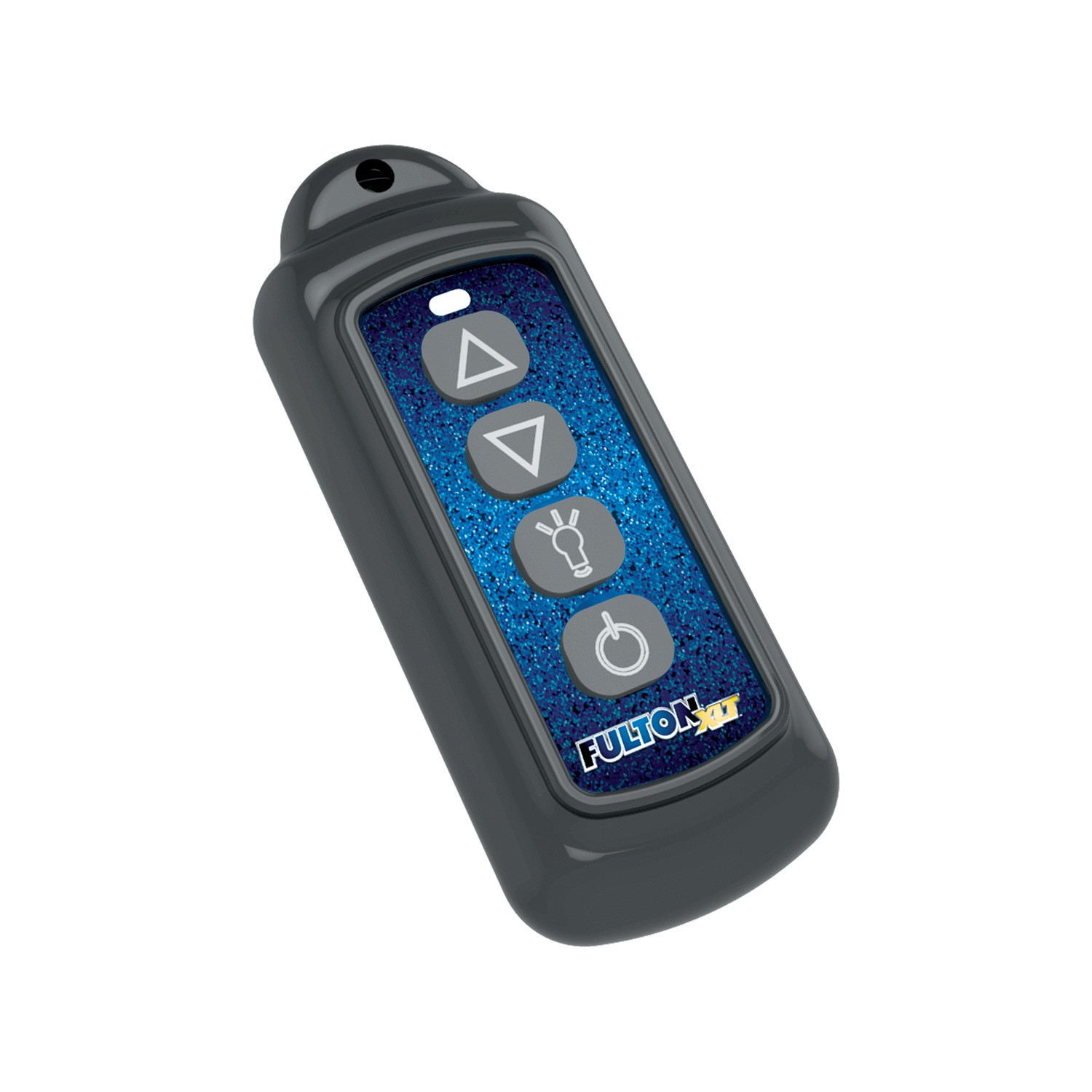
Yes, both the XLT 7.0 and XLT 10.0 come with a wireless remote control. The remote is pre-programmed and ready to use. It has an auto shutdown feature and a transmission range of 50 to 90 feet (15 to 27 m). The remote uses one 12V MN21/23 battery and operates on 2.4 GHz wireless transmission technology.
Both the XLT 7.0 and XLT 10.0 come with a 2" × 15' strap.
The following tools are required: adjustable wrench, 3/8" ratchet, 9/16" socket, and 9/16" combination wrench.
Both models require three 3/8"-16 Grade 5 carriage bolts, three 3/8" retaining washers, and three 3/8" NY-Lock nuts. Grade 5 (class 8.8 metric) hardware must be used. The mounting bolts must be torqued to 28-30 ft.-lbs. A minimum of two complete threads must protrude from the nut after tightening. The mounting system will dictate the bolt length, and you must confirm the required bolt length to ensure proper thread engagement.
The mounting surface must be equal to or greater than 4.5" × 6". The mounting surface must be sufficiently strong to withstand the maximum pulling capacity of the winch.
The fairlead should be a minimum of 6" away from the bow eye when the boat is fully loaded onto the trailer.
The strap must be wound from the bottom of the drum in an under-wound configuration only. Failure to install the strap in the correct under-wound condition may result in property damage, personal injury, or death.
The minimum requirement for the battery is 650 cold cranking amps. A fully charged battery and good connections are essential for proper operation of the winch.
Wire gauge depends on cable length: 5 feet = 7 gauge (10 mm²); 10 feet = 6 gauge (13 mm²); 15 feet = 4 gauge (21 mm²); 20 feet = 4 gauge (21 mm²); 25 feet = 2 gauge (34 mm²). Larger wire gauges are required for longer distances to help reduce voltage drop.
The voltage drop for the winch motor must not exceed 10% of the nominal voltage of 12V DC. This should be verified upon completion of installation during a system check.
Option 1: Secure the battery to the trailer and connect the positive and negative leads directly to the battery. This option requires the battery to be charged when not in use. Option 2: This option is ideal when a boat always uses the same tow vehicle. Route the power wire from the battery to the winch using the correct wire gauge for the distance, protect it from sharp edges and heat, secure it with zip ties, and use a quick connect plug to connect the winch. A short ground lead of the same gauge as the power lead must also be used. Professional installation is recommended for Option 2.
Route battery cables along a path that allows them to be secured with zip ties. Never route electrical cables over battery terminals, across sharp edges, near hot parts, or through moving parts. Avoid pinch and wear/abrasion points. Zip-ties should be snug but not cutting into wire insulation. Use electrical tape, rubber hose pieces, or electrical conduit to protect wires and harness where needed. All exposed wiring and electrical terminals must be insulated and protected. Loose or unsecured power cables can cause serious injury or death.
To prevent accidental activation of the winch and serious injury, complete the winch installation and attach the hook before installing the wiring and applying power.
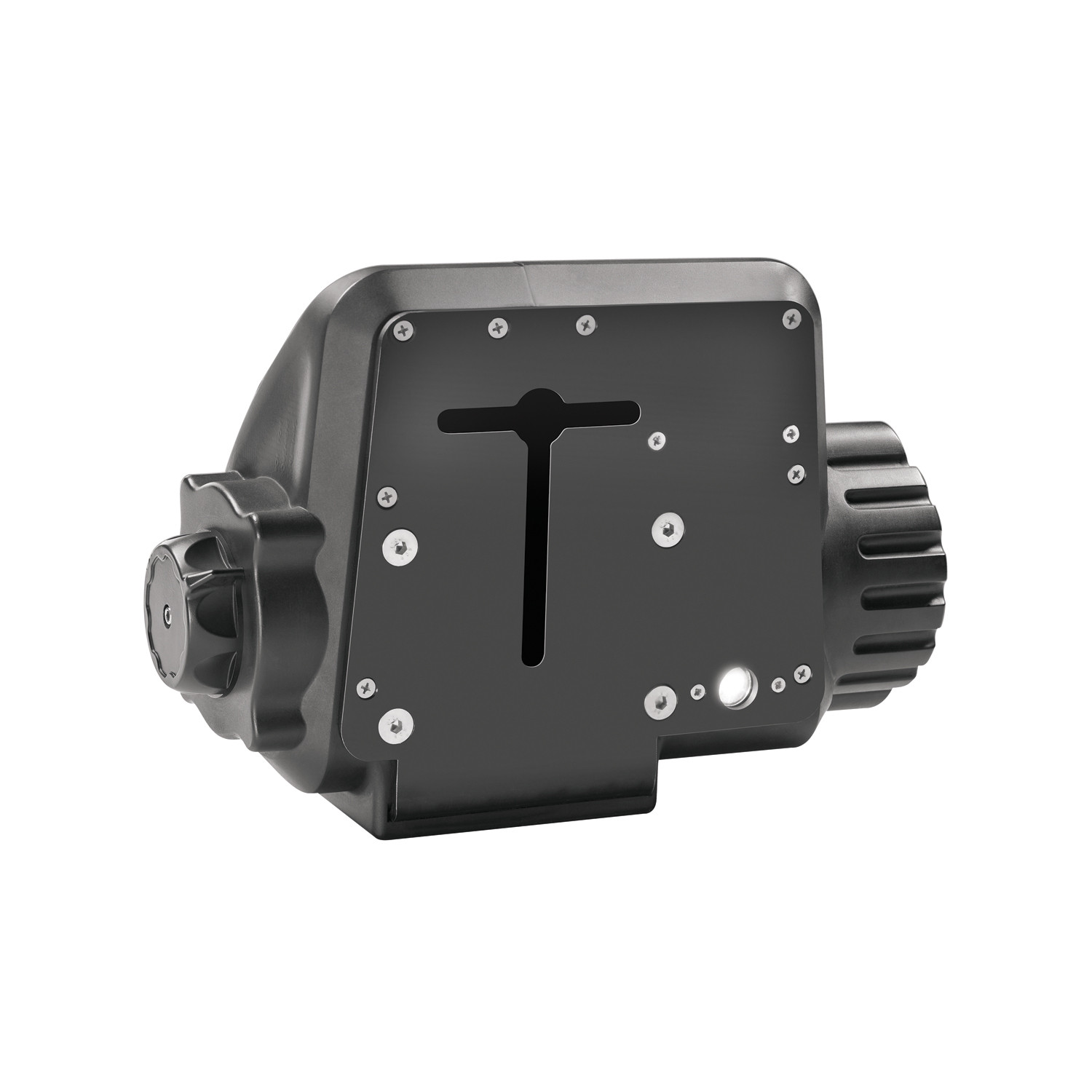
The Easy Install System uses a T-slot on the base of the winch. Place the three 3/8" Grade 5 carriage bolts with retaining washers into the T-slot on the winch base. Place the winch over the mounting plate and insert the bolts through the mounting holes in the mounting surface. Secure the flanged lock nuts to the mounting bolts and torque to 28-30 ft.-lbs. Ensure that a minimum of two complete threads show after tightening the flange lock nuts.
The Hawse Fairlead can reduce the contacting friction with the strap. An aluminum hawse fairlead is recommended because it has no sharp edges and resists wear damage more effectively than a roller fairlead. However, the fairlead does not ensure the strap will wind onto the drum in an orderly manner.
1. Ensure both winch cables are disconnected from the battery and the remote is turned off. 2. Connect the red terminal from the winch to the battery. 3. Press and hold the remote's ON/OFF button until the flashing blue LED light appears. 4. Simultaneously press and hold the LINE IN and LINE OUT buttons for 5 seconds without releasing. 5. While holding these buttons, connect the black terminal to the battery. 6. Release the LINE IN and LINE OUT buttons. 7. Wait for the remote's blue LED light to remain steady. 8. Test the remote. If the light remains blinking or the remote does not operate, follow the troubleshooting guide in Table 4.
The winch mounting bolts must be torqued to 28-30 ft.-lbs for both the XLT 7.0 and XLT 10.0.
Always remove jewelry and wear ear and eye protection. Always use leather gloves when handling the strap and hook.
No. Never use the winch as a lifting device or hoist for vertical lift. Never use the winch to lift, support or otherwise transport humans. Winches are not designed for these purposes.
No. Never use winch rope or strap for towing. The winch strap is designed only for winching loads onto the trailer.
No. Never use the winch to secure the load or to secure a boat to a trailer. Always secure the boat with a separate safety chain or tie down, not the winch.
If the motor stalls, allow it to cool for 15 minutes to reduce the chance of motor burnout. Never overload the motor to stall.
Both winches are rated for intermittent duty cycle: 1 minute of operation, followed by a 14-minute cool-down period. Do not exceed the recommended operational time for the winch. When the motor approaches stall speed, very rapid heat buildup occurs which may cause motor damage.
Immediately stop the winch if it begins to slow down excessively and/or if it feels like it is struggling to reel in. This is a sign that the rated capacity has been exceeded, and rapid buildup of excessive heat will occur, which can cause motor damage.
Pull from an angle of less than 5° laterally to avoid the strap from piling onto one side of the drum. Always avoid side pulls, which can pile up winch rope or strap at one end of the drum and damage the winch strap or winch.
The operator should always operate the winch from a safe position when pulling a load. The safest area is perpendicular to the winch strap. This safe position will help prevent the strap from striking the operator if the strap fails when under load. Never work around the winch strap while it is under load, and never step over a winch strap while it is under load.
No. Never engage or disengage the clutch if the winch is under load, the winch strap is in tension, or the drum is moving. Always fully engage or fully disengage the clutch knob to prevent damage.
No. Never submerge the winch in water.
Always inspect the winch strap and hook for damage or wear before operating the winch. Frayed, kinked or damaged winch strap must be replaced immediately. Damaged components must be replaced before operation. Always use a hook with a latch and ensure the hook latch is closed and supporting the load. Never use a hook whose throat opening has increased, or whose tip is bent or twisted.
Frayed, kinked or damaged winch strap must be replaced immediately. Discontinue use of the winch until the strap is replaced.
Before first use: read, understand, and follow all warnings and instructions in the manual; check all fasteners and verify they are at proper torque, replacing as necessary; check that wiring is correct and connections are tight; check that there are no damaged (chafed, cut, etc.), bare or exposed wires or terminals, repairing or replacing any components as necessary; check the condition of the strap and hook, discontinuing use and replacing immediately if damaged or worn.
After every use: check all fasteners and verify they are at proper torque, replacing as necessary; check that wiring is correct and connections are tight; check that there are no damaged (chafed, cut, etc.), bare or exposed wires or terminals, repairing or replacing any components as necessary; check the condition of the strap and hook, discontinuing use and replacing immediately if damaged or worn; keep winch, strap, and switch controls free from contaminants by using a clean rag or towel to remove dirt and debris.
Every 90 days: check all fasteners and verify they are at proper torque, replacing as necessary; check that wiring is correct and connections are tight; check that there are no damaged (chafed, cut, etc.), bare or exposed wires or terminals, repairing or replacing any components as necessary; check the condition of the strap and hook, discontinuing use and replacing immediately if damaged or worn.
1. Disengage the clutch knob. 2. Un-spool the entire strap. 3. Remove the clutch knob and side cover. 4. Remove the two bolts from the split collar. 5. Remove the split collar. 6. Remove the worn strap and the strap retaining pin. 7. Insert the new strap through the Hawse fairlead and insert the strap retaining pin through the strap loop. 8. Insert the strap retaining pin and strap into the groove on the winch drum. 9. Replace the split ring collar and torque bolts to 24 ft.-lbs. 10. Replace the side cover. 11. Replace the clutch knob and torque to 12 ft.-lbs. 12. Wind strap onto drum by pushing and holding the LINE IN button until the strap is spooled onto the drum. Keep tension on the strap while it is winding. Ensure that the strap is under-wound.
When replacing the split ring collar during strap replacement, torque the bolts to 24 ft.-lbs.
When replacing the clutch knob during strap replacement, torque it to 12 ft.-lbs.
All moving parts in the winch are permanently lubricated at the time of assembly. Under normal conditions, factory lubrication will suffice. If re-lubrication of the gearbox is necessary after repair or disassembly, use Shell EP2 or equivalent grease. Never lubricate the brake system.
The remote transmitter and receiver are paired and cannot be interchanged. If a wireless remote (transmitter) is lost, a new one can pair itself to an existing receiver using the pairing method described on page E10 (or F10 for French manual). If the red LED is blinking, the remote needs to be paired again.
Periodically check mounting hardware for proper torque and tighten if necessary. The maintenance checklist specifies checking all fasteners after every use and every 90 days.
After use, wash the winch externally with mild soap and water. Dry completely before storing.
XLT 7.0 rated first layer capacity: Pull = 2,500 lbs (not to be used as hoist); Roll = see Table 6 (varies by ramp inclination from 0° to 20°); Marine = 7,000 lbs (when trailer is equipped with rollers and on a maximum incline of 20 degrees; wooden and/or carpeted bunks will significantly reduce this capacity).
XLT 10.0 rated first layer capacity: Pull = 3,500 lbs (not to be used as hoist); Roll = see Table 6 (varies by ramp inclination from 0° to 20°); Marine = 10,000 lbs (when trailer is equipped with rollers and on a maximum incline of 20 degrees; wooden and/or carpeted bunks will significantly reduce this capacity).
The XLT 7.0 rolling load capacity varies by ramp inclination: 0° = 25,000 lbs; 3° = 20,000 lbs; 5° = 15,000 lbs; 10° = 10,000 lbs; 15° = 8,500 lbs; 20° = 7,000 lbs. All capacities shown are with 2 feet of strap on the reel and 10% rolling friction factor.
The XLT 10.0 rolling load capacity varies by ramp inclination: 0° = 35,000 lbs; 3° = 30,000 lbs; 5° = 25,000 lbs; 10° = 20,000 lbs; 15° = 15,000 lbs; 20° = 10,000 lbs. All capacities shown are with 2 feet of strap on the reel and 10% rolling friction factor.
The winch's capacity will be reduced by approximately 10% with each layer added to the reel. This is because as the boat gets closer to the bow stand, the strap will build up to a larger diameter on the drum, reducing the efficiency of the winch.
Wooden and/or carpeted bunks will significantly reduce the winch's capacity compared to roller-equipped trailers. The marine capacity ratings assume the trailer is equipped with rollers.
The wireless remote has a transmission range of 50 to 90 feet (15 to 27 m).
The wireless remote operating temperature range is -20°C to +70°C.
The wireless remote uses one 12V MN21/23 battery.
The wireless remote uses 2.4 GHz wireless transmission technology.
The wireless remote has four buttons: 1. The bottom button turns the wireless remote control and indicator light ON or OFF (press and hold). 2. The second button turns the winch lights ON or OFF. 3. The top two buttons power the winch line IN and OUT.
When the remote is turned on, it will search for a signal for 1 to 3 seconds. If a signal is found, the blue light will stay on. If the winch is not powered up or you are out of range, the blue light will blink regularly.
Turn the clutch knob to the free-spool position. The strap can now free-spool off the drum.
Turn the clutch knob to the engaged position. Never engage the clutch while the drum is rotating.
If you power out over 25 feet, let the winch cool for 15 minutes. The power-out function drives the winch motor against the brake, which is similar to driving your vehicle with the parking brake engaged. Do not use the power-out function for lowering a load; instead, use the free-spool function to pay out strap.
No. Do not shock load the winch when spooling. Avoid shock loads when spooling by pulsing the control switch to take up winch strap slack. Shock loads can momentarily far exceed the winch and strap ratings and cause damage.
Power-in the winch strap evenly and tightly on the drum. Never exceed the winch's rated line pull.
No. Never operate the winch in a stop-and-go fashion, especially when under load. Not following this instruction may lead to premature wear or damage to the winch.
Never apply load to the hook tip or latch. Apply load only to the center of the hook.
Never use a hook whose throat opening has increased, or whose tip is bent or twisted. Damaged hooks must be replaced immediately before operation.
Never let the winch strap slip through your hands. Always wear leather gloves when handling the strap and hook.
Never touch a winch strap or hook when someone else is at the controls. Never touch the winch strap or hook while under tension or under load.
No. Never wrap the winch strap back onto itself.
No. Never use excessive effort to free-spool the winch strap.
No. The operator and bystanders should never position any part of their body under any portion of the winch or the load being supported.
No. Never allow children to play on or around the winch or the load being supported.
No. Never operate the winch when under the influence of drugs, alcohol, or medication.
Yes. Always be aware of possible hot surfaces at the winch motor or drum during or after winch use.
Yes. Always keep others away while winching. Always ensure the operator and bystanders are aware of the stability of the vehicle and load.
Yes. Always remove jewelry and wear ear and eye protection when operating the winch.
Yes. Always ensure that the clutch is fully engaged before pulling.
Yes. Always be certain that the winch stand can withstand the load.
Yes. Always remove any element or obstacle that may interfere with safe winch operation.
Yes, the XLT 7.0 is rated for a maximum recommended boat weight of 7,000 lbs in marine applications (first layer capacity). Capacity reduces by approximately 10% with each additional layer of strap on the drum, and wooden or carpeted bunks significantly reduce capacity.
Yes, the XLT 10.0 is rated for a maximum recommended boat weight of 10,000 lbs in marine applications (first layer capacity). Capacity reduces by approximately 10% with each additional layer of strap on the drum, and wooden or carpeted bunks significantly reduce capacity.
You need an adjustable wrench, 3/8" ratchet, 9/16" socket, and 9/16" combination wrench.
The manual does not specify whether drilling is required. Installation depends on your mounting surface and the Easy Install System using a T-slot on the winch base with three 3/8" Grade 5 carriage bolts. Consult your specific trailer or mounting surface documentation.
Torque mounting bolts to 28-30 ft.-lbs for both models. Use three 3/8"-16 Grade 5 carriage bolts with retaining washers and NY-Lock nuts. Ensure a minimum of two complete threads protrude from the nut.
No. Never use the winch as a lifting device, hoist for vertical lift, or to lift, support or transport humans. Never use the winch strap for towing or to secure a boat to a trailer.
Check all fasteners are at proper torque; verify wiring is correct and connections are tight; inspect for damaged, bare or exposed wires or terminals; check strap and hook for damage or wear. Replace any damaged components before operation.
The remote is searching for a signal from the winch and has not successfully paired. Disconnect the black terminal from the battery and repeat the pairing steps 3-7: Connect the red terminal to the battery, press and hold the remote's ON/OFF button until the flashing blue LED appears, simultaneously press and hold LINE IN and LINE OUT buttons for 5 seconds, while holding these buttons connect the black terminal to the battery, release the buttons, and wait for the blue light to remain steady.
The remote has successfully paired but is not responding. Turn the remote off, wait 30 seconds and turn it back on, then test the remote. If it still does not work, disconnect the black terminal from the battery, turn off the remote, and repeat the pairing steps 2-7.
The remote battery is dead. Remove the remote's cover, inspect the battery, and replace it if necessary. The remote uses one 12V MN21/23 battery.
The remote needs to be paired again. Follow the pairing procedure: ensure both winch cables are disconnected from the battery and the remote is turned off, connect the red terminal from the winch to the battery, press and hold the remote's ON/OFF button until the flashing blue LED appears, simultaneously press and hold LINE IN and LINE OUT buttons for 5 seconds, while holding these buttons connect the black terminal to the battery, release the buttons, and wait for the blue light to remain steady.
On Sale Today
Original price was $607.50. Current price is $598.26.You save $9.24
Free Shipping
Ships free on all orders
 Authorized Dealer
Ann
The staff was able to quickly assist me with locating the correct product I needed. Shipping was really fast. Item arrived in 2 days. Will be using TowUniverse again!!
May 22, 2023



FREE ShippingFREE SHIPPING
Estimated delivery Sat, Oct 17 - Tue, Oct 20
Order before 2 PM EST Monday–Friday for same-day processing
Guaranteed safe & secure checkout