CURT 16150 Industry-Standard 5th Wheel Hitch Rails and 4-Bolt Brackets, Gloss Black, 25,000 PoundsCURTOriginal price was $285.95. Current price is $179.99.In Stock
View productOur in-house experts typically reply within one business day.

CURT
On Sale Today
Original price was $254.95. Current price is $179.95.These rails fit any truck, but the mounting brackets that bolt them to your frame are vehicle-specific. Select your vehicle to find the custom-fit bracket kit for an easy, no-drill installation.



Always the correct part
We know our products
Quality Products
Free Shipping!
Always the correct part
We know our products
Quality Products
Free Shipping!
Includes mounting bolts, two base rails and four universal brackets #16101

Includes mounting bolts, two base rails and four universal brackets #16101
Warranty: Limited Lifetime Warranty (One-Year Finish, One-Year Parts)
Finish: CARBIDE BLACK POWDER COAT
Installation Time Exact (Minutes): 0
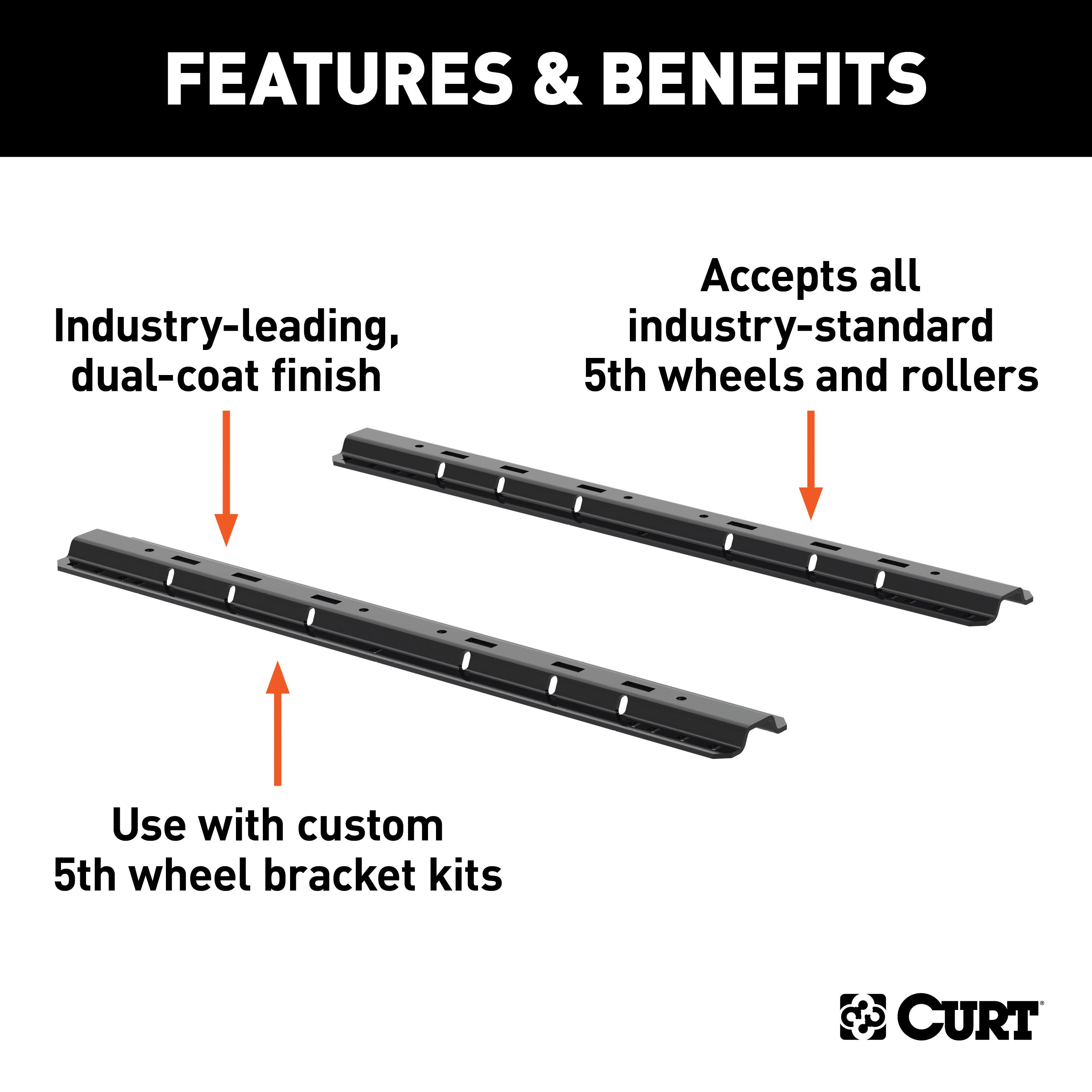
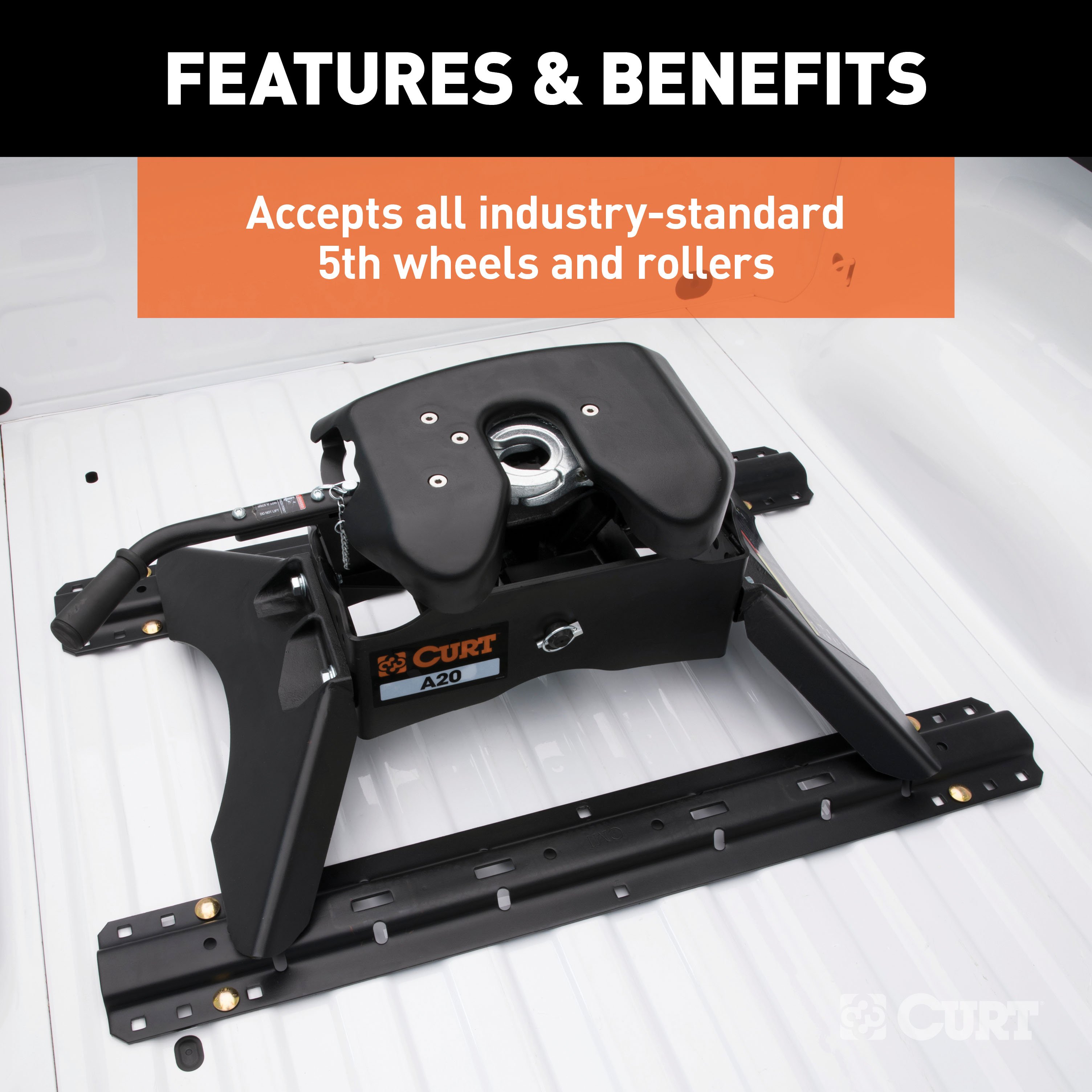
CURT 5th wheel base rails are industry-standard, meaning they can be used with any 5th wheel trailer hitch with industry-standard anchoring points. They are compatible with virtually all CURT 5th wheel trailer hitches and many competitors. Installation of CURT universal 5th wheel base rails is quick and simple. They mount with high-strength hardware, providing a solid mounting place for a new 5th wheel hitch. 5th wheel base rail bolts and other hardware can also be purchased separately to aid in reinstalling used rails. To protect our 5th wheel base rails from corrosion, scratches and UV damage, we coat each one in a co-cured finish of A-coat and powder coat. This gives them the tough skin they need for hauling that RV trailer, flatbed or other heavy-duty trailer and gives you the confidence to tow wherever the horizon leads. This set of 5th wheel rails is rated for 25,000 pound gross trailer weight and has a carbide black finish. Knowing that your 5th wheel trailer hitch is properly mounted in your truck bed is vitally important to the success of your towing. Without a firm attachment point, a 5th wheel hitch is rendered useless to your tow vehicle. When you choose a 5th wheel hitch for your pickup, install it with confidence with a CURT 5th wheel bracket kit and a set of CURT 5th wheel base rails.

CURT offers a variety of high-quality trailer hitches and accessories for select vehicle models. Find the perfect fit for your towing needs at TowUniverse.
CURT, a Lippert brand, offers a complete line of towing products and is the leading manufacturer of custom-fit trailer hitches. We offer the broadest selection of custom-fit hitches, and each one is designed, welded, and coated in Wisconsin.
CURT is also a leader in flat towing products, as well as 5th wheel, gooseneck, and weight distribution hitches, ball mounts, electrical components, cargo solutions, and other towing accessories.
For everything from passenger cars and vans to full-size pickups and SUVs, CURT is 'The First Name in Towing Products®.'
Experts available to answer your questions
Call 888-634-9494Rediscover "Us" Time | Tested. Proven. Safe. Towing Products
The CURT 16100 and 16200 base rails fit Chevrolet, GMC, Ford, Dodge, and Toyota trucks. Specific fitment depends on your truck model year and configuration. Check the vehicle-specific installation pages in the manual for your exact truck (Silverado, Sierra, F-150, F-250, F-350, Ram, Dakota, or Tundra). Some vehicles require custom bracket kits sold separately (#16300, #16301, #16302, #16303, #16304, #16305).
You will need: torque wrench, socket set, drill, 3/16" drill bit, 7/32" drill bit, 17/32" drill bit, 3/4" wrench, 3/4" socket, C-clamps, and fish wire (provided). Some Dodge applications also require a 1" drill bit. The installation is rated as moderate difficulty.
Yes. Raise the rear of the truck high enough to allow jack stands to be placed under the rear spring hanger bracket. This provides maximum space to install the 5th wheel brackets. Ensure the truck is properly blocked and restrained to prevent it from falling.
Yes. You must drill 10 holes in the truck bed and frame. Drill all holes first with a 3/16" drill bit, then enlarge them with a 17/32" drill bit. For some Dodge applications, you will also drill with a 1" drill bit. Always check for obstructions (fuel lines, brake lines, structural members) before drilling.
Torque all 1/2" nuts to 110 lb-ft (not the general 106 lb-ft specification). For other bolt sizes: 1/4" = 122 in-lbs, 5/16" = 251 in-lbs, 3/8" = 37 ft-lbs, 7/16" = 59 ft-lbs. Do not lubricate bolt threads, as this may cause bolt failure.
For long bed trucks, the center of the hitch should be at least 52" from the back of the cab to prevent the trailer from hitting the cab when turned 90°. The actual distance depends on trailer width and king pin location. Short bed trucks (38" minimum from back of cab to axle center line) require a minimum 13" extended pin box for regular maneuvers; the 52" rule does not apply.
No. Plastic bed liners must be cut out of the way. Base rails may be installed on a spray liner, but you should consult an installer for curing times.
Some vehicles require custom bracket kits sold separately. Toyota Tundra standard cab 00-06 requires #16302 spacer kit. Ford F-150 04-14 requires #16300 bracket kit. Dodge 2500/3500 with overload springs 03-12 requires #16301. Dodge 1500/2500 without overload springs 02-08 requires #16303. Dodge Ram 1500 09-10 and 11-18 requires #16305. Toyota Tundra 07-08 requires #16304 add-on kit with #16100 universal kit.
The 16100 is gloss black and the 16200 is carbide black. Both use the same installation procedure and hardware. The choice is based on your preferred finish color.
Yes. The CURT 16100 and 16200 fit Chevrolet Silverado and GMC Sierra 1500, 2500, and 3500 models from 2011 and newer. The hitch center should be positioned 30-3/8" from the rear edge of the truck bed for long box or 25-1/2" for short box. The king pin is centered over the axle.
Yes, but you must purchase the separate #16300 bracket kit. The hitch center should be positioned 29-5/16" from the rear edge of the truck bed for both long and short boxes. The king pin is approximately 1-1/2" forward of the axle center. Installation requires removing the jounce block from the bottom of the frame on both sides.
Yes, but fitment depends on model year and suspension type. Dodge Ram 1500 02-08 and 2500 03-12 without overload brackets fit the standard kit. Dodge 2500/3500 03-12 with overload springs require #16301 bracket kit. Dodge 1500/2500 02-08 without overload springs require #16303 custom bracket kit. Dodge Ram 1500 09-10 and 11-18 without factory air suspension require #16305 custom bracket kit. Dodge 1500 94-01 and 2500/3500 94-02 fit the standard kit.
Yes, but fitment depends on model year and bed length. Toyota Tundra standard cab 00-06 (long box only) fits the standard kit and requires #16302 spacer kit. Toyota Tundra 07-08 (excluding CrewMax, 6.5' and 8' beds) requires #16304 add-on kit with #16100 universal kit. The #16302 spacer kit requires stacking one 3/16" and one 5/16" slotted spacer to avoid crushing the truck bed.
1. Raise the rear of the truck on jack stands under the rear spring hanger bracket. 2. Center the hitch between the fender wells and square the base rails by adjusting until diagonal measurements are equal. 3. Drill 10 holes: first with 3/16" bit, then enlarge with 17/32" bit. 4. Insert 1/2" - 13 x 2" carriage bolts and U-shaped spacers, then install mounting brackets and secure with washers and nuts, torquing to 110 lb-ft. 5. Drill two holes in the frame for each bracket and install eight 1/2" - 13 x 1-1/2" ribbed neck bolts with washers and nuts, torquing to 110 lb-ft.
Center the hitch between the fender wells. Measure diagonally from the same reference point on both sides. Adjust the position of the rails until both diagonal measurements are the same. This ensures smooth operation of 5th wheel roller units. For most applications, measure from the rear edge of the truck bed to the rear edge of the mounting rail closest to the rear edge of the truck. Specific distances vary by vehicle model and bed length (see vehicle-specific pages).
You need three drill bit sizes: 3/16" (initial drilling), 17/32" (enlarging holes in frame and bed), and 7/32" (for some applications). Some Dodge applications also require a 1" drill bit to open up holes through the truck bed only. Always drill with the smaller bit first, then enlarge with the larger bit.
The 17/32" drill bit is critical for drilling holes in the chassis frame. If too small a hole is drilled, the ribbed neck bolts may break. If too large a hole is drilled, the ribbed neck bolts may not grip properly. Always use the correct 17/32" bit size to ensure proper bolt function.
The kit includes: 2 base rails, 1 long mounting bracket right, 1 short mounting bracket right, 1 short mounting bracket left, 1 long mounting bracket left, 10 U-shaped spacers (5/16"), 8 ribbed neck bolts (1/2" - 13 x 1-1/2"), 10 carriage bolts (1/2" - 13 x 2"), 18 lock washers (1/2"), 18 hex nuts (1/2" - 13), 10 flat washers (1/2"), 2 round hole spacers (1/2" x 1-1/4" x 2-1/2"), 2 carriage bolts (1/2" - 13 x 4-1/2"), 2 round tube spacers (1" OD x 14 GA, A-513), and 1 fish wire. All hardware is grade 8 unless otherwise specified.
U-shaped spacers (5/16") are placed above or below the truck bed to fill corrugations in the bed floor. This ensures proper seating of the carriage bolts and prevents the bolts from crushing the bed. For Toyota Tundra applications, you may need to stack one 3/16" and one 5/16" U-shaped spacer to avoid crushing the truck bed.
The fish wire is used to pull ribbed neck bolts through the frame when direct access is not available. Insert the fish wire through the frame hole, attach it to the bolt, and pull the bolt through from the opposite side. This is particularly useful on vehicles where the frame brackets are mounted in locations that are difficult to access from inside the frame.
No. Do not lubricate bolt threads. Lubrication may cause bolt failure. Tighten all nuts dry.
Torque all 1/2" nuts to 110 lb-ft. This applies to both the carriage bolts through the mounting brackets and bed (Step 4) and the ribbed neck bolts through the frame (Step 5). Do not use the general 1/2" specification of 106 lb-ft; use 110 lb-ft instead.
Install the long mounting brackets (#2, #5) on the front bolts and short mounting brackets (#3, #4) on the rear bolts. Note that long and short brackets can be interchanged as needed for your specific vehicle. Secure the carriage bolts through the mounting brackets with flat washers, lock washers, and hex nuts. Torque all nuts to 110 lb-ft.
Each frame bracket must be secured with two bolts unless optional weld is used. Each base rail must have a bolt in either of the marked holes (identified by black dots on the installation diagram). Select the holes that will give the largest spread between bolts.
Yes. Do not drill in the approximately 4" between parallel rows of bed sill spot welds where the bed sill sits. Always check for obstructions before drilling, including fuel lines, brake lines, and structural members. On some vehicles, you must avoid drilling through both walls of the frame; drill only through the wall to which the bracket is mounted.
If the truck is raised, ensure it is properly blocked and restrained to prevent it from falling. Failure to do so may result in the truck falling suddenly, causing death or serious injury. Use jack stands under the rear spring hanger bracket to provide the maximum amount of space to install the 5th wheel brackets.
Before drilling, check for obstructions that could be damaged, including fuel lines, brake lines, and structural members. Failure to check could result in damaged fuel or brake lines, structural members, or other vehicle components. The manual emphasizes that it is ultimately the responsibility of the installer to prevent damage due to installation.
Yes. The CURT 16100 and 16200 fit Chevrolet Silverado Classic and GMC Sierra Classic 1988-1998, including 1992-1998 4-door models and 1999 models with tapered frame and red turn signals. The hitch center should be positioned 30-15/16" from the rear edge of the truck bed for long box or 26-3/16" for short box. The king pin is approximately 1-1/2" forward of the axle center.
Yes. The CURT 16100 and 16200 fit Chevrolet Silverado and GMC Sierra 1999 (excluding Sierra Classic) and 2000-2010 models, including HD models. The hitch center should be positioned 30" from the rear edge of the truck bed for long box or 25-1/8" for short box. The king pin is centered over the axle.
Yes. The CURT 16100 and 16200 fit Chevrolet and GMC 4-door models 1973-1987 and 1973-1992 with 34" straight frame and outside shock absorbers (or inside shock absorbers). The hitch center should be positioned 34-7/8" from the rear edge of the truck bed for both long and short boxes. The king pin is approximately 3-1/2" forward of the axle center. Installation requires cutting the provided tube spacer to fit snugly between the frame and bed.
Yes. The CURT 16100 and 16200 fit Ford F-150 and F-250 1997-2003 (8,500 max GVW) and Ford Heritage Edition 2004. The hitch center should be positioned 29-1/4" from the rear edge of the truck bed for both long and short boxes. The king pin is approximately 1-1/2" forward of the axle center. You may need to move the mounting rail location to avoid interference with fuel lines or exhaust hangers.
Yes. The CURT 16100 and 16200 fit Ford F-150 and F-250 through 1996, Ford F-250 1997 (over 8,500 GVW), Ford F-350 through 1997, and Ford F-250, F-350, F-450 Super Duty 1999-2004 (excluding cab and chassis). The hitch center should be positioned 32-1/2" from the rear edge of the truck bed for both long and short boxes. The king pin is approximately 4" forward of the axle center.
Yes. The CURT 16100 and 16200 fit Dodge Ram 1500 2002-2008 and Dodge Ram 2500 2003-2012 without overload brackets. The hitch center should be positioned 28-5/16" from the rear edge of the truck bed for long box or 26-5/16" for short box. The king pin is centered over the axle. Installation requires drilling through the bed sill with a 17/32" bit and opening up the hole through the truck bed only with a 1" bit.
Yes, but you must purchase the separate #16301 bracket kit. The hitch center should be positioned 28-3/8" from the rear edge of the truck bed for long box or 26-5/16" for short box. The king pin is centered over the axle. Installation requires drilling through the bed sill with a 17/32" bit and opening up the hole through the truck bed only with a 1" bit.
Yes, but you must purchase the separate #16303 custom bracket kit. The hitch center should be positioned 28-5/16" from the rear edge of the truck bed for long box or 26-5/16" for short box. The king pin is centered over the axle. The custom bracket #16303 is used on the passenger side only.
Yes, but fitment depends on model year and suspension. Dodge Ram 1500 2009-2010 and Ram 1500 2011-2018 without factory air suspension require the separate #16305 custom bracket kit. The hitch center should be positioned 29" from the rear edge of the truck bed for short box. It may be necessary to notch the ends of the bed sill in row 3 to allow access to and bolting down of base rail hardware.
Yes. The CURT 16100 and 16200 fit Dodge 1500 1994-2001 and Dodge 2500/3500 1994-2002. The hitch center should be positioned 32-1/2" from the rear edge of the truck bed for long box or 28-7/16" for short box (1500) or 32-7/16" for long box or 28-7/16" for short box (2500/3500). The king pin is centered over the axle (1500) or approximately 2" forward of the axle center (1500 94-01).
Yes. The CURT 16100 and 16200 fit Dodge full size trucks through 1993. The hitch center should be positioned 29-5/8" from the rear edge of the truck bed for both long and short boxes. The king pin is centered over the axle.
Yes. The CURT 16100 and 16200 fit Dodge Dakota 1994-2004. The hitch center should be positioned 26" from the rear edge of the truck bed for both long and short boxes. The king pin is centered over the axle. Installation requires cutting 1" from the top flange of the brackets and mounting brackets under the bed with flanges facing out. Rear brackets should be on row 3 for models 1997 and newer, or row 4 for models 1996 and earlier.
Yes, but only for long box models. The CURT 16100 and 16200 fit Toyota Tundra standard cab 2000-2006 (long box only). The hitch center should be positioned 32-1/2" from the rear edge of the truck bed. The king pin is approximately 1-1/4" forward of the axle center. The #16302 spacer kit is required. Stack one 3/16" and one 5/16" slotted spacer to avoid crushing the truck bed.
Yes, but you must purchase the separate #16304 add-on kit with the #16100 universal kit. The CURT 16100 and 16200 fit Toyota Tundra 2007-2008 (excluding CrewMax, 6.5' and 8' beds). The hitch center should be positioned 29-3/4" from the rear edge of the truck bed for both long and short boxes. The king pin is centered over the axle. Installation uses 3" carriage bolts, 1-3/4" carriage bolts, tube spacers, and beveled washers.
On vehicles with heavy-duty suspensions, check for interference with the bolts where the brackets are mounted to the frame. If there is interference with the suspension springs, you have two options: cut the bolts flush to the nut outboard of the frame, or use the optional weld option instead of bolts.
Lubrication of the knurls of all ribbed neck bolts is recommended. However, do not lubricate the bolt threads themselves, as this may cause bolt failure. Apply lubrication only to the knurled portion of the bolts.
For ribbed neck bolts, tighten the nuts until the bolt heads seat. Then torque all nuts to 110 lb-ft. For carriage bolts through the mounting brackets and bed, secure with flat washers, lock washers, and hex nuts, then torque all nuts to 110 lb-ft.
Modifications depend on your vehicle. For Dodge Dakota 1994-2004, cut 1" from the top flange of the brackets. For Chevrolet/GMC 4-door 1973-1987/1973-1992, cut the provided tube spacer to fit snugly between the frame and bed. For Dodge Ram 1500 2009-2018, it may be necessary to notch the ends of the bed sill in row 3. For Ford F-150 04-14, remove the jounce block from the bottom of the frame on both sides. Plastic bed liners must be cut out of the way.
For Dodge Ram 1500 2002-2008 and 2500 2003-2012 without overload brackets, drill through the bed sill with a 17/32" drill bit. Then open up the hole through the truck bed only with a 1" drill bit. Drop the tube spacer through the hole in the truck bed when torquing the 4-1/2" carriage bolt to avoid crushing the bed sill.
For Ford F-150 2004-2014 (excluding Heritage Edition), remove the jounce block from the bottom of the frame on both sides. When the brackets are in place, one of the front two holes should line up with a hole in the frame. Drill a hole in the frame at the rearward bracket hole. Using the provided fish wire, pull the carriage bolts with bolt plates through the hole in the bottom of the frame where the jounce block was removed and through the rear hole in each bracket. Replace the jounce block.
For Chevrolet/GMC 4-door 1973-1987 or 1973-1992 with 34" straight frame, install a spacer with a 1/2" hole between the frame and bed. Cut the provided tube spacer down to fit snugly between the frame and bed. Drill through both the bed and truck frame. Do not torque to 85 lb-ft; instead, tighten but do not crush the bed sill.
For Dodge Dakota 1994-2004, cut 1" from the top flange of the brackets. Mount brackets under the bed with flanges facing out. Put the rear brackets on row 3 for models 1997 and newer, or row 4 for models 1996 and earlier. Find parallel rows of bed sill spot welds and do not drill in the ~4" between them.
For Toyota Tundra 2007-2008 (excluding CrewMax, 6.5' and 8' beds), use the #16304 add-on kit with the #16100 universal kit. Install long brackets on the front base rail and short bracket on the rear driver-side base rail using 1-3/4" carriage bolts. For row 3 attachment, place a tube spacer inside the bed sill on top of the frame and under the bottom of the bed. For row 4 passenger-side attachment, stack two 1/2" spacers and a beveled washer to fill the gap between the bed and frame. Use 3" carriage bolts for the rear rail on the passenger side.
The manual does not specify a maximum towing capacity for the hitch itself. However, it states: Never exceed the vehicle manufacturer's recommended towing capacity. Consult your vehicle's owner manual for the maximum towing capacity of your specific truck.
Yes. CURT Group stands behind their products with industry-leading warranties. You can register your purchase by visiting warranty.curtgroup.com/surveys. Registration helps CURT understand your needs and make improvements to their product line.
Save the installation manual for future reference. If you sell or transfer the hitch to another owner, pass on copies of the manual to any other user or owner of the hitch. Dealers should provide this installation manual to the end user and physically demonstrate all procedures in the manual.
The installation is rated as moderate difficulty. Proper tools will improve the quality of installation and reduce the time required. Before you begin installation, read all instructions thoroughly.
No. Custom mounting brackets are required on some installations, but not all. Check the vehicle-specific installation pages for your truck model to determine if custom brackets are needed. Some vehicles use the standard kit, while others require separate bracket kits (#16300, #16301, #16302, #16303, #16304, #16305).
Before installation, measure the truck and trailer to ensure there is clearance at the cab and bumper to allow for turns. For long bed trucks, the center of the hitch should be at least 52" from the back of the cab to prevent the trailer from hitting the cab when turned 90°. The actual distance depends on the trailer width and king pin location. Short bed trucks require a minimum 13" extended pin box for regular maneuvers.
Diagonal measurements must be the same to ensure smooth operation of 5th wheel roller units. Measure diagonally from the same reference point on both sides. Adjust the position of the rails until both diagonal measurements are the same. This ensures the hitch is properly centered and square.
Yes. Use the mounting channel / cross member assembly to position the base rails. This assembly is sold separately and helps ensure proper positioning of the hitch.
For most applications, measure from the rear edge of the truck bed to the rear edge of the mounting rail that is closest to the rear edge of the truck. Specific distances vary by vehicle model and bed length. See the vehicle-specific installation pages for your truck model for the exact measurement.
You need to drill 10 holes total. Choose 10 holes identified by black dots on the installation diagram that correspond with your individual vehicle configuration. Each base rail must have a bolt in either of the marked holes. Drill all holes first with a 3/16" drill bit, then enlarge them with a 17/32" drill bit.
Always drill with the smaller bit first, then enlarge with the larger bit. Drill all holes first with a 3/16" drill bit, then enlarge them with a 17/32" drill bit. This two-step process ensures proper hole sizing and prevents damage to the frame and bed.
The last four carriage bolts (#8) go through the truck bed. Secure them with flat washers (#11), lock washers (#9), and hex nuts (#10). Torque all nuts to 110 lb-ft. U-shaped spacers (#6) should be placed above or below the truck bed to fill corrugations in the bed floor.
Eight 1/2" - 13 x 1-1/2" ribbed neck bolts (#7) are installed through the frame with the threads pointing outward, lock washers (#9), and hex nuts (#10). Use the provided fish wire (#15) to pull the ribbed neck bolts through the frame as needed. Tighten the nuts until the bolt heads seat, then torque all nuts to 110 lb-ft.
Install the ribbed neck bolts with the threads pointing outward. This ensures proper seating and grip of the bolts in the frame.
The king pin location varies by vehicle model. Consult the vehicle-specific installation page for your truck to find the exact king pin location. For example, on Chevrolet Silverado 2011 and newer, the king pin is centered over the axle. On Ford F-150 1997-2003, the king pin is approximately 1-1/2" forward of the axle center.
Use the provided fish wire (#15) to pull the ribbed neck bolt through the frame. Insert the fish wire through the frame hole, attach it to the bolt, and pull the bolt through from the opposite side. This is particularly useful on vehicles where direct access is not available.
The round hole spacers (1/2" x 1-1/4" x 2-1/2") are used to fill gaps between the frame and bed on certain vehicle applications. They help distribute the load and prevent crushing of the bed sill.
The round tube spacers (1" OD x 14 GA, A-513) are used on certain vehicle applications to fill gaps between the frame and bed. On Dodge Ram and some other vehicles, the tube spacer is placed inside the bed sill when torquing the 4-1/2" carriage bolt to avoid crushing the bed sill.
Only on Ford F-150 2004-2014 (excluding Heritage Edition). Remove the jounce block from the bottom of the frame on both sides. After installation, replace the jounce block.
Three types of washers are used: flat washers (1/2"), lock washers (1/2"), and beveled washers (on Toyota Tundra 2007-2008 only). Flat washers are placed under the bolt head, lock washers prevent loosening, and beveled washers fill gaps between the bed and frame on certain applications.
The long mounting brackets (#2, #5) are typically installed on the front bolts and the short mounting brackets (#3, #4) on the rear bolts. However, long and short brackets can be interchanged as needed for your specific vehicle. On some vehicles with overload springs or other features, the brackets may need to be switched.
The manual covers fitment for Chevrolet, GMC, Ford, Dodge, and Toyota trucks. If your truck model is not listed in the vehicle-specific installation pages, the hitch may not be compatible. Contact CURT Manufacturing at 877-287-8634 for fitment information on vehicles not covered in this manual.
You may need to move the base rail location +/- 1/2" to ensure the frame brackets do not interfere with the bed sills. This adjustment is noted for several vehicle applications. Make this adjustment before drilling to avoid drilling in the wrong location.
On some vehicles, long and short brackets on the driver-side may need to be switched to avoid interference with the exhaust hanger. This is noted for Ford F-150/F-250 1997-2003. Make this adjustment before drilling.
On some vehicles, you may need to move the mounting rail location to avoid interference with fuel lines. This is noted for Ford F-150/F-250 1997-2003 and Ford F-150/F-250 through 1996. On Dodge Ram 1500 and other vehicles, the driver-side forward bracket may need to be positioned on row 2 to avoid fuel line interference. Make these adjustments before drilling.
On vehicles with overload springs, switch the position of the long and short brackets. This is noted for Ford F-150/F-250 through 1996 and Dodge vehicles. Make this adjustment before drilling.
On some vehicles, later models will require exchanging forward long brackets side to side and repositioning the driver-side bracket to row 2 to avoid the brake cable hanger. This is noted for Chevrolet Silverado/GMC Sierra 1999-2010. Make these adjustments before drilling.
Due to dimensional instability in the bed sill placement with Dodge trucks, interference could result when drilling in rows 3 and 4. It is very important that the brackets in row 2 are against the rear side of the bed sill (or forward side for older models). Observe all warning notes and double-check all areas prior to drilling.
Due to tubular frames having thinner walls than previous C-channel frames, extra caution needs to be used when mounting with the optional welding. Do not drill through both walls of the frame; drill only through the wall to which the bracket is mounted.
The manual shows optional weld patterns on the vehicle-specific installation diagrams (marked with asterisks). Each frame bracket can be secured with two bolts or with optional welding instead of bolts. The weld option is particularly useful on vehicles with heavy-duty suspensions where bolt interference with suspension springs occurs.
For Chevrolet Silverado Classic or GMC Sierra Classic 1999 with tapered frame and red turn signals, find parallel rows of bed sill spot welds in the bed of the truck. No drilling should be done in the ~4" between parallel rows of spot welds where the bed sill sits. The hitch center should be positioned 30-15/16" from the rear edge of the truck bed for long box or 26-3/16" for short box.
For Chevrolet Silverado or GMC Sierra 1999-2010, find parallel rows of bed sill spot welds in the bed of the truck. No drilling should be done in the ~4" between parallel rows of spot welds where the bed sill sits. Later models may require exchanging forward long brackets side to side and repositioning the driver-side bracket to row 2 to avoid the brake cable hanger. The fish wire provided may be needed to install hardware into the bracket through the frame.
For Chevrolet Silverado or GMC Sierra 2011 and newer, find parallel rows of bed sill spot welds in the bed of the truck. No drilling should be done in the ~4" between parallel rows of spot welds where the bed sill sits. The fish wire provided may be needed to install hardware into the bracket through the frame.
For Chevrolet or GMC 4-door 1973-1987 or 1973-1992 with 34" straight frame and outside shock absorbers, install a spacer with a 1/2" hole between the frame and bed. Cut the provided tube spacer down to fit snugly between the frame and bed. Drill through both the bed and truck frame. Do not torque to 85 lb-ft; instead, tighten but do not crush the bed sill.
For Chevrolet or GMC 4-door 1973-1987 or 1973-1992 with 34" straight frame and inside shock absorbers, the installation is similar to the outside shock absorber version. Do not torque to 85 lb-ft; instead, tighten but do not crush the bed sill.
For Ford F-150 or F-250 1997-2003 (8,500 max GVW) and Ford Heritage Edition 2004, long and short brackets on the driver-side may need to be switched to avoid interference with the exhaust hanger. You may need to move the mounting rail location +/- 1/2" to ensure the frame brackets do not interfere with the bed sills. You may need to move slightly to avoid interference with the fuel lines.
For Ford F-150 2004-2014 (excluding Heritage Edition), you must purchase the separate #16300 bracket kit. Remove the jounce block from the bottom of the frame on both sides. When the brackets are in place, one of the front two holes should line up with a hole in the frame. Drill a hole in the frame at the rearward bracket hole. Using the provided fish wire, pull the carriage bolts with bolt plates through the hole in the bottom of the frame where the jounce block was removed. Replace the jounce block. Do not drill through both walls of the frame; drill only through the wall to which the bracket is mounted.
For Ford F-150 and F-250 through 1996, Ford F-250 1997 (over 8,500 GVW), Ford F-350 through 1997, and Ford F-250, F-350, F-450 Super Duty 1999-2004, on short bed vehicles, attach the driver-side forward bracket on row two to avoid interference with the fuel lines. On vehicles with overload springs, switch the position of the long and short brackets. You may need to move the base rail location +/- 1/2" to ensure the frame brackets do not interfere with the bed sills.
For Dodge Ram 1500 2002-2008 and Dodge Ram 2500 2003-2012 without overload brackets, drill through the bed sill with a 17/32" drill bit. Open up the hole through the truck bed only with a 1" drill bit. Drop the tube spacer through the hole in the truck bed when torquing the 4-1/2" carriage bolt to avoid crushing the bed sill. The rib neck bolts will need to be pulled through the access holes in the frame with the provided fish wire. It is very important that the brackets in row 2 are against the rear side of the bed sill. Due to dimensional instability in the bed sill placement, interference could result when drilling in row 3. To avoid drilling inside the frame on the passenger-side row 3, optional custom bracket #16303 can be purchased.
For Dodge 2500 or 3500 with overload springs 2003-2012, you must purchase the separate #16301 bracket kit. Drill through the bed sill with a 17/32" drill bit. Open up the hole through the truck bed only with a 1" drill bit. Drop the tube spacer through the hole in the truck bed when torquing the 4-1/2" carriage bolt to avoid crushing the bed sill. The rib neck bolts will need to be pulled through the access holes in the frame with the provided fish wire. It is very important that the brackets in row 2 are against the rear side of the bed sill. The rear brackets can be mounted to the frame with two bolts in any combination of the three bracket holes.
For Dodge 1500 or 2500 without overload springs 2002-2008, you must purchase the separate #16303 custom bracket kit. Drill through the bed sill with a 17/32" drill bit. Open up the hole through the truck bed only with a 1" drill bit. Drop the tube spacer through the hole in the truck bed when torquing the 4-1/2" carriage bolt to avoid crushing the bed sill. The rib neck bolts will need to be pulled through the access holes in the frame with the provided fish wire. The custom bracket #16303 is used on the passenger side only.
For Dodge Ram 1500 2009-2010 and Ram 1500 2011-2018 without factory air suspension, you must purchase the separate #16305 custom bracket kit. It may be necessary to notch the ends of the bed sill in row 3 to allow access to and the bolting down of base rail hardware. The rib neck bolts will need to be pulled through the access holes in the frame with the provided fish wire. Do not drill through both walls of the frame; drill only through the wall to which the bracket is mounted.
For Dodge 1500 1994-2001 or Dodge 2500/3500 1994-2002, it is very important that the brackets in row 2 are against the forward side of the bed sill. Due to dimensional instability in the bed sill placement, interference could result when drilling in rows 3 and 4. You may need to move the base rail location +/- 1/2" to ensure the frame brackets do not interfere with the bed sills.
For Dodge full size trucks through 1993, you may need to move the base rail location +/- 1/2" to ensure the frame brackets do not interfere with the bed sills.
For Toyota Tundra standard cab 2000-2006 (long box only), the #16302 spacer kit is required. Stack one 3/16" and one 5/16" slotted spacer to avoid crushing the truck bed.
| Kit # | Base Rails Only # | Brackets & Hardware # | Capacity | Finish | Description |
|---|---|---|---|---|---|
| Base Rails & Brackets | |||||
| 16150 | -- | -- | 25,000 lbs. | Gloss black | Two rails, 4-bolt |
| 16100 | 16104 | 16101 | 25,000 lbs. | Gloss black | Two rails, 10-bolt |
| 16200 | 16204 | 16101 | 25,000 lbs. | Carbide black | Two rails, 10-bolt |
| -- | -- | 16205 | 40,000 lbs. | Teridium grey | Two rails, 10-bolt |
| Replacement Hardware | |||||
| 16111 | Installation hardware kit | ||||
| 16103 | Wheel bolts, qty 8 (for installing new brackets) | ||||
| Kit # | Head Series | GTW / Vertical Load | Kit Includes | Height Range | |||
|---|---|---|---|---|---|---|---|
| Hitch with Standard Legs # | Head with Adapter Plate # | Slider Only # | Base Rails # | ||||
| Long-Bed Options | |||||||
| 16115 | E16 | 16,000 / 4,000 lbs. | 16115 | -- | -- | -- | 13" - 17" |
| 16116 | E16 | 16,000 / 4,000 lbs. | 16115 | -- | -- | 16200 | 14" - 18" |
| Short-Bed Options | |||||||
| 16511 | E16 | 16,000 / 4,000 lbs. | -- | 16515 | 16564 | -- | 14" - 17" |
| 16611 | E16 | 16,000 / 4,000 lbs. | -- | 16515 | 16564 | 16204 | 15" - 18" |
| Kit # | Head Series | GTW / Vertical Load | Hitch with Standard Legs # | Head Only # | Slider Only # | Base Rails # | Height Range |
|---|---|---|---|---|---|---|---|
| Long-Bed Options | |||||||
| 16120 | A16 | 16,000 / 4,000 lbs. | 16120 | -- | -- | -- | 13" - 17" |
| 16121 | A16 | 16,000 / 4,000 lbs. | -- | 16120 | -- | 16200 | 14" - 18" |
| 16140 | A20 | 20,000 / 5,000 lbs. | 16140 | -- | -- | -- | 13" - 17" |
| 16141 | A20 | 20,000 / 5,000 lbs. | -- | 16140 | -- | 16200 | 14" - 18" |
| 16180 | A25 | 25,000 / 6,250 lbs. | 16180 | -- | -- | -- | 13" - 17" |
| 16181 | A25 | 25,000 / 6,250 lbs. | -- | 16180 | -- | 16200 | 14" - 18" |
| 16190 | A30 | 30,000 / 7,000 lbs. | 16190 | -- | -- | -- | 13" - 17" |
| 16191 | A30 | 30,000 / 7,000 lbs. | -- | 16190 | -- | 16205 | 14" - 18" |
| Short-Bed Options | |||||||
| 16052 | A16 | 16,000 / 4,000 lbs. | -- | 16520 | 16564 | -- | 17-1/2" - 21-1/2" |
| 16053 | A16 | 16,000 / 4,000 lbs. | -- | 16520 | 16564 | 16204 | 18-1/2" - 22-1/2" |
| 16352 | A20 | 20,000 / 5,000 lbs. | -- | 16540 | 16564 | -- | 17-1/2" - 21-1/2" |
| 16353 | A20 | 20,000 / 5,000 lbs. | -- | 16540 | 16564 | 16204 | 18-1/2" - 22-1/2" |
| 16551 | A25 | 25,000 / 6,250 lbs. | -- | 16580 | 16574 | -- | 17-1/2" - 21-1/2" |
| 16553 | A25 | 25,000 / 6,250 lbs. | -- | 16580 | 16574 | 16204 | 18-1/2" - 22-1/2" |
You save $75.00 (29%)
Free Shipping
Ships free on all orders
 Authorized Dealer
Quick Ship
In stock and ready to ship — order now!
Shipping from Eau Claire, WIFREE SHIPPING
Estimated delivery Mon, Sep 28 - Wed, Sep 30
Order before 2 PM EST Monday–Friday for same-day processing
Guaranteed safe & secure checkout
No reviews have been added for this product.